
Demo Wizard is the Ultimate Store Sampling & Demonstration management software for Brick and Mortar Retailers and CPG Vendors.
Chat with us

Phone
Copyright © 2026 Demo Wizard

Scaling CPG in-store demos past a handful of locations breaks manual spreadsheets and overwhelms coordinators. Purpose-built demo management software replaces scattered logistics with a centralized scheduling layer, integrated brand ambassador management and payroll, and standardized post-demo reporting—enabling a single coordinator to run hundreds of multi-state events and measure conversion ROI without adding headcount.
Understanding best field marketing software for managing large scale in-store demo campaigns for cpg brands is essential. The best field marketing software for managing large-scale in-store demo campaigns for CPG brands is a platform built specifically to schedule, coordinate, and track ROI across many simultaneous activations, not a general event-management or staffing tool. CPG brands running dozens or hundreds of demos per month need centralized scheduling, real-time ambassador coordination, and standardized post-demo reporting (conversion rate, sales lift, shopper feedback) to replace spreadsheets and email chains. A purpose-built platform like Demo Wizard lets one coordinator manage hundreds of monthly events without adding headcount, while giving brands consistent, comparable data across every store.
Running 50 or 100 in-store demos a month across multiple retailers turns into a logistics problem that spreadsheets were never built to solve. Once a brand activation manager is coordinating ambassadors, stores, and inventory across several states at once, the job stops being marketing and starts being traffic control.
Every demo depends on three moving parts landing in the same place at the same time: a confirmed ambassador, an available store slot, and product on the shelf. At low volume, a coordinator can track this by memory and a few phone calls. At scale, a store manager reschedules a Saturday slot, an ambassador calls in sick two hours before a shift, or product shipped to the wrong distribution point, and nobody notices until the demo window has already passed.
Scheduling conflicts compound across regions. A coordinator running 30 stores in one state and 40 in another cannot personally verify every confirmation, and double-booked ambassadors or missed inventory deliveries become routine rather than rare.
Spreadsheets and email chains fail at volume because there is no single source of truth, one coordinator's inbox shows a confirmation, another's calendar shows a conflict, and nobody can say with certainty which stores are actually covered this weekend. Teams end up duplicating effort just chasing status updates instead of running the program.
Centralized coordination replaces that with one shared calendar, one standardized post-demo report format, and one consistent data structure across every store and every ambassador. This is the core reason brands search for the best field marketing software for managing large scale in-store demo campaigns for CPG brands rather than trying to extend a generic project tool to cover it.
With scheduling and reporting centralized, a coordinator's time shifts from chasing confirmations toward reviewing performance data, comparing conversion rates between stores, flagging ambassadors who need coaching, and deciding where to add dates next month. Demo Wizard is built around this shift specifically: it lets one coordinator manage hundreds of monthly events across locations without adding headcount, because the scheduling, ambassador assignment, and post-demo reporting run through a single system rather than scattered threads.
This is a different problem than general field marketing or event-management software addresses. Those tools are typically built for broader activation types, trade shows, pop-up events, merchandising audits, not the repeatable, high-frequency rhythm of in-store sampling programs that CPG brands run week after week in the same retail footprints.
A dedicated platform replaces phone calls and spreadsheets with a single scheduling layer: coordinators post open demo slots, ambassadors accept them, and confirmations happen automatically rather than through back-and-forth email.
That mechanism is what separates the best field marketing software for managing large scale in-store demo campaigns for CPG brands from a generic event calendar. A coordinator uploads store locations, demo windows, and staffing needs for a given week or month. Ambassadors see available shifts in the field and claim the ones that fit their territory and schedule. The system tracks who's confirmed, who's pending, and where gaps remain, so a coordinator running 200 events across 20 states isn't manually chasing down each assignment. Demo Wizard builds this scheduling layer specifically for retail sampling, which is why a single coordinator can run hundreds of monthly events without adding headcount.
Once a demo wraps, the ambassador submits a standardized post-demo report from the floor: units sampled, conversion rate, and shopper comments about taste, price, or packaging. Standardizing that report format matters more than it sounds. When every ambassador answers the same fields in the same order, a brand manager can compare a Tuesday afternoon demo in Ohio against a Saturday demo in Texas without reconciling five different reporting styles first.
Brands and agencies see demo conversion rate and in-demo sales estimates pulled from the post-demo report, not the retailer's point-of-sale or sales velocity data. That POS data belongs to the retailer, who owns the register and the loyalty-card history. A brand can estimate how many samples converted to on-the-spot purchases during the event window, but total store sales velocity over the following days stays outside that visibility unless the retailer chooses to share it. Demo Wizard can ingest retailer or third-party sales data when a brand already has access to it, which lets that data sit alongside demo performance in one view. It does not connect directly to POS systems, so brands without an existing retailer data-sharing arrangement should expect demo conversion, not storewide sales, as their core metric.
Compliance here means proving a demo followed food safety basics and in-store display rules, not holding a specific certification. Standardized checklists covering handwashing stations, sample temperature, table setup, and signage placement give ambassadors a consistent routine to follow at every location. Photo submissions tied to each report let a coordinator confirm the station looked the way it was supposed to, rather than relying on an ambassador's word after the fact. For brands running dozens of simultaneous activations, that paper trail becomes the fastest way to answer a retailer's question about what actually happened on the floor.
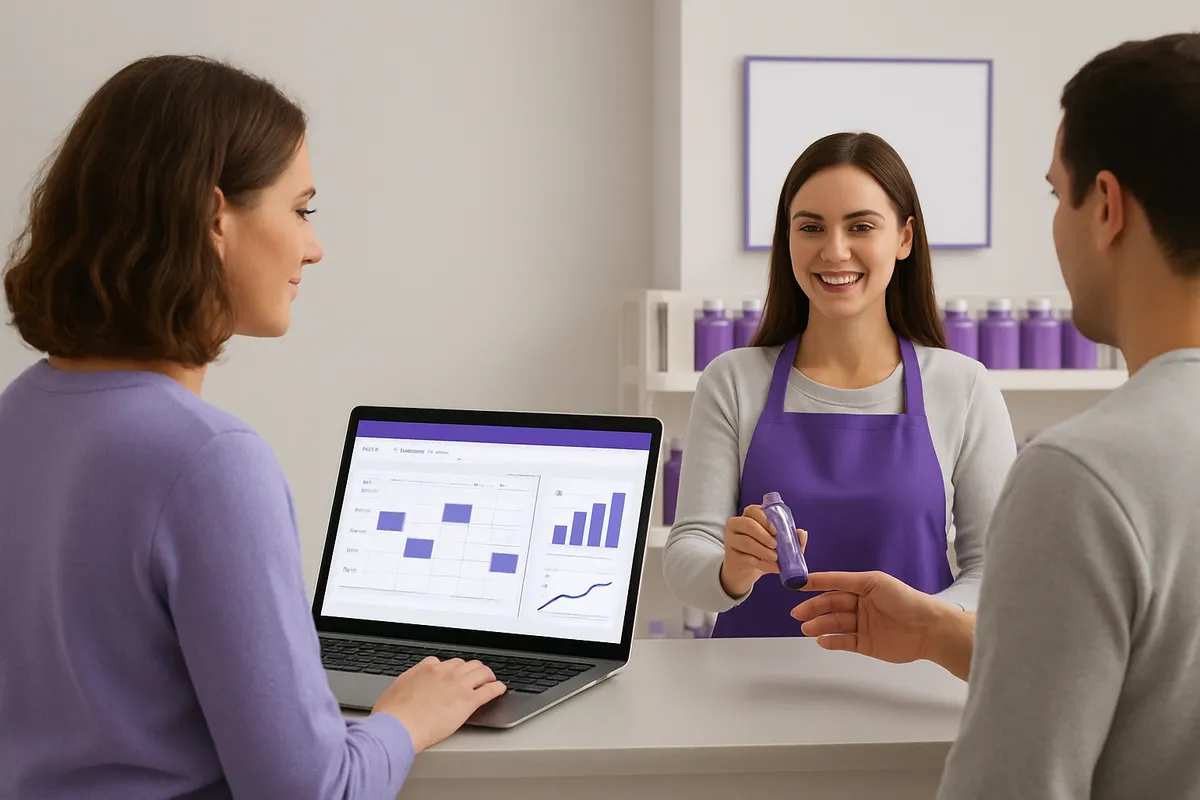
The best field marketing software for managing large scale in-store demo campaigns for cpg brands shares five traits: one calendar, built-in ambassador management, unified reporting, usage-based pricing, and a narrow focus on the demo workflow itself.
At 100-plus events a month, a spreadsheet or a general calendar tool breaks down fast. Four capabilities separate platforms that hold up at volume from ones that don't:
Ambassador management matters more as volume climbs, because every additional handoff between a scheduling tool, a payroll system, and a communications app is another place a shift can fall through. Demo Wizard bundles ambassador assignment and payroll processing into the same system as scheduling, so a completed demo flows directly into compensation without a coordinator re-entering hours in a separate tool. That matters at 20 events a month; it becomes the difference between hiring a second coordinator or not at 200. Visibility is the second place platforms diverge. A brand running activations through multiple regional agencies often ends up with reporting silos, one dashboard per agency, one spreadsheet per region, making it hard to answer a basic question like which stores converted best last quarter. A platform built for scale consolidates that into one dashboard view, with store-level and time-period filtering, so performance across every retailer and market sits in one place [2].
Cost structures also diverge in ways that matter more than feature lists suggest. Platforms purpose-built for demo coordination tend to price around the number of events run, which scales naturally with campaign size, rather than charging flat per-seat licensing that penalizes brands for adding coordinators or locations. When comparing options, it's more useful to think in budget-friendly, mid-range, and premium tiers than to assume a higher price buys proportionally more capability, a mid-range, demo-specific tool often outperforms a premium all-in-one suite for this one workflow.
That focus is the real dividing line. Broad retail execution suites and general event-management platforms [4] cover far more ground, task management, content approvals, multi-channel campaigns, which dilutes attention on the narrow mechanics of scheduling, staffing, and reporting on in-store demos specifically. A tool built around that one workflow, rather than adapted to fit it, tends to serve high-volume CPG demo programs better than a platform trying to be everything at once.
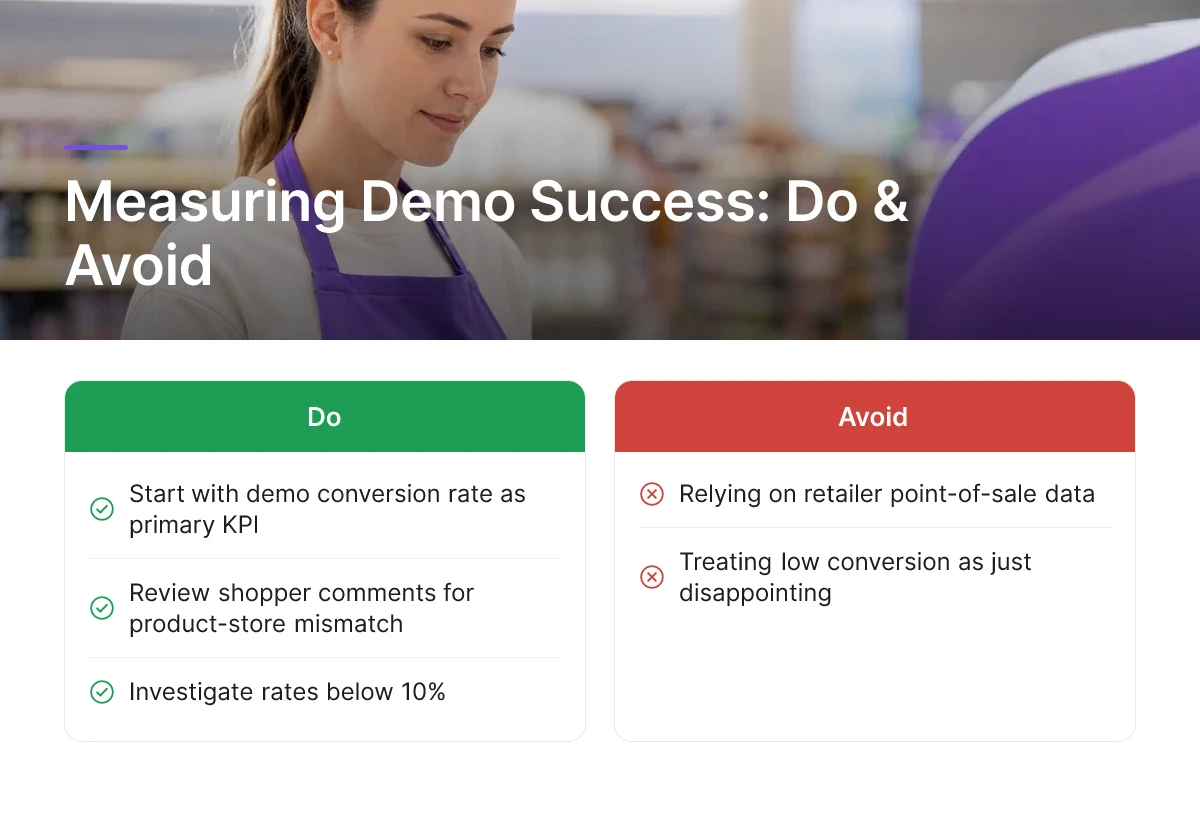
Success comes down to one number first: demo conversion rate, the share of samples that turn into purchases at the table, pulled from the post-demo report. Everything else is supporting evidence.
For a CPG brand running dozens or hundreds of events a month, demo conversion rate is the only KPI fully within view, since brands don't see the retailer's point-of-sale data. A rate below 10% is a signal to investigate, not just a disappointing number. Start with shopper comments in the post-demo report to check for a product-store mismatch, the wrong flavor profile, price point, or dietary category for that store's customer base. If comments look fine, evaluate whether the brand ambassador was the right fit for the product and audience. Also check the physical setup: a demo station positioned too far from the shelf breaks the path from tasting to buying, even when the product and ambassador are both strong.
Store conversion rate tells a brand which locations have shoppers who match the product, while sales velocity, a figure only the retailer owns, remains the real measure of lift. A high samples-to-sales ratio at a particular store is a demographic-fit signal, not a substitute for actual sales data. Brands can estimate velocity from their own demo results, but they cannot verify it without retailer POS access, which is typically out of reach in most brand-retailer relationships. Treat store conversion as the leading indicator and sales velocity as the outcome you're trying to predict.
Stores with consistently high demo conversion rates point to where the next quarter's activation budget should go. Across a multi-state program, brands also track consumer engagements, the BA taste-to-purchase ratio, cost per sample, repeat purchase rate, and overall campaign ROI. None of these numbers mean much compared side-by-side unless every event reports them in the same standardized format, a demo logged with different fields in Texas than in Ohio can't be benchmarked fairly. This is where the this strategy earns its keep: standardized reporting across every store and every ambassador, so a coordinator can compare results honestly instead of reconciling spreadsheets built by different people. Demo Wizard's post-demo analytics apply this consistency automatically, surfacing high-performing stores and time windows without extra manual tagging.
The shopper comments collected during hundreds of demos matter beyond the conversion math. Direct reactions to taste, packaging, and price feed back into product and packaging decisions in ways a sales figure alone never will.
The this approach is the one that matches your monthly event volume, not the one with the longest feature list.
Everything covered above points to five criteria worth checking off before you commit to a platform:
Automating coordination mainly pays off in two ways: fewer administrative hours per event and reporting consistent enough to compare performance across stores. A brand running demos manually through spreadsheets and email threads typically spends those hours chasing confirmations and reconciling conversion numbers that were never collected the same way twice. A platform built for this workflow removes most of that overhead, which is why the evaluation checklist above weighs coordination scale and standardized reporting so heavily, they are the two factors that determine whether a single coordinator can actually manage a growing event count.
A tool purpose-built for in-store demo and sampling coordination tends to outperform a general field marketing tool, a CRM, or a broad retail execution suite for this specific job. General tools are built to handle many different field activities at once, merchandising checks, audits, sales visits, and demo-specific needs like ambassador payroll or experience-to-purchase conversion tracking get bolted on as an afterthought, if they exist at all.
Demo Wizard was built specifically for this use case: coordinating, scheduling, and tracking ROI on in-store demos and brand activations for CPG brands, retailers, demo companies, and marketing agencies. It combines scheduling, ambassador management, payroll, and post-demo analytics in one system, which is what lets one coordinator manage hundreds of monthly events without hiring additional staff.
Demo Wizard is not a consumer messaging or engagement platform, and it does not integrate with point-of-sale systems to pull shopper-level sales data. It coordinates ambassadors and in-store staff, not shoppers, and it reports on demo-level conversion rather than retailer POS velocity.
Brands comparing options should request a walkthrough built around their actual monthly event count, 20 demos a month and 200 demos a month are different operational problems, and the right platform should be tested against the one you actually have.
Integration depth varies by platform, so check this against your existing stack before committing to a tool. Many brands already run Salesforce or HubSpot for CRM and a separate TPM system for trade spend; a demo platform that exports clean, store-level conversion and scheduling data makes it easier to pull into those systems for reporting, even without a native, real-time connector.
No, demo coordination software tracks demo events, ambassadors, and aggregate sample-to-purchase conversion, not individual shoppers. Platforms like Demo Wizard report on samples given versus units bought at the table and shopper feedback left during the demo, but they do not identify or follow specific consumers.
Field marketing software covers broad territory tasks like merchandising checks and store audits, while demo management software focuses specifically on scheduling, staffing, and measuring sampling events. General field marketing tools often lack demo-specific features, like ambassador payroll tied to completed events or experience-to-purchase conversion tracking by store and time, which is why CPG brands running large sampling programs tend to need a dedicated system instead.
With automated scheduling and ambassador management, one coordinator can realistically manage hundreds of monthly demo events instead of dozens. Demo Wizard is built around this exact scale, letting a single person run multi-state campaigns without hiring additional staff to handle the logistics.

Scaling in-store demos past a handful of stores breaks spreadsheets and overwhelms any coordinator working alone. The fix isn't more headcount; it's software built for the specific mechanics of sampling: scheduling across hundreds of locations, managing ambassador payroll, and tracking demo conversion rate by store and time period. Treat sub-10% conversion as a signal to investigate, not a number to ignore. Before your next multi-state campaign, map how many hours your team spends on scheduling and payroll today, then compare that against what a platform like Demo Wizard, at roughly $3 per demo, would cost to automate it.
Explore more from our content library:
Demo Wizard is the Ultimate Store Sampling & Demonstration management software for Brick and Mortar Retailers and CPG Vendors.
Chat with usPhone