Scaling In-Store Demos with Retail Activation Operations
TL;DR
Scaling in-store demos across multiple retail locations requires a centralized system to manage scheduling, staffing, inventory, compliance, and performance tracking. By standardizing brand ambassador training, automating coordination, and measuring sales lift and ROI, brands can expand their demo programs efficiently without proportionally increasing operational costs. Purpose-built platforms like Demo Wizard help streamline workflows, maintain consistent execution, and identify high-performing stores and campaigns.
Centralize Operations: Use a shared system to coordinate demo schedules, staffing, inventory, retailer requirements, and reporting across multiple locations.
Standardize Training and Compliance: Implement digital training modules, pre-demo checklists, and consistent procedures to maintain brand quality across distributed teams.
Measure ROI and Sales Performance: Track conversion rates, cost per trial, sales lift, and post-demo results to identify successful locations and optimize future campaigns.
Automate to Scale Efficiently: Replace spreadsheets and manual follow-ups with dedicated coordination software to reduce administrative work and support growth across regional and national markets.
Retail activation operations represent the end-to-end coordination of in-store demos across multiple locations, scaling successfully when scheduling, staffing, compliance, and ROI tracking are managed through a single operational system rather than disconnected point solution software, spreadsheets, and emails. The core challenge is not running one great demo; it is replicating that result across dozens or hundreds of stores without proportional increases in overhead. Brands and retailers that build structured workflows, use purpose-built coordination tools, and track post-demo sales data consistently outperform those that improvise at scale.
From One Store to Many
Retail activation operations is the full operational system—scheduling, staffing, logistics, compliance verification, cost control, and reporting—that makes in-store demos repeatable across locations, not just a one-off event. This approach is particularly relevant for anyone approaching retail activation as a growth strategy rather than a one-time tactic.
Tactical vs. Operational Scale: A single demo is a tactic, while retail activation operations provide the infrastructure that turns that tactic into a program.
The Scaling Bottleneck:
When a CPG brand runs one sampling station at a flagship store, the coordinator handles everything manually, but running 80 demos across 5 states without a structured system introduces a severe operational bottleneck.
Point-of-Purchase Distinction: In-store demos are direct, conversion-focused tactics executed inside the store with product in hand, competing with media spend at a fundamentally different moment in the shopper's decision process.
What Are the Different Formats of In-Store Brand Activation?
Sampling stations require minimal equipment and low ambassador skill thresholds, making them the easiest format to replicate across many stores.
Live cooking demos need heat sources, perishable ingredients, and ambassadors with culinary confidence, causing prep complexity to rise sharply with location counts.
Product trials (beauty testers, personal care samples) depend on hygiene compliance and often require retailer-specific setup rules that vary by chain.
Interactive kiosks reduce ambassador dependency but introduce equipment logistics, installation coordination, and technology failure risk at scale.
What Actually Drives Conversions in Demo Programs Versus Other Activation Formats?
Sensory Trial and Objection Handling: The core conversion mechanism combines sensory trial with real-time objection handling, reducing immediate purchase risk when a shopper tastes, touches, or sees a product demonstrated.
Sales Velocity Impact: Products featured in in-store demos often sell over 40% better compared to non-sampled items.
Accelerating Decisions: Trained ambassadors answer questions about ingredients, usage, price, or comparisons at the exact moment of decision, acting as the highest-intent execution layer of a brand activation strategy.
How to Plan and Execute a Multi-Location In-Store Demo Program
Retail Activation Operation platform ensure thequality of the in-store demo execution
Running demos across multiple retail locations requires a centralized operational plan connecting scheduling, supply chain management, and ambassador oversight into one coordinated system.
Logistics, Scheduling, and Supply Chain Requirements for Multi-Location Programs
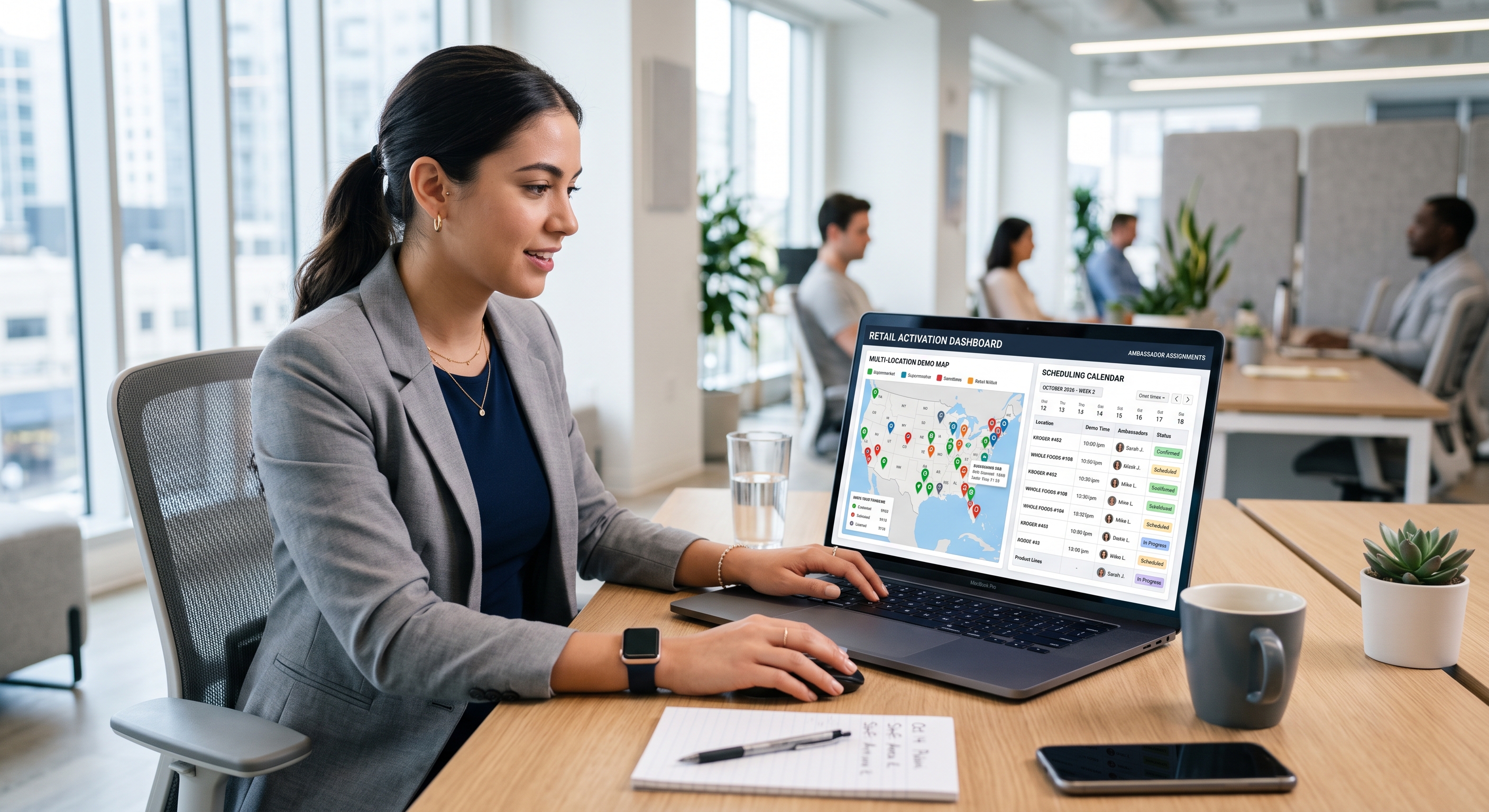
Centralized Calendars: A shared calendar provides a single source of truth for brand coordinators, store managers, and ambassadors, managing peak traffic windows, blackout dates, and table placement rules.
Hard Dependencies: Retailer-side coordination requires advance notice for table placement and shelf-stocking before a demo runs, transforming recurring fire drills into a managed checklist.
Supply Chain Alignment: Sampling units, display materials, and perishable products must arrive on time to prevent zero-conversion events caused by well-staffed tables lacking product.
How to Hire, Train, and Maintain Quality Control Across Distributed Demo Teams
Localized Hiring Pipelines: Sourcing brand ambassadors locally reduces travel costs and improves scheduling flexibility while maintaining consistency through standardized onboarding.
Identical Training Protocols: Digital briefing materials, recorded walkthroughs, and pre-demo checklists allow ambassadors to prepare independently.
Quality Control Loops: Post-demo reporting tracks conversion counts, shopper questions, and product feedback, allowing tools like Demo Wizard to automate scheduling, reporting, and performance analytics oversight. Products featured in retail demos frequently sell over 40% better than non-sampled items when execution remains consistent.
Building a Scalable Onboarding Process for Brand Ambassadors
Self-Serve Modules: Programs expanding into new regions utilize digital training modules covering product knowledge, brand messaging, and retailer compliance rules.
Independent Checklists: Pre-demo checklists ensure the product is on the shelf, display materials are present, and certifications are current before an event begins.
Structural Compliance: Embedding these steps directly into a coordination platform turns compliance into a structural feature rather than a manual enforcement task.
The Biggest Operational Challenges When Scaling Demos Regonally or Nationally
Scaling in-store demos from a local pilot to a national program exposes non-linear coordination gaps that manual systems cannot absorb.
Common Failure Modes When Scaling Retail Activation Nationally
Multiplied Complexities: Adding new SKUs or stores multiplies setup instructions, compliance rules, and inventory logistics exponentially, causing spreadsheets to collapse at scale.
Execution Inconsistencies: Fragmented training and procurement lead to regional performance variations, late inventory arrivals, and poor timing windows.
Deteriorating Retailer Relations: Ad hoc communication and unexpected arrivals erode store goodwill, risking restricted or revoked demo privileges.
Compliance Gaps: Enforcing food safety and brand standards across hundreds of stores requires automated checkpoints rather than relying purely on individual ambassador judgment.
How to Ensure Compliance and Retailer Integration Across Different Store Formats
Accommodating Store Variations: Different store formats—from 50,000-square-foot grocery stores to smaller neighborhood layouts—require adaptive configurations rather than rigid, one-size-fits-all approaches.
Automated Configuration: Platforms like Demo Wizard build store-level variables (format, traffic patterns, retailer requirements) directly into scheduling logic.
Audit Trails: Centralized calendars create transparent audit trails visible to store managers and vendors, eliminating communication gaps and unexpected arrivals.
How to Measure ROI and Success Metrics for In-Store Demo Programs
Credible demo ROI measurement separates outcome metrics—such as sales lift and trial-to-purchase conversion—from basic activity metrics like hours staffed or demos run.
Which Financial KPIs Prove Budget Spent Versus Revenue Generated?
Stakeholder Metrics: Brand managers track cost-per-trial and conversion rates; retail buyers examine category velocity and shelf turn; finance teams calculate incremental revenue minus total program cost.
Control Group Comparison: Sales lift is measured by comparing velocity in demo stores against matched control stores receiving no demo activity.
Ambassador Data Capture: Structured post-demo reporting forms capture units sampled, customer interactions, and observed sales to make ROI calculations possible.
Real-Time Adjustments: Analytics platforms help coordinators identify high-performing stores and reallocate future demo dates immediately based on post-demo velocity.
Tools, Technology, and Team Structure for Managing Demos at Scale
Managing demos at scale requires purpose-built software and structured team models designed around automation.
What Software Platforms Do Brands Use to Manage Retail Activation Operations?
Retailer Benefits: Shared calendars allow store managers to view upcoming activity, eliminating individual vendor calls and emails while reducing store-level disruption.
Three-Layer Stack: A mature stack spans scheduling/coordination software (such as Demo Wizard), payroll/compliance tracking, and retail sales data integration for velocity reporting.
Administrative Efficiency: Automation handles confirmations, reminders, and report collection, allowing a single coordinator to manage high monthly event volumes.
How Should You Structure Your Demo Team for National Scaling?
Configuration Models: In-house teams, third-party demo companies, and hybrid models shape platform access controls and reporting views differently.
Distributor vs. Brand Views: Distributors generally welcome or even require visibility into assigned locations, whereas brand managers need aggregate performance data across the entire footprint.
Hybrid Operations: Brand coordinators often manage campaign strategy and analytics while external partners handle local field execution through a unified portal.
Frequently Asked Questions
How many in-store demos per month does a brand need to run before investing in dedicated coordination software? Most brands find dedicated software pays for itself once they exceed 15 demos per month, saving hours of manual scheduling and follow-up time.
What is the difference between a demo company, a distributor, and a brand ambassador? A demo company manages end-to-end event execution and staffing; a distributor moves product and coordinates timing to support sell-through; a brand ambassador runs the demo on the floor, interacting directly with shoppers.
How do grocery retailers benefit from a centralized demo scheduling system? Centralized calendars give store managers a single view of all scheduled events, enforcing compliance automatically and eliminating disruptive vendor calls that fragment staff time.
What should a post-demo report capture to make ROI calculation possible? Reports should capture units sampled, units sold during the demo window, baseline sales for a comparable non-demo day, ambassador hours worked, and store location details.
How do you maintain brand consistency when ambassadors are hired locally? Consistency is maintained through standardized digital training modules, messaging guides, and pre-demo checklists completed prior to every event, alongside structured post-event reporting.
How can a brand effectively combine internal brand ambassadors with third-party demo companies using a centralized system?
Regional and/or national-scale programs frequently adopt hybrid management structures where a brand-side coordinator retains overarching control over campaign strategy and analytics, while external demo companies or regional distributors manage local field staffing through a shared system portal.
A centralized software platform acts as the critical connective layer, granting each party customized access views—such as distributors seeing only their assigned locations and brand managers viewing aggregate footprint data—without creating version-control problems or duplicate data entry.
Conclusion & Recommended Resources
Scaling in-store demos is primarily an operations challenge rather than purely a marketing one. Brands that grow from 10 events per month to 40 and beyond without adding headcount do so by replacing manual coordination with structured systems, defined ambassador roles, automated compliance rules, and data-driven scheduling.