
Demo Wizard is the Ultimate Store Sampling & Demonstration management software for Brick and Mortar Retailers and CPG Vendors.
Chat with us

Phone
Copyright © 2026 Demo Wizard
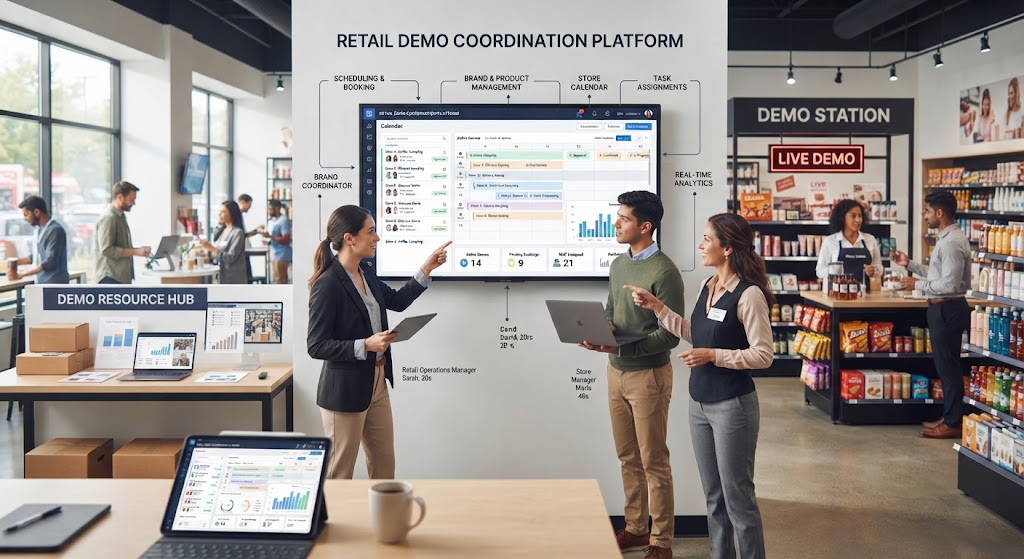
A demo coordination platform is software that centralizes the scheduling, staffing, execution, and performance tracking of product demonstrations, keeping every stakeholder aligned from planning through post-event reporting. For CPG brands and grocery retailers, purpose-built platforms replace employee staffing software tools, fragmented spreadsheets and manual communication chains with a single system that helps to find the best locations and time for demos, assigns brand ambassadors, enforces in-store compliance, and captures sales uplift data in real time.
This type of software connects CPG brands, retailers, distributors, demo companies, and brand ambassadors inside one shared operational system, not a shopper-facing tool.
The platform manages the full chain of activity that in-store sampling requires: a brand submits a demo request, the retailer approves it, an ambassador is assigned based on availability and location, a pre-event compliance checklist is completed, the demo runs in-store, and post-demo sales data flows back into a centralized report. Each handoff is tracked inside the platform rather than scattered across email threads and spreadsheets.
On any given day, a platform like Demo Wizard handles ambassador scheduling across multiple store locations, payroll tied to completed events, and performance data segmented by store and time slot. A shared calendar, visible to the brand team, the retailer's merchandising staff, and the distributor, eliminates the back-and-forth that currently pulls store employees away from the floor to confirm dates, check vendor credentials, or chase down contact information.
Without that shared view, scheduling conflicts are common: a demo lands on a store reset day, or two brands book the same demo station at the same time. A centralized calendar makes those conflicts visible before they become problems.
Generic tools, spreadsheets, broad project management apps, email chains, fail-at-in-store product demonstration software in predictable ways: double-bookings with no conflict detection, missed selling opportunities due to short inventory of product, missed compliance steps because checklists live in a separate document no one opens, and zero ROI visibility after the event closes.
In-store product demonstration software fundamentally solves a coordination and tracking problem, not a presentation problem. Screen-share tools and slide decks have no role here. What matters is whether the right ambassador arrived at the right store, followed the correct setup protocol, and whether that demo moved product off the shelf, data that only a purpose-built platform is designed to capture.
A centralized scheduling system replaces the fragmented mix of phone calls, emails, and paper forms that currently pull store staff away from the sales floor.
Right now, store managers at grocery and mass-market retailers field ad-hoc requests from multiple CPG vendors, distributors, and brand ambassadors through disconnected channels. Each request arrives separately, requires a manual response, and often generates follow-up calls when details change. That friction adds up to real labor cost, and it falls almost entirely on store employees who have other work to do.
A purpose-built platform gives store managers one centralized calendar showing every scheduled demo activity: who is arriving, when, which product they are sampling, and which floor space they will occupy. No chasing vendors for updates, no cross-referencing email threads against a paper log.
That single view also surfaces conflicts before they happen. If two brands request the same end-cap on the same Saturday, the system flags it, not the store manager. This is the core scheduling function that platforms like Demo Wizard handle across hundreds of monthly events, connecting in-store demo scheduling and brand ambassador management into one visible workflow for all parties.
A demo coordination platform can require brand ambassadors to confirm setup conditions, submit photos of their station, and acknowledge store-specific rules before a demo is marked active. That verification happens inside the platform, not through a store employee walking the floor to check.
The direct result is fewer interruptions to floor staff, elimination of manual approval workflows, and a measurable drop in no-show and late-start incidents. Store employees stop acting as the enforcement layer between CPG vendors and the sales floor, which is where the overhead reduction is most tangible.

A purpose-built demo coordination platform includes ambassador scheduling, retailer approval workflows, compliance tracking, post-demo sales capture, and ROI reporting by store and SKU. For more information, see Request A Demo.
Generic scheduling tools and broad retail suites were built for inventory management or point-of-sale workflows. They handle one party well, the retailer's internal operations, but they were not designed for the multi-party coordination loop that in-store demos require: brand teams, retail store managers, distributors, and field ambassadors all need to communicate, confirm, and report in a single workflow. That gap is where activations break down.
Any serious evaluation should cover five feature categories:
CPG vendors' ability to request space and time for desired in-store demo events without interrupting store employees
Retailer-facing approval workflows, a centralized calendar that gives store managers visibility into upcoming activations so demos don't arrive as surprises
Brand Ambassador scheduling and availability management, the ability to match qualified ambassadors to open slots across multiple locations without manual back-and-forth
Real-time compliance tracking, confirmation that demos are executed on time, at the right location, and to the retailer's in-store conduct requirements
Post-demo sales data capture, structured collection of units sampled, conversion observations, and shopper feedback at the event level
ROI reporting by store and SKU, linking execution data (date, location, ambassador, product) to post-event sales lift so teams can identify which stores, time slots, and ambassadors drive the highest conversion rates
That last mechanism is what separates product demonstration software built for retail from everything else. When Demo Wizard ties ambassador and scheduling data to store-level sales impact, a single coordinator can identify which locations and time slots consistently outperform, and reallocate budget accordingly, without hiring additional staff.
The market breaks into three broad tiers. Budget-friendly tools cover basic scheduling but offer limited reporting. Mid-range platforms add analytics and some ambassador management. Premium options deliver full multi-party coordination, payroll integration, and deep ROI tracking tied to trade promotion management, the combination that gives brand teams and retail partners the conversion proof they need to justify shelf space and repeat activations.
A demo coordination platform lets a single coordinator run hundreds of monthly in-store activations by automating the tasks that would otherwise require a full team.
Without platform support, scaling from 20 to 100 monthly demos typically means hiring more coordinators. With scheduling, ambassador communication, compliance tracking, and reporting handled by the platform, one person can manage that volume across dozens of retail accounts. Demo Wizard, for example, is built specifically so a single coordinator can run hundreds of monthly events without additional headcount, a direct answer to the CPG industry's pressure to grow activation reach without growing overhead.
Post-demo analytics capture sales data by store, by ambassador, by product, and by time period, giving brand teams a clear view of which activations produce real sales uplift and which locations or formats consistently underperform.
That data does more than report the past. When a brand can see that Saturday afternoon demos at a specific regional grocery chain convert at twice the rate of weekday slots at another account, the next campaign schedule reflects that finding. Budgets shift toward high-performing store-and-time combinations rather than being spread evenly across all locations.
Ambassador performance tracking adds another layer. A platform that records individual results over multiple campaigns lets brand teams identify reliable, high-converting ambassadors and prioritize them for future activations, rather than rebuilding the field team from scratch each cycle.
Documented ROI data also strengthens a brand's position in retailer conversations. Proof of measurable sales uplift from past activations supports requests for premium shelf placement, expanded demo slots, or increased retailer co-investment, turning field execution data into a commercial negotiating tool.
For tactical guidance on structuring individual activations, see our in-store product demonstration strategy guide. This section focuses on the platform's role in making that strategy repeatable at scale.
The right demo coordination platform fits your demo volume, your retail account structure, and how many parties need access to the same scheduling data.
Start evaluation with four criteria that matter most for in-store use cases: multi-party access (brand, retailer, distributor, and ambassador all working in one system), mobile usability for field staff who check in and report from the store floor, compliance enforcement that captures required documentation at the event level, and reporting depth that connects demo execution to actual sales impact by store and time period. The GS1 US standards organization provides useful frameworks for understanding how product and location data should flow between trading partners, which is directly relevant to how demo platforms exchange information across brands, distributors, and retailers.
Ask these before committing to any platform:
Can all parties: brand, retailer, distributor, ambassador, access the same calendar without separate syncing?
Does the mobile interface let ambassadors check in, log compliance data, and submit post-demo reports from the store floor without a laptop?
How long before the first demo event is live in the system? Platforms that require heavy IT integration before any value is visible lose adoption fast.
What does the ROI report look like, and how quickly does it appear after a demo completes? Demo Wizard, for example, generates post-demo analytics tied to experience-to-purchase conversion rates, available at the store and time-period level without manual data assembly.
Does pricing scale with demo volume rather than user count or location count? A per-demo model removes the friction of adding ambassadors or retail accounts as campaigns grow.
Implementation follows a clear sequence. Onboard the retailer calendar first, that single step creates immediate visibility for every party. Then add brand and distributor access so campaign details flow without email chains. Train ambassadors on mobile check-in last; by that point, the schedule they're checking into already exists and is accurate. It takes up to an hour to implement the Demo Wizard platform and train a store team of users.
Purpose-built tools with pre-configured demo workflows, rather than generic event or project management software adapted for retail, reduce setup time because the data fields, compliance checkpoints, and reporting templates already match in-store demo requirements. The Association of National Advertisers publishes research on field marketing effectiveness that can help teams benchmark what good activation performance looks like before selecting a platform.
Measure early success by tracking three numbers: the reduction in manual coordination touchpoints per demo event, the percentage of demos completed with full compliance documentation, and the time from demo execution to ROI report availability. Improvement across all three within the first 30 days signals the platform is working.
The right pricing tier, budget-friendly, mid-range, or premium/enterprise, depends on demo volume, the number of retail accounts you manage, and whether multi-party coordination or deep analytics is the primary driver. A brand running 20 demos per month across five stores has different requirements than a distributor coordinating 300 monthly events across four regional retailers.

This practice serves both CPG brands and retailers, though each side uses it differently. CPG brands use it to schedule ambassadors, track conversion data, and prove ROI to retail partners. Retailers use it to maintain a centralized calendar of all in-store activation events, enforce compliance with store conditions, and reduce the time their own staff spend managing vendor communications. Demo Wizard, for example, is built to serve both audiences within a single coordinated system.
Most platforms maintain a bench of pre-vetted, available ambassadors who can be reassigned when a scheduled demonstrator cancels. Demo Wizard manages ambassador availability data directly, so coordinators can identify a qualified replacement without working through a separate spreadsheet or phone chain. The system logs the change, keeping the event record accurate for post-demo analytics and payroll processing, both of which depend on knowing exactly who worked which shift.
No, the two categories solve different problems. Product demonstration software typically refers to tools that simulate or showcase a software product to sales prospects, often in a digital or virtual environment. This method manages the logistics of physical, in-store product demonstrations: scheduling, ambassador deployment, compliance, and sales-impact tracking. The term "product demonstration software" can overlap with demo coordination in a retail context, but the two categories are distinct.
Most teams see measurable scheduling and administrative gains within the first month, once the platform is configured with store locations and ambassador profiles. Conversion and ROI data becomes meaningful after running enough events to establish a baseline, usually 30 to 60 days of consistent campaign activity across multiple locations. Store-level performance patterns, such as which locations and time slots drive the highest purchase rates, typically become clear after two to three months of post-demo reporting.
A well-designed strategy is useful at any volume, though the return on investment grows as demo frequency increases. Small brands running a modest number of monthly events benefit from reduced scheduling errors and cleaner compliance documentation, even if they don't yet need the full analytics depth that enterprise users require. Many platforms offer tiered access so smaller teams can start with core scheduling and reporting features, then expand as their activation programs grow.
This approach does three things that manual processes cannot do at scale: it removes scheduling bottlenecks so one coordinator can manage hundreds of monthly events, it gives retailers a single calendar that eliminates store-level disruption, and it connects each activation to purchase data so brands can stop guessing which locations and time slots actually move product.
If your team is still coordinating in-store demos through spreadsheets and email threads, the first concrete step is to audit one month of past campaigns, count the hours spent on scheduling logistics, then count how many of those events produced documented sales lift. That gap is what a platform like Demo Wizard is built to close.
Explore more from our content library:
About the Author
Written by the SaaS / Retail Marketing Technology experts at Demo Wizard. Our team brings years of hands-on experience helping businesses with SaaS / Retail Marketing Technology, delivering practical guidance grounded in real-world results.
Demo Wizard is the Ultimate Store Sampling & Demonstration management software for Brick and Mortar Retailers and CPG Vendors.
Chat with usPhone