
Demo Wizard is the Ultimate Store Sampling & Demonstration management software for Brick and Mortar Retailers and CPG Vendors.
Chat with us

Phone
Copyright © 2026 Demo Wizard

Multi-location demo coordination works best when brands and retailers manage scheduling, staffing, and compliance for in-store product demonstrations through one centralized system rather than store-by-store phone calls and spreadsheets. This reduces administrative overhead for both the brand and the retailer, cuts down on no-shows and missed setups, and gives everyone involved—brand managers, distributors, brand ambassadors, and store staff—visibility into what's happening at every location. The result is more consistent execution and a clearer line from demo attendance to actual sales conversion.

It means aligning a brand ambassador, product inventory, and a retail host around one scheduled event, repeated correctly across every store door, not just filling shifts on a calendar.
A single in-store demo has three parties who all need to agree on the same day and time: the CPG brand sending the ambassador, the retailer approving floor space, and often a distributor or broker delivering product. Multi-location demo coordination is what happens when a brand or agency has to get that three-way alignment right dozens or hundreds of times a month, across stores that don't share a manager, a loading dock schedule, or even a layout. Misalignment between retail execution teams and CPG brand teams is a recurring theme in industry discussions of why coordination breaks down at scale [source].
Employee scheduling assigns a worker to a shift. Demo coordination has to synchronize four separate moving parts at once: the ambassador's availability, the retailer's approval to occupy floor space that day, the distributor's inventory delivery landing before the event starts, and the store's normal operations continuing around all of it. Miss any one of those and the event fails, even if the ambassador shows up on time.
This is why tools built for shift scheduling tend to fall short for retail activations. A roadshow or sampling event isn't a labor slot to fill; it's a coordinated handoff between a brand's field team and a retailer's physical space, and both sides need to see the same schedule to avoid double-booking a table or missing a delivery window. Effective multi-location demo coordination treats that handoff, not the shift itself, as the thing being managed.
In this context, a multi-location business is a brand or retailer running the same type of activation—a sampling event, a roadshow, a cart demo—across many store doors at the same time. Each location has its own store manager, its own foot traffic pattern, and often its own compliance rules about where a table can go or what hours demos are allowed.
A single-store plan is one phone call and one calendar entry. Scale that to 50 or 200 stores running events the same month or quarter, and a coordinator managing it store-by-store has no way to see which locations are confirmed, which are short an ambassador, or which never received product. That gap is precisely where centralized coordination earns its keep, since fragmented communication and disconnected handoffs are a documented source of operational friction in any multi-site operation [5].
Operations research on distributed environments consistently points to the same root cause: friction concentrates in the gaps between decisions, not in a shortage of raw data [3].
Running 10 demos a month at one store is manageable with a spreadsheet; running 200 demos across 50 stores without a system turns into double-bookings, missed shifts, and store managers fielding calls they never agreed to take. Multi-location demo coordination breaks down in predictable ways once volume and geography scale past what a single coordinator can track manually.
The recurring failure points tend to cluster around a few categories:
A national brand running demos in Pacific, Mountain, Central, and Eastern time zones risks booking a 10 a.m. slot that lands during a store's delivery window or shift change three time zones away. Add in regional differences in local manager approval processes, some stores require 72 hours' notice, others sign off same-day, and a single spreadsheet schedule starts producing errors that nobody catches until an ambassador shows up to a locked door.
Scheduling conflicts also happen at the store level, not just across regions. Two brokers or brand ambassadors frequently try to claim the same high-traffic end-cap or front-aisle slot on a Saturday morning, the exact window that drives the highest sampling volume. Without a shared calendar visible to every vendor and retailer contact, these conflicts surface only when both ambassadors arrive at the same table.
Store employees absorb the cost of poor coordination even when they have nothing to do with the brand's campaign. A manager who fields vendor phone calls all morning, approves ambassador setups on the fly, and manages surprise inventory drops with no advance notice is doing unpaid demo logistics work on top of running the store.
Operational friction like this compounds rather than staying isolated, a missed communication about one demo's start time cascades into inventory shortages, confused staff, and a frustrated retail partner [5]. The actual friction rarely lives in a single bad event; it lives in the accumulation of small gaps between what a vendor planned and what the store was told to expect [3]. Broader discussions of integration friction point to the same pattern across industries: the cost sits in the handoffs, not in any single failure point [source].
Lack of centralized visibility is the root cause behind most of these failures. Without one calendar that both the brand and the retailer can see, double-bookings go unnoticed until two ambassadors arrive for the same slot, no-shows go unnoticed until the shift is already missed, and the store loses the high-traffic window it set aside for the activation. For a brand running demos in 30 states, that lost momentum adds up fast, and it's the kind of cost that never shows up on an invoice, only in the sales numbers that don't materialize.
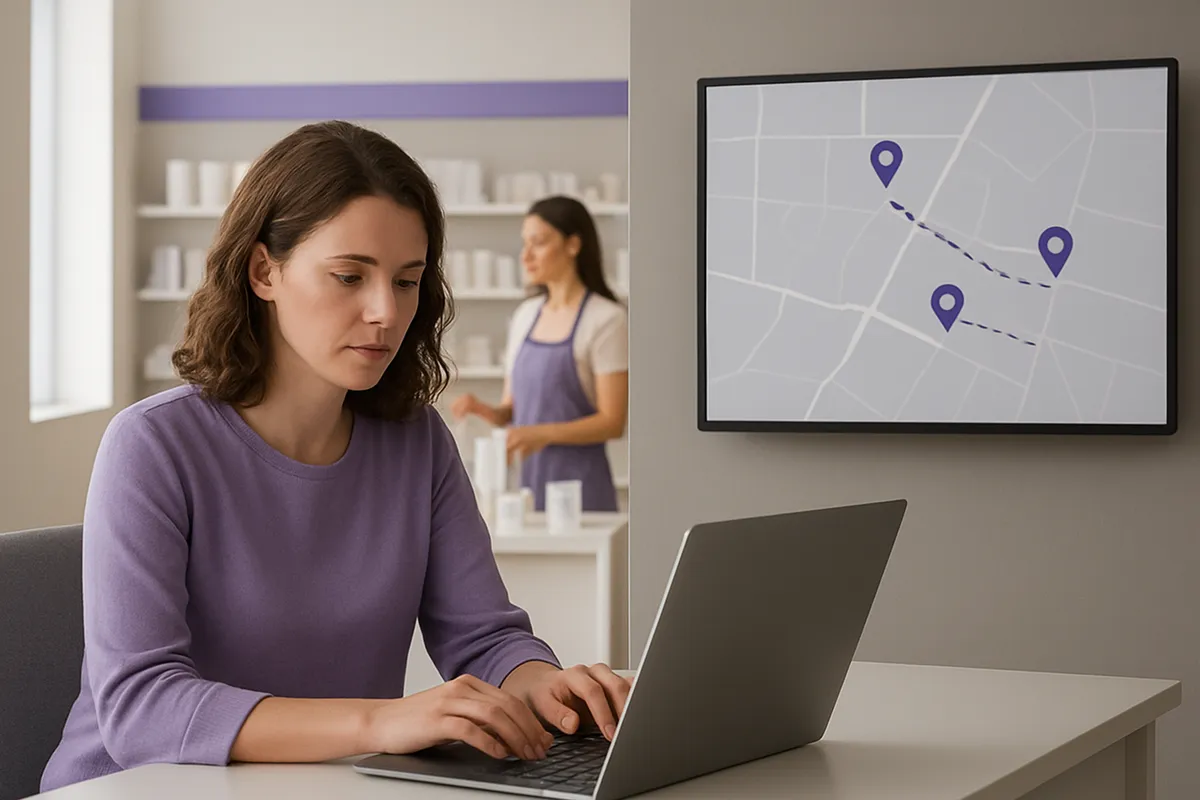
A shared calendar replaces scattered texts and spreadsheets with one source of truth, cutting the double-bookings and no-shows that quietly erode sampling campaigns.
Most demo failures trace back to a communication gap, not a staffing shortage. Operational friction research describes this pattern directly: friction rarely comes from missing data, it comes from gaps between decisions, a store manager who never got the memo, a distributor who shipped product to the wrong door, an ambassador who confirmed with one coordinator but not the retailer [5]. Multi-location demo coordination multiplies those gaps every time a brand adds another state or store banner.
A calendar visible to the brand, the distributor, and the store staff closes the exact gap where cancellations originate. When a regional grocery manager, a brand ambassador, and a trade marketing director all check the same schedule, nobody double-books the end-cap or forgets to confirm a Saturday slot. Operational friction analyses consistently identify missed communication and lack of visibility as two of the most common sources of repeated work and dropped handoffs [5]. A shared calendar removes both at once: everyone sees the same event, the same time window, and the same staffing assignment, with no translation layer of phone calls or forwarded emails in between. Real-time visibility into where people and product are at any given moment is a recurring theme in operational friction research across industries beyond retail as well [source].
Automated reminders and confirmation workflows catch the no-shows that manual phone-and-email coordination misses. An ambassador who gets a text confirmation 48 hours out, then a day-of check-in prompt, is far less likely to forget a shift than one relying on a coordinator's memory to follow up. That reliability matters commercially: a demo table that opens on time in a high-traffic spot near the entrance or checkout captures more of the day's peak foot-traffic window, and every hour lost to a late setup is an hour of samples never handed out.
The administrative payoff compounds. Automating confirmations, reschedules, and backfill when an ambassador cancels cuts the hours a coordinator spends chasing logistics per event. Demo Wizard's scheduling and ambassador management tools are built around that exact math, automating the coordination layer so a single coordinator can manage hundreds of monthly events across dozens of store locations without adding headcount, instead of capping growth at whatever one person can track by phone. Emerging generative AI tools for retail operations teams point toward similar efficiency gains in planning and demand forecasting, which complements the coordination layer rather than replacing it [source].
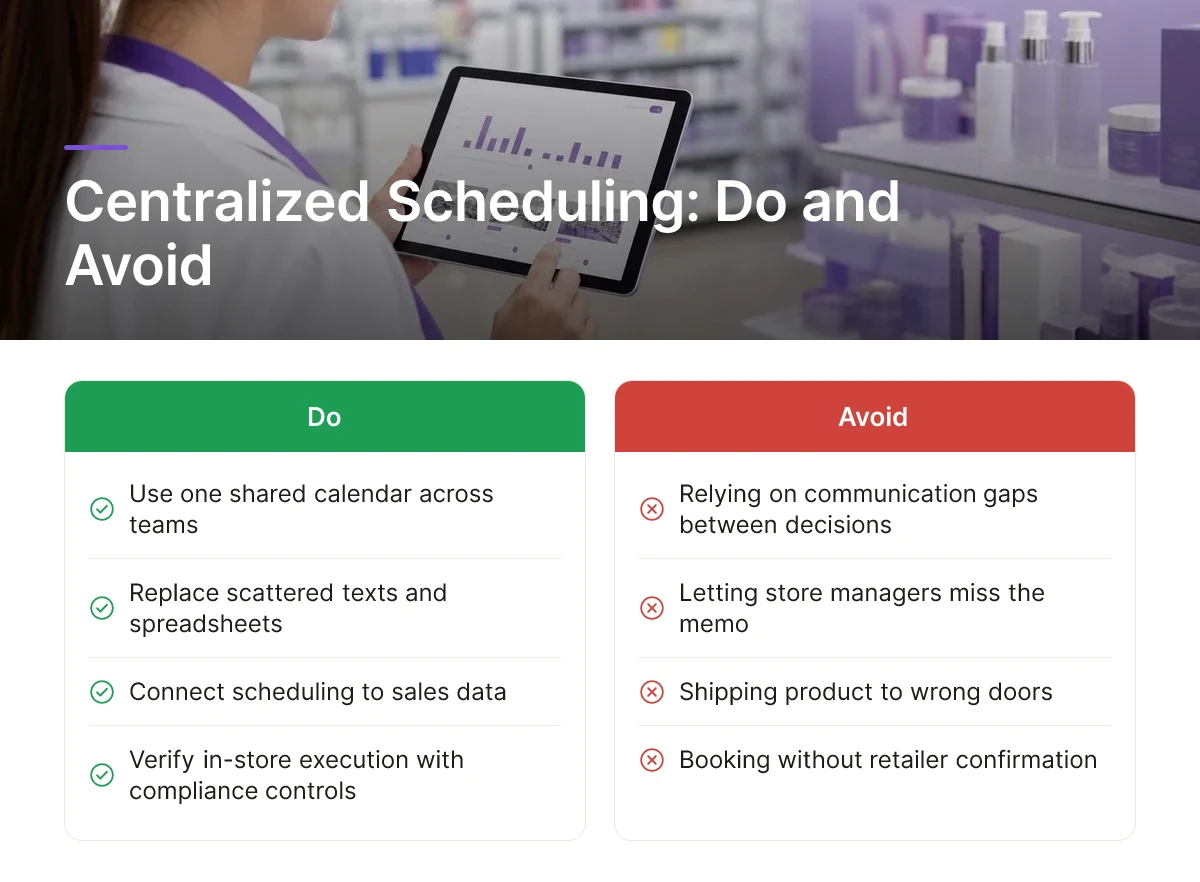
Look for CRM integration that ties demos to sales data, compliance controls that verify in-store execution, one shared calendar across teams, and pricing that fits your event volume.
A tool built for multi-location demo coordination has to do more than fill a calendar. It needs to connect scheduling data to what actually happened at the shelf and what sold afterward, and it needs to do that across every store on the list, not just a handful of flagship locations. At minimum, evaluate a platform against this list:
Integration with CRM and point-of-sale or distributor sales data matters because it closes the loop between a scheduled event and the units moved during that window.
Without that connection, a brand activation manager knows a demo happened on a Saturday at a given store but has no reliable way to tie it to a sales lift. With it, the team can match a specific ambassador shift, time block, and store against the sales data from that same period, the basis for any real experience-to-purchase conversion measurement. Demo Wizard's analytics dashboard was built around this gap: it measures conversion rate and sales impact by store and time period, so a trade marketing director can show a retail buyer exactly which activations earned their shelf space and which didn't.
A platform should enforce check-in and check-out confirmation, photo proof of setup, and adherence to the agreed footprint and signage before an event counts as complete.
These controls protect both sides of the relationship. Retailers get confirmation that a vendor's team followed store rules and didn't overstay a reserved slot or wander outside an approved area. Brands get proof that the ambassador actually showed up, set up correctly, and represented the product the way the campaign brief specified, evidence that matters when a retailer questions results or when a brand needs to audit agency performance across dozens of doors.
One shared calendar that brand teams, distributors, and store managers can all see replaces the regional spreadsheets that cause double-bookings and missed handoffs. When a store manager can check the same schedule a brand's coordinator is working from, there's no guesswork about who's showing up or when. This is the core mechanism behind effective multi-location demo coordination: a single source of truth instead of parallel, disconnected records.
Evaluation should match the tool's cost tier to the number of locations and events being coordinated. A budget-friendly scheduling tool may suit a brand running a handful of regional demos, but a brand or agency managing hundreds of monthly events across multiple states needs ROI tracking and ambassador payroll built into the platform, not bolted on through a separate system.
ROI in multi-location demo coordination comes from four tracked metrics compared side by side across stores, plus the administrative hours saved by centralizing the work.
Four numbers tell most of the story. Units sold per shift shows raw sales output and lets you compare a Saturday demo in one store against a Thursday evening demo in another. Attendance and no-show rate tells you whether the ambassador actually showed up and worked the full shift, a demo that never happened produces zero conversion no matter how good the product is. Cost per completed demo rolls in ambassador pay, product samples, and any slotting or scheduling fee the retailer charges, giving you a true unit cost rather than just a labor line.
The fourth metric is the one most spreadsheet-based operations skip: conversion lift compared to non-demo periods at the same store. Pulling baseline sales for the same SKU, same store, same day-of-week when no demo ran isolates what the activation actually added, rather than crediting a demo for sales that would have happened anyway.
Centralizing data across locations is what turns these four metrics from isolated facts into a comparison tool. Once every store reports into one system, a brand activation manager can rank locations by units sold per shift or by cost per completed demo and see immediately which stores or regions justify a repeat booking, and which ones aren't worth the ambassador cost next quarter.
Reduced coordinator hours deserve a place in the ROI math too, even though they don't show up on a sales report. A coordinator who used to spend 15-plus hours a week chasing store managers by phone and reconciling spreadsheets is time that costs the business money regardless of what the demos themselves sold. When that administrative burden drops because scheduling, ambassador assignment, and reporting run through one platform, that's a real cost saving sitting alongside the sales data. This is the practical payoff of multi-location demo coordination done well: fewer hours spent chasing logistics and more hours spent analyzing what actually drives sales.
The before-and-after shift is structural, not incremental. Manual, store-by-store coordination produces scattered records, delayed reporting, and sales numbers that are hard to attribute to a specific event. A centralized system, the kind Demo Wizard's analytics dashboard is built around, produces fewer missed shifts because availability and confirmations live in one place, faster reporting because the data aggregates automatically by store and time period, and clearer attribution because each sale window maps directly to a scheduled demo. That combination is what lets a brand defend its activation budget with evidence instead of anecdotes.
Yes, when scheduling and ambassador assignment are centralized instead of handled store-by-store. Demo Wizard is built around this specific outcome: one coordinator can manage hundreds of monthly events across dozens of states because the platform automates scheduling, ambassador deployment, and payroll instead of routing each task through email or spreadsheets.
Retailers benefit directly, not just CPG brands running the campaigns. A shared, centralized calendar visible to store staff eliminates scheduling conflicts and cuts the time employees spend fielding vendor calls or coordinating ambassador access, while giving store managers visibility into which activations are happening on their floor and when.
A centralized system standardizes the parts of compliance that are operational—check-in times, setup windows, staffing assignments—while leaving retailer-specific rules (table placement, signage approval, supervisor sign-off) as inputs coordinators set per location. The platform doesn't replace retailer policy; it makes sure the right ambassador follows the right rule set at each store automatically.
A no-show gets flagged immediately, and the gap can be filled from a pool of available ambassadors rather than discovered after the fact by a store manager. Centralized scheduling systems surface attendance issues in real time, which matters more at scale—one missed shift among 200 monthly demos is easy to miss without automated tracking.
There's no fixed threshold, but the tipping point usually arrives when one coordinator can no longer hold every store's schedule, approvals, and inventory status in their head or a spreadsheet without errors. Brands running demos at a dozen or more stores in the same week typically see the clearest benefit from switching to multi-location demo coordination rather than manual tracking.
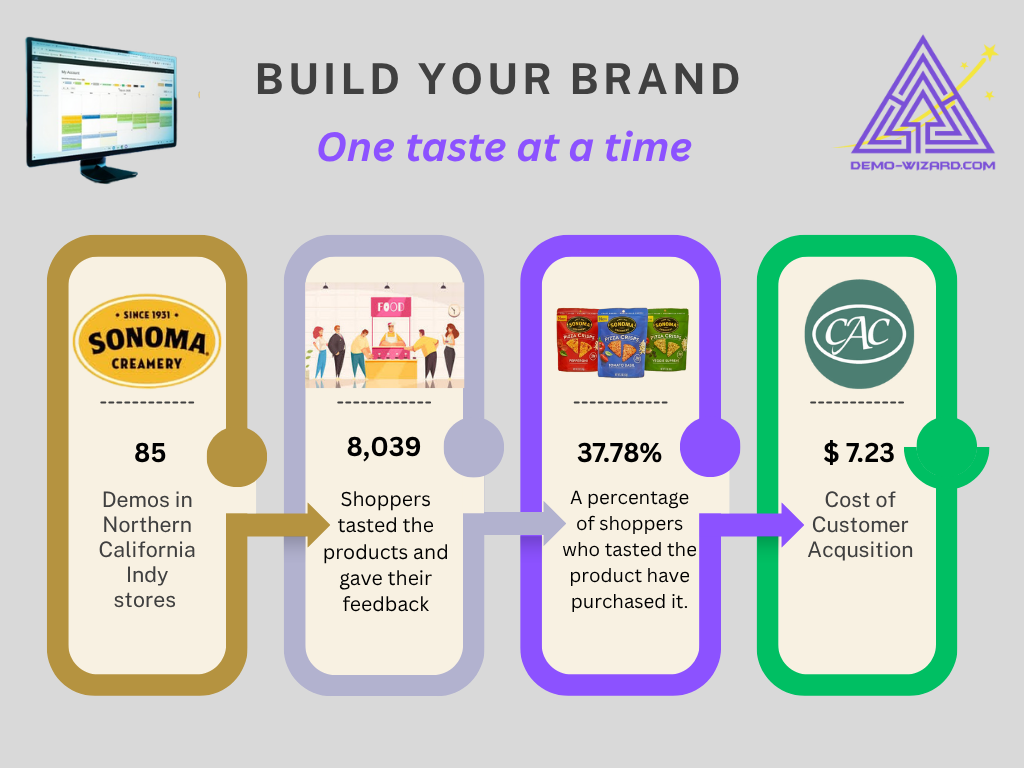
Coordinating demos across dozens or hundreds of stores breaks down when it relies on spreadsheets, phone calls, and one coordinator's memory. The fix isn't more headcount, it's centralizing scheduling, ambassador management, and performance data into one system that both brand teams and store staff can see. Start by auditing how many hours your team currently spends per week on manual scheduling and vendor calls; that number usually makes the case for automation on its own. From there, pilot a centralized platform like Demo Wizard on one region before rolling it out nationally, so you can validate ROI tracking and store-level reporting before scaling further.
Explore more from our content library:
About the Author
Written by the SaaS / Retail Marketing Technology experts at Demo Wizard. Our team brings years of hands-on experience helping businesses with SaaS / Retail Marketing Technology, delivering practical guidance grounded in real-world results.
Demo Wizard is the Ultimate Store Sampling & Demonstration management software for Brick and Mortar Retailers and CPG Vendors.
Chat with usPhone