
Demo Wizard is the Ultimate Store Sampling & Demonstration management software for Brick and Mortar Retailers and CPG Vendors.
Chat with us

Phone
Copyright © 2026 Demo Wizard
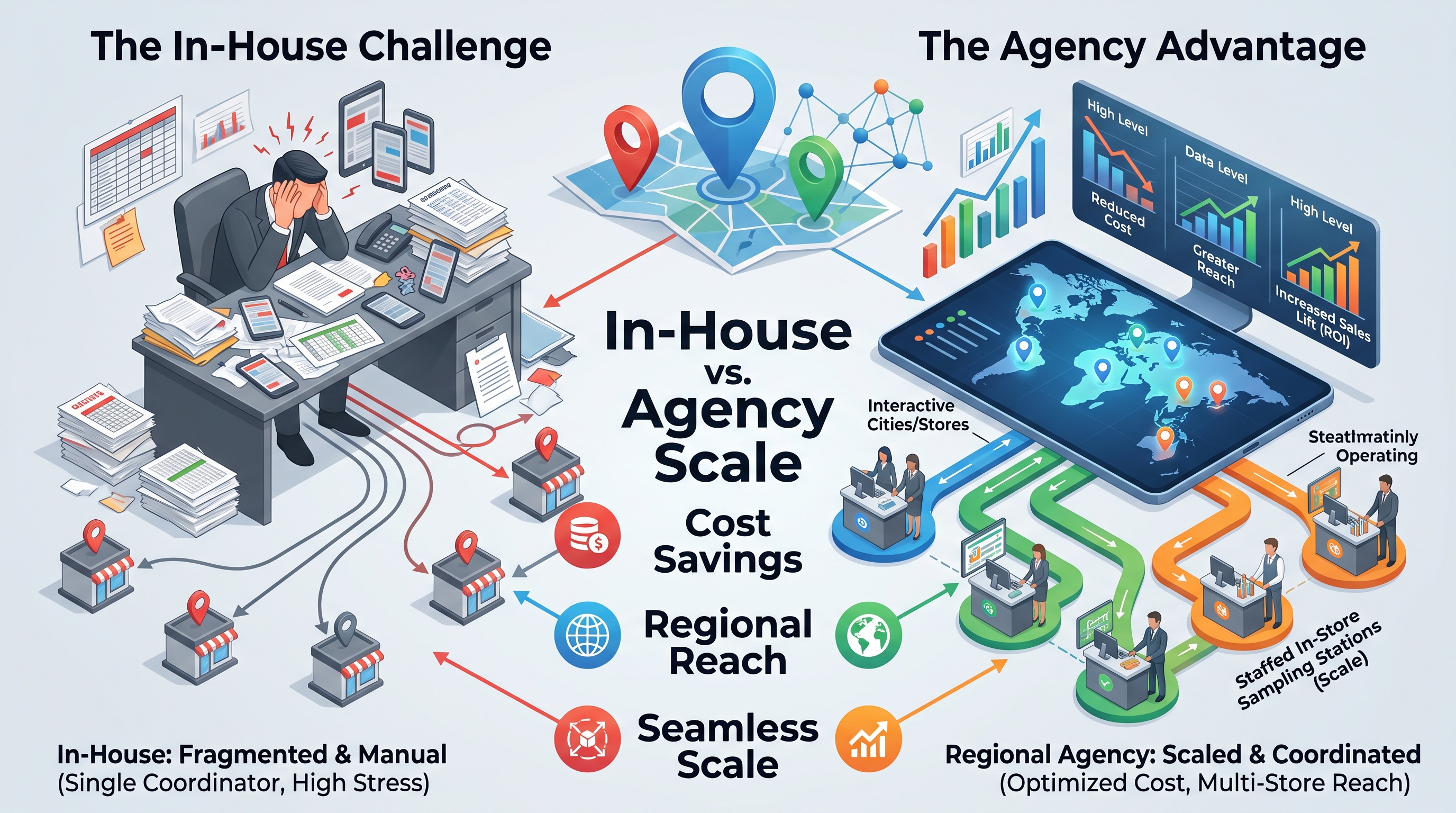
A product demo agency helps CPG brands plan, staff, coordinate, and measure in-store product demonstrations across retail locations. By managing brand ambassadors, retailer compliance, scheduling, and post-event reporting, agencies reduce the operational burden on internal teams. Brands can choose between in-house coordination, a full-service agency, software automation, or a hybrid approach depending on their demo volume, staffing needs, and reporting requirements. Platforms like Demo Wizard help automate scheduling and performance tracking so brands can scale their programs more efficiently.
A product demo agency in the CPG retail space coordinates, staffs, and measures in-store product demonstrations for brands and retailers. Unlike an in-house setup—where coordinators or field marketing managers often manually manage scheduling and follow-ups via spreadsheets and phone calls—an agency routinely uses a software platform to handle brand ambassador scheduling, retailer compliance, and multi-store ROI reporting at scale. Brands typically partner with local or regional agencies when doing so offers advantages in cost, reach, or scale.
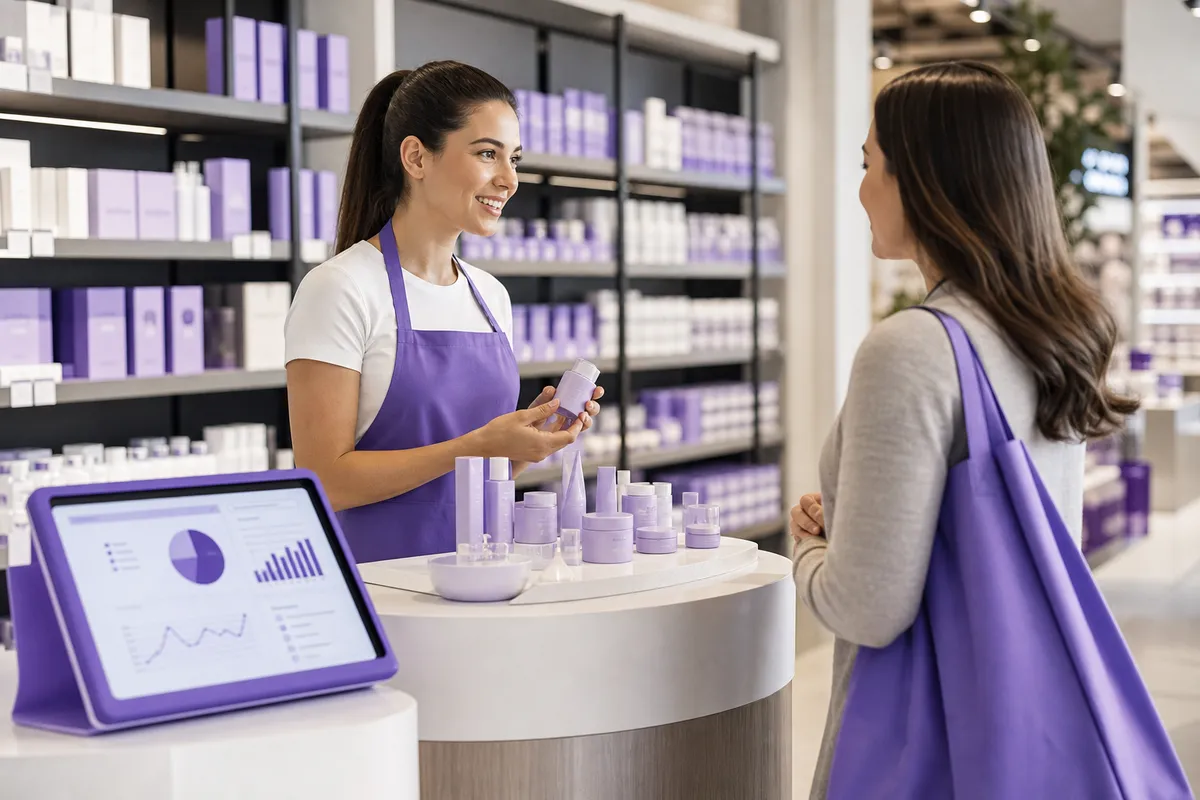
A product demo agency sits between the brand and the store floor, handling the scheduling, staffing, and reporting work that an internal coordinator would otherwise do alone. The relationship is contractual, not organizational, the brand still owns the product and the strategy behind it, while the agency or platform executes the logistics across many stores at once.
Brands reach for this model once demo volume outgrows what a single person can track in a spreadsheet. A brand running four demos a month can manage with phone calls and a shared calendar. A brand running forty demos a month across a dozen states needs something closer to an operating system for the job [1].
Three staffing models dominate: brand ambassadors hired directly by the brand, reps supplied by a distributor, or talent sourced through an agency's own ambassador pool. Each affects consistency differently. Directly hired ambassadors know the product best but are harder to scale fast; distributor reps are convenient but split their attention across multiple brands; agency-supplied talent is trained for in-store selling broadly but may need extra briefing on a specific product's story [3]. The strongest programs train ambassadors deeply on ingredients, sourcing, and objection handling, since the person behind the table is the brand's only human touchpoint in that moment [5].
The agency typically owns scheduling across locations, tracking retailer compliance rules, and generating post-event reporting. The brand keeps control of product supply, pricing, and promotional strategy, decisions that shape what gets sampled and why. The retailer, meanwhile, controls floor space, store rules, and timing windows [2].
Without that division, one coordinator ends up juggling every piece at once: calling store managers, tracking ambassador no-shows by text, and reconciling sales data by hand after the fact. A coordinated model replaces that with a centralized calendar visible to the brand, the agency, and often the store manager, so nobody is chasing information that already exists somewhere else. Platforms like Demo Wizard build this division directly into the software, automating the scheduling and reporting side so the brand's internal team stays focused on product and promotional decisions rather than logistics.
In practice, a brand evaluating whether to bring in a product demo agency should weigh a few recurring factors:
Coordination works when every party: the brand, the retailer, and the field team, can see the same calendar of events before a date gets confirmed. Without that shared view, scheduling becomes a guessing game played out over email chains and phone calls, and the store ends up absorbing the confusion.
A single grocery store might field booking requests from a snack brand, a beverage company, and a frozen foods vendor for the same Saturday end-cap. Without a shared calendar, two brands can book the identical slot, and the store manager finds out only when both ambassadors show up with tables and coolers at 9 a.m.
That kind of double-booking does more than embarrass a brand; it burns the retailer's goodwill and makes the next scheduling request harder to approve. A centralized calendar visible to the brand, the retailer, and demo staff closes that gap. Each party sees what's already booked before submitting a new request, so overlapping reservations and last-minute cancellations become visible before they become a problem on the floor. This is the core mechanic that separates a disciplined operation from one running on spreadsheets and guesswork, and it's the reason a dedicated product demo agency or scheduling platform earns its keep on anything beyond a handful of monthly events.
Store employees need five things visible in advance: the date, the time window, the physical footprint (end-cap, lobby, center aisle), the assigned ambassador's name, and the specific product being sampled. Without that detail, front-end staff end up fielding vendor arrivals they weren't told about, improvising table placement, or turning people away entirely.
Multi-day roadshow activations raise the stakes further. A roadshow occupies a dedicated footprint for anywhere from three to ten days, with branded signage, staged inventory, and bundled offers that need sign-off before the display goes up, far more coordination than a single ambassador working a sampling table for an afternoon. Signage approval, pallet placement, and staffing continuity across multiple days all have to be locked in ahead of time, not negotiated on arrival.
Inventory alignment is the step most schedules skip, and it's often the most costly to miss. Confirming that product has actually arrived at the store, not just that it's in transit, before a slot gets confirmed prevents the worst outcome in retail sampling: an ambassador staffing a table with nothing to hand out. Running out of stock mid-event undercuts the entire campaign, and the fix is procedural: no confirmed date without a confirmed delivery.
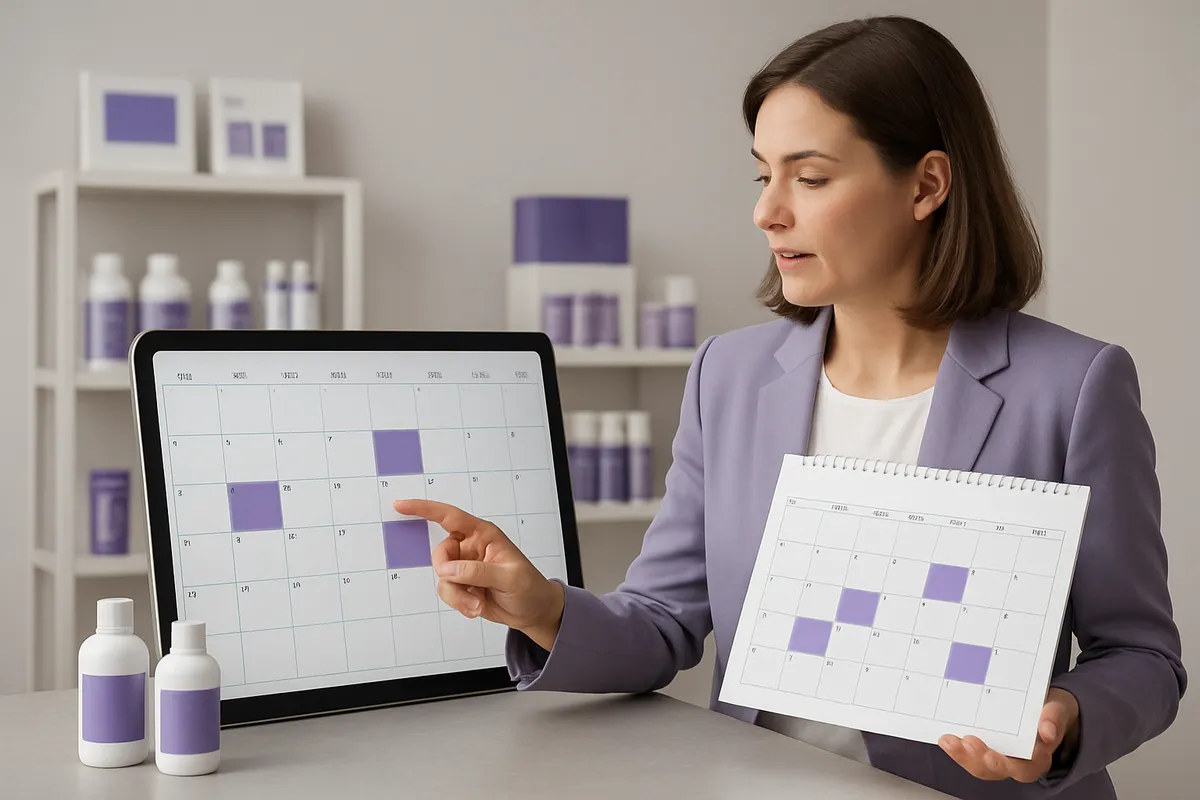
Four data points form the backbone of any demo ROI report: units sold during the shift window, samples distributed, photo and compliance confirmation, and staff check-in and check-out times. Without all four, a brand manager can't tell whether a slow sales day was a bad product fit or a brand ambassador who showed up late and left early. For more information, see Seo Agency Alternatives: Smart Cost-Effective Options For.
These aren't vanity numbers. A regional grocery director and a CPG brand's trade marketing lead are asking the same underlying question after every activation: did this event earn its spot on the calendar? Units sold answers the sales question. Samples distributed shows reach. Check-in and check-out timestamps confirm the labor actually happened as scheduled. Photo compliance proves the table looked like what was promised, not a half-set folding table shoved near the restrooms.
The mechanism is straightforward: compare store-level velocity for the demo SKU during the shift window against a baseline period for that same SKU and store, then isolate the lift.
If a 12-ounce salsa jar normally sells 8 units a day at a given store and sells 34 units on a Saturday roadshow, that 26-unit delta is the attributable lift, assuming no other promotion ran concurrently. Products featured in retail demos often sell meaningfully better than non-sampled items [2], and that comparison only holds up if the brand captured clean before/during/after sales data tied to the exact store and date range. Run this comparison across enough locations and patterns emerge: certain store formats, times of day, or regions consistently outperform others, data that should shape where next quarter's budget goes. A guide to scaling retail demos lays out similar logic for tracking performance across locations [Experiential Marketing for CPG Brands].
Across a multi-store campaign, the compliance record should confirm three things at every single location: the ambassador set up on time, followed planogram and signage placement rules, and submitted the required photos before closing the shift.
This matters beyond internal recordkeeping. When a CPG brand's trade marketing director has to justify a demo line item to finance, or when a retailer audits whether a vendor honored the agreed footprint, timestamped check-ins and photo evidence are the proof that holds up. A platform like Demo Wizard captures this automatically across hundreds of monthly events, giving a single coordinator the same visibility a product demo agency would need a full compliance team to assemble manually.
Roadshows need a faster feedback loop than a standard sampling shift. Because a roadshow runs on scarcity and lasts only a handful of days, tracking real-time units-per-hour lets a brand or agency catch a slow day and adjust staffing, signage, or inventory while the event is still running, not after the display comes down.
Automation replaces the phone calls, emails, and spreadsheet updates that multiply with every added store with one shared system that schedules, tracks, and reports automatically.
Manual coordination has a hidden multiplier problem. One demo at one store needs a handful of calls and confirmations. Fifty demos across twenty stores in a month means dozens of brands, ambassadors, and store managers all trying to confirm the same details through different channels, a text here, an email there, a phone call to check if a time slot is still open. Each additional store doesn't add administrative work in a straight line; it compounds it, because every new location adds another set of relationships that someone has to manage by hand. This is often the exact point where a brand starts comparing a product demo agency against an in-house hire, or against adopting a scheduling platform outright.
Store staff are usually the ones absorbing this tax even though demos aren't their job. A grocery employee at the front of the store ends up fielding vendor calls asking to confirm a Saturday slot, approving paperwork for a brand ambassador they've never met, and relaying schedule changes between the brand, the distributor, and whoever shows up that day. None of that moves product. A centralized scheduling platform takes those three tasks off the store's plate entirely: the schedule lives in one system, ambassador assignments are confirmed automatically, and changes propagate without anyone at the store having to pick up a phone.
When a vendor, distributor, and retailer are all looking at the same live schedule, there's no need for the round of confirmation emails that normally fills that gap. A platform built for retail activations, the kind a product demo agency or brand team would use to run multiple campaigns at once, gives every party a single source of truth instead of three separate calendars that have to be reconciled by phone. That shared view also enforces the rules a store cares about: permitted hours, footprint limits, and check-in requirements get built into the system rather than repeated by a store manager to every ambassador who walks through the door.
The scale effect is the real payoff. Demo Wizard is built around this exact mechanism, automating scheduling, ambassador management, and ROI reporting so a single coordinator can manage hundreds of monthly events without hiring additional staff. Industry guides on scaling in-store demos point to the same operational reality: logistics and scheduling discipline are what separate programs that work locally from ones that hold up nationally [2]. Removing the manual relay work between store, vendor, and brand isn't a convenience, it's what makes that scale possible at all.
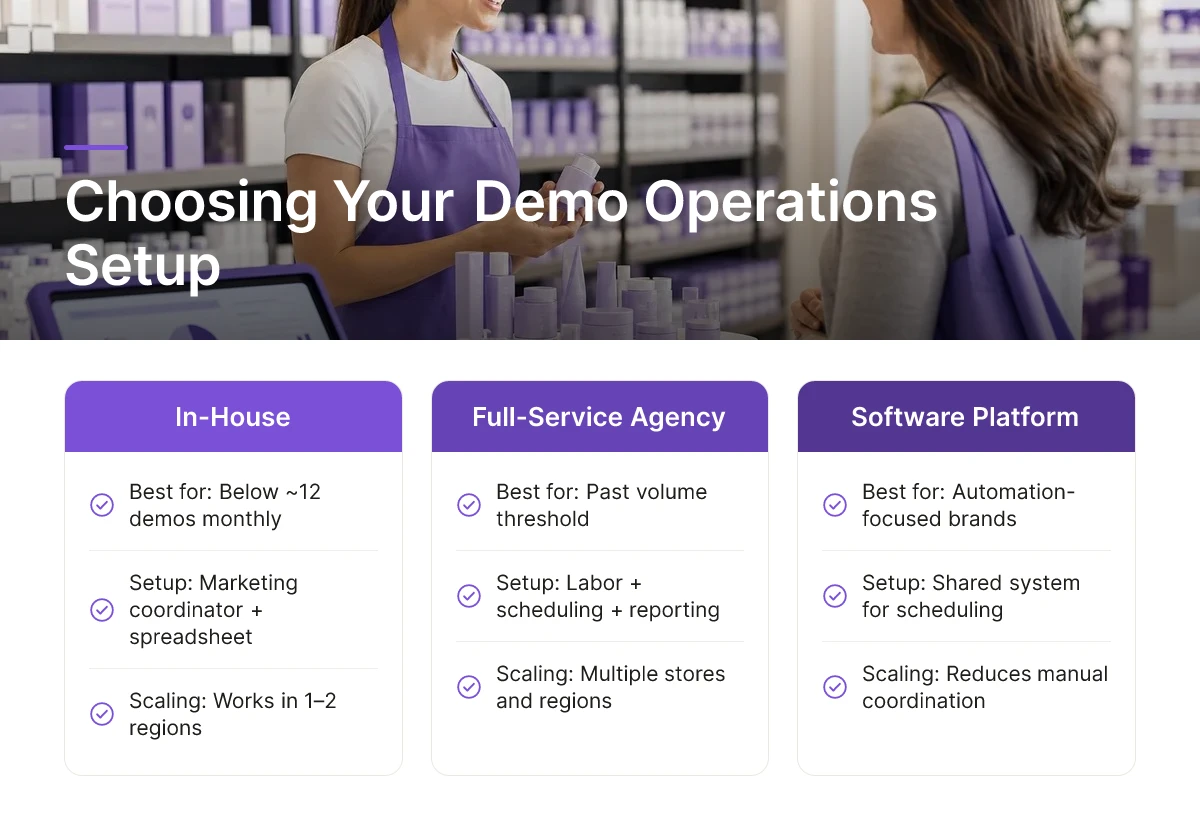
The right choice depends on how many demos you run monthly, how many retail banners you work across, and whether you need labor, software, or both, not on which option sounds most sophisticated.
Most CPG brands land in one of three setups, and the decision point is usually volume and/or the requirement for a formalized reporting and analytics. Below roughly a dozen demos a month in one or two regions, a marketing coordinator running a spreadsheet and a group text with ambassadors can work fine. Past that, the administrative load grows faster than headcount usually does, and that's the threshold where a full-service agency, a dedicated platform or both starts to pay for itself.
A full-service product demo agency makes sense when you need boots on the ground, trained ambassadors, physical staffing, and someone else managing the labor relationship, but less sense if what you actually need is visibility into which stores and time slots convert. A platform like Demo Wizard fits the gap between the two: it doesn't supply ambassadors, but it automates the scheduling, ambassador deployment, and ROI reporting that otherwise consumes a coordinator's week, letting one person run hundreds of monthly events across multiple states without new hires. Some brands use a platform to manage an in-house ambassador roster; others use it to coordinate the agency staff they've already hired. Both are legitimate answers depending on whether labor or logistics is the bigger bottleneck.
A useful way to frame the decision is by matching the setup to what the brand actually needs:
Expect a data migration step before anything else, loading store lists, ambassador rosters, and historical schedules is the part that takes longest, not the software itself. Brands with clean spreadsheets of store locations and ambassador contact details can usually get a platform running within days; brands with fragmented records across regional teams should budget more time for cleanup. Staff training tends to be light since scheduling interfaces mirror tools coordinators already use, but it's worth confirming ambassadors themselves need minimal onboarding, since they're the ones checking in at stores.
Cost should map to what's included, not just to the sticker price. Budget-friendly tools often cover scheduling alone. Mid-range options add ambassador management or payroll. Premium platforms bundle scheduling, ambassador deployment, and post-demo analytics, the combination that lets a single coordinator prove ROI without stitching together three separate systems.
Retailer fee structures sit underneath all of this and shouldn't be ignored when budgeting. Club stores and mass retailers often require an exclusive vendor and charge a turnkey fee per shift; regional grocers may charge a smaller slotting fee to reserve calendar space while letting the brand staff its own team; independent and natural grocers frequently waive fees entirely in exchange for the foot traffic a demo brings. Whatever a brand spends on internal coordination or a platform subscription sits on top of whichever retailer model applies.
Before signing with any agency or platform, ask: Can it manage multiple brands or product lines on one calendar? Does it capture compliance photos to confirm setup matched the plan? And can both the retailer and the brand's own team access the same performance reports, or does someone have to compile them manually afterward? These same questions apply whether you're vetting a software platform or interviewing a product demo agency directly.
Sometimes, and the amount depends entirely on the retailer's format and vendor policy. Club stores and big-box chains often mandate an exclusive demo agency and charge a turnkey fee per shift that can run into the hundreds of dollars. Regional grocery chains more commonly charge a smaller slotting or scheduling fee while letting the brand supply its own staff. Independent and natural food retailers frequently waive fees entirely, since they view sampling as a traffic driver rather than a line item to monetize.
A standard demo is a brand ambassador handing out samples from a table or cart for a single shift. A roadshow is a multi-day, dedicated footprint, often a center-aisle or lobby display with branded signage, staged inventory, and bundled or exclusive offers not found on the regular shelf. Roadshows typically run three to ten days and aim to create urgency and high-volume trial, functioning more like a temporary pop-up store than a sampling table.
Yes, with the right scheduling and ambassador management platform replacing manual spreadsheets and phone calls. Software built specifically for retail demo coordination, like Demo Wizard, automates event scheduling, ambassador assignment, and payroll across locations, which is what lets a single coordinator run hundreds of monthly events instead of hiring additional staff for each new market.
Most retailers expect demo requests submitted two to four weeks ahead, though club stores and mandatory-vendor chains often require more lead time. Inventory forecasting matters as much as the booking itself, a demo scheduled without confirmed stock on the shelf risks running out mid-shift and undercutting the entire activation.
It typically makes sense once demo volume outgrows a single coordinator's capacity, once a brand needs trained ambassador labor across multiple regions, or once retailer compliance requirements become too complex to track manually. A product demo agency is also worth considering when a brand lacks the internal bandwidth to vet, hire, and manage ambassadors directly across many stores at once.

Running in-store demos profitably comes down to three things: knowing which fee model your retailer uses before you budget, matching the activation format (single-table sampling versus a multi-day roadshow) to the sales goal, and tracking store-level conversion data so you can defend the spend to finance and retail partners alike. Agencies and brokers add value when compliance and staffing complexity demand it, but for brands running recurring programs across many doors, the bottleneck is usually coordination, not strategy. Start by auditing how many hours your team spends weekly on scheduling and payroll logistics versus analyzing which stores and time slots actually convert, that single number will tell you whether it's time to automate.
Explore more from our content library:
About the Author
Written by the SaaS / Retail Marketing Technology experts at Demo Wizard. Our team brings years of hands-on experience helping businesses with SaaS / Retail Marketing Technology, delivering practical guidance grounded in real-world results.
Demo Wizard is the Ultimate Store Sampling & Demonstration management software for Brick and Mortar Retailers and CPG Vendors.
Chat with usPhone