
Demo Wizard is the Ultimate Store Sampling & Demonstration management software for Brick and Mortar Retailers and CPG Vendors.
Chat with us

Phone
Copyright © 2026 Demo Wizard
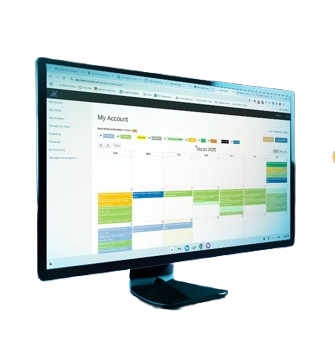
Brand activation management software connects CPG brands, retailers, and brand ambassadors on one system to schedule in-store product demonstrations, confirm execution in real time, and track ROI without manual phone calls or spreadsheets. Instead of coordinators chasing staff availability and retailers fielding vendor calls, a shared calendar and automated check-in process handle scheduling, compliance, and recap reporting. The result: fewer no-shows, less disruption to store employees, and clear sales-uplift data tied to each demo event.
It automates the operational side of in-store demos: building shift schedules, assigning ambassadors, verifying they showed up, and collecting recap data after each event. Brand activation management software is not a messaging tool or a loyalty platform, it's built to coordinate people and schedules inside physical stores, nothing more and nothing less. For a broader view of how brands approach this space, this overview of leading brand activation services offers useful context on how different providers structure their offerings.
General retail marketing tools focus outward, on shoppers, personalizing offers, running loyalty programs, or tracking customer journeys across channels [2]. Brand activation management software focuses inward, on the operational mechanics of getting a qualified ambassador to the right store at the right time with the right product in hand.
That distinction matters for CPG brand teams evaluating software. A platform built for consumer engagement will have dashboards for email campaigns and customer segments; a platform built for demo coordination will have dashboards for shift fill rates, no-show percentages, and which stores converted best. Brands running dozens of weekly demos need the latter, not a repurposed event-ticketing or CRM tool [1].
Four workflows sit at the core of most demo coordination platforms:
None of this touches individual shoppers directly, the system tracks ambassador activity and store-level outcomes, not consumer identities or purchase histories.
Demo Wizard, for example, handles this chain end-to-end: scheduling across locations, ambassador deployment, and payroll tied to completed shifts, so a coordinator isn't re-keying the same shift details into three different spreadsheets.
Before this kind of coordination existed as software, the same four steps ran through phone calls, email threads, and shared spreadsheets passed between brand, agency, and retailer. A store manager would call the agency to confirm an ambassador's arrival; the agency would email the brand a recap days later; nobody had a single, current view of what was actually happening on the floor that week. A shared system replaces that chain with one calendar and one record of truth, visible to the brand, the agency, and the store at the same time.
The actors involved are consistent across this category: brand ambassadors who staff the table, demo coordinators who build the schedule, store managers who approve floor access, and distributors who keep product stocked for the event. Shoppers who sample the product are the intended outcome of the work, not participants the software tracks.
Automated coordination replaces scattered phone calls and spreadsheets with one shared schedule that store managers, brand coordinators, and ambassadors can all see in real time. That single change is what separates brand activation management software from the ad-hoc email chains most CPG brands and retailers still rely on.
A centralized calendar removes the back-and-forth that used to land on store staff every time a vendor needed to confirm a time slot or find out who was showing up. Instead of a department manager fielding calls from three different brokers about three different Saturday demos, the schedule lives in one system that every party can check without picking up the phone.
This matters most for grocery and warehouse locations running multiple activations per week. When a brand coordinator reschedules a demo because an ambassador is sick, the store manager sees the update immediately instead of learning about it when nobody shows up at the table. Demo Wizard's multi-location coordination tools let a single coordinator manage hundreds of monthly events across dozens of stores, which means the retailer gets one consistent point of contact instead of a different vendor process for every brand on the calendar.
Fewer calls and texts also mean store employees spend less time acting as unpaid dispatchers for CPG vendors, distributors, and ambassador agencies, time they can redirect to customers and shelf work.
Automated shift confirmations and reminders cut down on day-of no-shows by prompting ambassadors to reconfirm availability before their scheduled slot, rather than leaving confirmation to a last-minute text the night before. When an ambassador cannot make it, the system flags the gap early enough for a coordinator to find backup coverage instead of discovering an empty table mid-shift.
Location-based check-in confirms that an ambassador actually arrived at the correct store, set up on time, and stayed for the scheduled window, information that used to depend on a supervisor's spot visit or a store manager's secondhand report. Photo proof and timestamped check-ins give brands documented evidence that a demo ran as planned, which replaces manual verification calls that pulled store employees away from their own responsibilities. For more information, see Best Review Management Software Restaurants.
For retailers, this compliance layer also protects in-store conditions: it confirms ambassadors followed table placement rules, signage requirements, and safety protocols without requiring staff to police every vendor visit personally.
Five numbers matter most for tracking the health of a demo program:
Units sold per shift is the core velocity metric for any CPG demo program. It tells a brand manager whether a Saturday sampling table in a regional grocery chain actually moved product, not just whether an ambassador showed up. The problem is capturing that number consistently. Most teams still rely on ambassadors texting photos of handwritten recap sheets, which a coordinator then re-types into a spreadsheet days later, a process that loses data and introduces errors. Brand activation management software that captures recap data digitally at the point of the shift, tied to the store and time slot, replaces that manual tally and gives finance a number they can trust.
Experience-to-purchase conversion compares how many shoppers engaged with a demo against the point-of-sale lift recorded during that same window. If an ambassador distributes 300 samples on a Saturday afternoon and the store rings up 90 units of that SKU above its normal baseline for that time slot, that ratio becomes the benchmark for the next store on the schedule. Running this comparison across many locations is how a brand identifies which store formats, end-caps, or dayparts actually convert versus which ones just produce friendly foot traffic. Without a system that timestamps samples distributed against the sales window, this comparison is close to impossible to make reliably.
The honest answer is qualitative: expect fewer wasted shifts, fewer coordinator hours spent on scheduling logistics, and a cleaner view of which stores deserve repeat visits, not a guaranteed dollar figure. True cost-per-demo isn't just the ambassador's hourly rate; it has to include no-show rate, since a paid shift that never happens still costs money and burns a retailer relationship. When labor cost per shift and no-show rate feed into one calculation, a brand can see whether a coordination fee is actually cheaper than the hours lost to spreadsheet chasing and last-minute replacement calls. Consistent, timestamped recap data across dozens or hundreds of stores is also what lets a brand builder spot its five best-performing Kroger locations out of fifty and shift budget there instead of spreading it evenly and hoping.
The right choice depends on three factors: how well a platform fits existing store systems, how its complexity scales with your footprint, and whether its pricing matches your actual event volume.
Integration priorities should start with the systems your teams already touch every day, not with a long feature checklist. For CPG brands and demo agencies, that means compatibility with existing distributor and vendor contact systems so ambassador assignments and product shipments stay linked to the same event record.
Point-of-sale or inventory alerts matter almost as much. A platform that can flag low stock ahead of a weekend roadshow prevents the kind of mid-event stockout that undermines an otherwise well-staffed activation. Finally, check whether the tool can sync with the calendar systems store managers already use day to day. If a platform forces store staff to learn a new interface just to see what's happening in their aisle next Saturday, adoption suffers and the calendar stops being a reliable source of truth. A comparison of retail-focused activation platforms can help teams benchmark which integrations matter most for their footprint.
Deployment complexity rises with three variables: the number of store locations, the number of ambassadors you manage, and the number of retail banners involved. A brand running demos in 15 stores under one regional banner has a simple rollout. A brand coordinating hundreds of monthly events across multiple national chains, each with different approval processes and floor rules, needs a platform built to handle that variation without requiring a larger coordination team.
Pricing in this category generally falls into three tiers. Budget-friendly tools cover basic scheduling for brands running occasional, small-scale demos. Mid-range options add ambassador management and reporting for brands scaling into dozens of monthly events. Premium or enterprise tiers bundle scheduling, payroll, and ROI analytics for brands or agencies running activations at national scale. Demo Wizard's per-demo pricing model, with no per-user or per-location restrictions, sits deliberately against the grain of tools that charge more as headcount or store count grows.
Retailers evaluating brand activation management software should also weigh a narrower but critical requirement: any store employee should be able to view the activation calendar without being responsible for managing it. That visibility, without administrative burden, is what lets a produce manager or shift lead confirm a vendor's scheduled arrival without fielding a phone call.
Last, confirm whether a platform is purpose-built for in-store demo coordination or a general event and CRM suite adapted to fit. Broad platforms built for ticketing or customer engagement [2] often lack the retail-specific logic, ambassador payroll, store-level conversion tracking, multi-banner compliance, that in-store sampling actually requires.
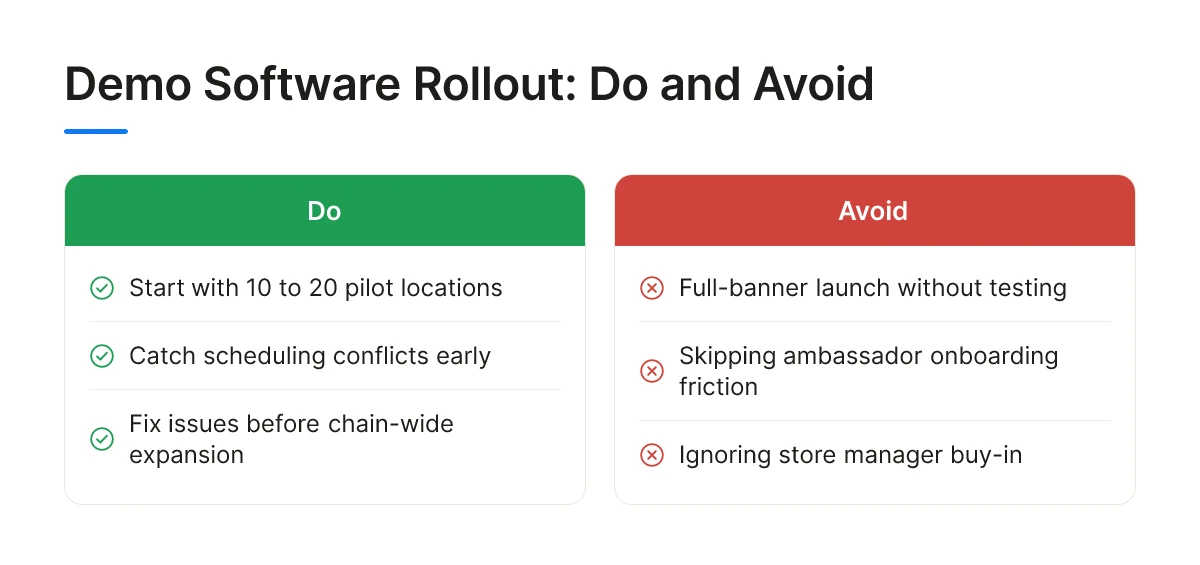
Expect a phased rollout, friction around ambassador onboarding, and store manager buy-in to matter more than any feature list in the software itself.
A pilot-first approach beats a full-banner launch. Most CPG brands and retailers that succeed with brand activation management software start with a handful of stores, often 10 to 20 locations across one region, before expanding chain-wide. This lets a brand activation manager catch scheduling conflicts, calendar gaps, or ambassador no-show patterns while the stakes are still small, then fix those issues before rolling out to 200 stores at once.
Ambassador onboarding is the second hurdle. Brand ambassadors accustomed to paper sign-in sheets or text-message scheduling need a transition period. Mobile-first check-in, where an ambassador confirms arrival and logs hours from a phone at the demo table, cuts training time substantially compared to legacy paper processes, since there's no manual form to learn or submit. Coordinators should expect a short learning curve in week one, not zero friction.
Demo management software handles ambassador scheduling, availability, and work records, not shopper or consumer data, which keeps the privacy scope narrow. Because the platform tracks who worked which shift at which store and processes payroll tied to completed demos, the compliance burden resembles standard employee data handling rather than consumer privacy regulation. Brands evaluating a platform should confirm this scope directly: a tool built for coordinating brand ambassadors and in-store staff carries a much lighter data governance load than one built to track individual shoppers.
Timelines vary by retail footprint, but a pilot phase of four to six weeks followed by a staged expansion over one to two quarters is a realistic baseline for a multi-region rollout. The pace is set less by the software and more by store manager buy-in, locations where managers actively support scheduling visibility and ambassador access tend to onboard faster than locations where the rollout is pushed top-down without local input.
Common early missteps slow this down: skipping in-store training for the first wave of locations, or underestimating how much calendar visibility store teams and coordinators need across multiple banners. Brands that build in time for both tend to reach full-scale adoption faster than those that treat rollout as a one-time software switch.
No, software coordinates and tracks demos, but it doesn't replace trained brand ambassadors or agency expertise in staffing and execution. Platforms like Demo Wizard handle scheduling, payroll, and ROI tracking so agencies and brands can run more demos with the same headcount. The agency or in-house team still delivers the in-store experience; the software removes the administrative burden around it.
Yes, scheduling and ROI platforms are built to serve both models without restructuring how either team operates. A CPG brand running its own ambassadors can schedule and track performance directly, while a demo agency managing multiple brand clients can coordinate hundreds of events across locations from one dashboard, with no per-user or per-location limits.
Automated platforms flag the open slot immediately and surface available, qualified ambassadors nearby to fill it. This cuts the scramble of phone calls and texts that typically follows a no-show. Coordinators managing hundreds of monthly demos can't manually chase replacements for every market; a system that tracks ambassador availability in real time turns a last-minute gap into a quick reassignment rather than a missed event.
Event management software handles ticketing and attendance for single events, while demo management software coordinates recurring, distributed in-store activations with ROI tied to sales. Tools like Eventtia focus on event logistics and attendee engagement [2], whereas Demo Wizard focuses on scheduling ambassadors across many retail doors and measuring experience-to-purchase conversion by store and time.
Beyond scheduling features, compare how each vendor handles ambassador payroll, store-level reporting, and support for multi-banner retail rules. A vendor built specifically for in-store demos will show deeper retail logic than a general event platform, and will typically make it easier to track conversion data by store rather than just by campaign.
Scaling in-store demos profitably comes down to three things: cutting the manual scheduling load, keeping ambassador payroll and deployment in one system, and tying every event to a sales outcome instead of a vague impression report. Brands and agencies that track conversion by store and time period can redirect budget toward what's actually working, rather than repeating the same underperforming locations. Retailers benefit too, through fewer vendor disruptions and one visible calendar of activity. If you're still coordinating demos through spreadsheets and phone calls, start by auditing one month of activations against actual sales lift. That gap is usually where the case for automation becomes obvious.
Explore more from our content library:
Demo Wizard is the Ultimate Store Sampling & Demonstration management software for Brick and Mortar Retailers and CPG Vendors.
Chat with usPhone