
Demo Wizard is the Ultimate Store Sampling & Demonstration management software for Brick and Mortar Retailers and CPG Vendors.
Chat with us

Phone
Copyright © 2026 Demo Wizard

Understanding why is demo scheduling difficult is essential. Demo scheduling is difficult because it requires syncing brand ambassador availability, retailer calendars, distributor inventory timing, and store-specific compliance rules across many locations at once, and most teams still coordinate this through email, phone calls, and spreadsheets. Each added location or stakeholder multiplies the chances of double-booking, no-shows, or missed compliance, while manual tracking makes it nearly impossible to see which demos are confirmed, completed, or driving sales until after the fact.
Demo scheduling gets difficult fast because each store adds its own staff availability, inventory timing, and operating hours to an already complex equation. A campaign covering five stores is manageable on a spreadsheet. A campaign covering 150 stores across three states is not.
The math is the problem. Every additional store multiplies the number of variables a coordinator has to track, not just adds to them. Store A closes at 9 p.m. and restocks on Tuesdays; Store B closes at 10 and restocks on Thursdays. Multiply that by ambassador availability, which changes weekly, and the coordination load grows faster than headcount can keep up. This is a big part of why is demo scheduling difficult for any brand trying to scale beyond a handful of doors.
Staffing constraints compound the issue as campaigns scale. A brand running demos in 10 stores can usually rely on two or three ambassadors covering overlapping territories. At 100 stores, the same brand needs a bench of ambassadors spread across regions, each with different availability windows, drive times, and blackout dates. Retail and CPG supply chains face similar alignment challenges across departments, as outlined in this overview of why retail and CPG alignment keeps breaking down.
Without a shared system, every location becomes its own manual coordination effort, a separate email thread, a separate phone call, a separate confirmation, instead of one repeatable process applied at scale. This is why brands and demo companies running multi-door campaigns feel this acutely, while a single-store operator rarely does; the friction only shows up once coordination has to repeat itself hundreds of times a month.
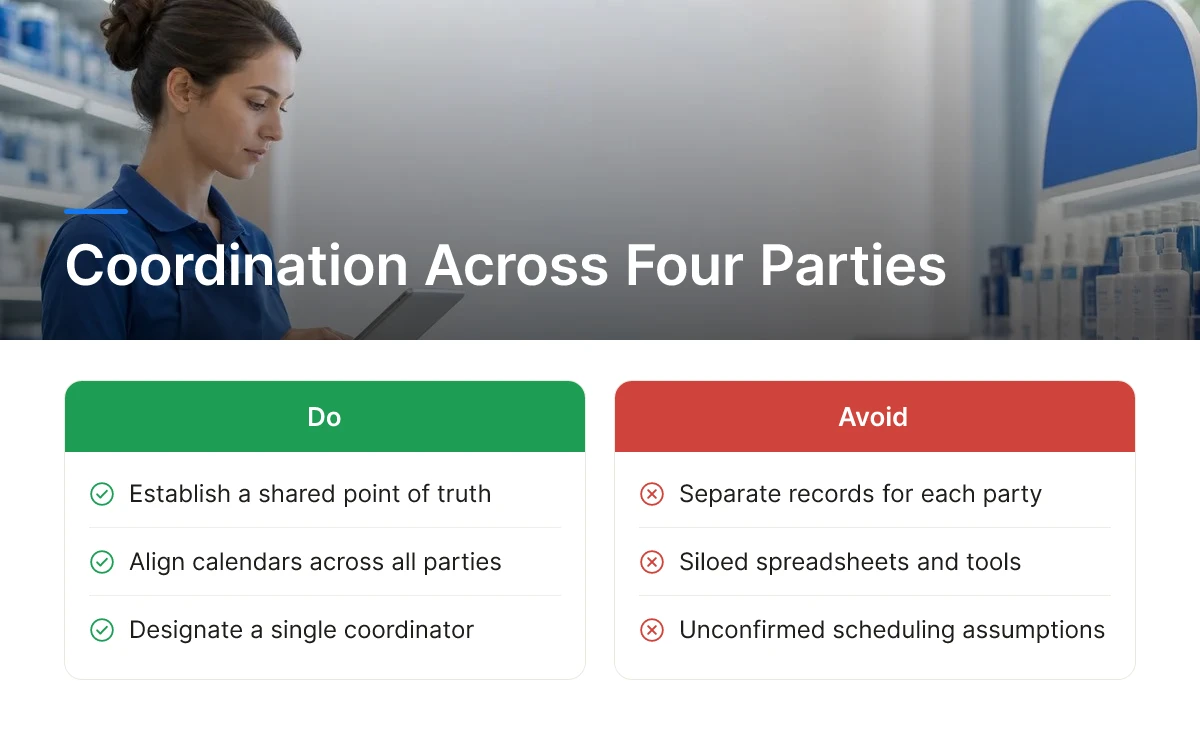
Scheduling breaks down when brands, retailers, distributors, and demo staffing companies each keep separate records with no shared point of truth for a single event. This lack of alignment is one of the clearest answers to why is demo scheduling difficult once more than two parties are involved in a single event.
Four parties typically touch a single in-store demo: the CPG brand planning the campaign, the retailer hosting it, the distributor managing product delivery, and the demo staffing company or agency providing the ambassador. Each of these groups tends to run its own calendar, its own spreadsheet, or its own internal ticketing tool. When the retailer's regional office reschedules a demo to avoid a conflicting store reset, that change doesn't automatically reach the distributor responsible for shipping product, or the agency responsible for staffing it. Broader retail supply chain risks, including inventory timing and distributor coordination, are detailed in this breakdown of retail supply chain challenges CPG suppliers must manage.
Regional management structures add approval layers before a demo date is even confirmed. A national campaign often requires sign-off from a district manager, then a store-level manager, before a slot becomes official, and each layer adds delay. Spread across multiple regions with different chains of command, this is a core reason why demo scheduling is difficult to standardize even within a single brand's campaign. For a deeper look at logistics coordination across regions, see this retail and CPG logistics guide to optimizing your supply chain.
Most guides frame this as a communication problem. The deeper issue is structural: there's no single record all four parties can see and trust at the same time, so miscommunication is the default outcome, not the exception.
Manual confirmation chains fail because a scheduling change buried in an email thread rarely reaches the store manager or ambassador before the demo date arrives.
A brokerage rep confirms a demo slot by phone, the store manager updates a physical calendar, and the ambassador finds out by text a day later, if at all. Each handoff is a chance for the message to arrive late, get missed, or get contradicted by a more recent update nobody forwarded. This is one of the more mechanical reasons why demo scheduling is difficult to manage reliably once a brand runs more than a handful of events a month.
Unlogged or unconfirmed demos lead directly to no-shows, double-booked staff, or duplicated outreach when two people try to fix the same gap without knowing the other already has. Compare that to a centralized confirmation log that timestamps every change and notifies every stakeholder automatically, the difference isn't speed of communication, it's whether anyone is working from stale information [5]. The signs below often indicate a scheduling process that's already costing a brand money:
The real cost of manual coordination isn't the hours spent writing emails. It's the decisions, staffing calls, inventory shipments, store approvals, made on information that was already out of date by the time someone acted on it. This is precisely why is demo scheduling difficult to fix with communication tweaks alone; the structure of the process has to change, not just the speed of messages within it.

Syncing ambassador, retail staff, and store calendars is difficult because none of them originate from the same source or update on the same schedule.
An ambassador's availability lives in a staffing agency's roster. The store's operating calendar lives with its own management system. Retail staff shift schedules live somewhere else entirely. None of these three feed each other, so a coordinator has to manually cross-reference all three every time a demo gets booked, and manually re-check them every time something changes.
A single cancellation, an ambassador calling out sick, a store closing early for an inventory count, forces a manual search for a replacement, often discovered too late to avoid a gap in coverage. One mismatch ripples outward: the missed window doesn't just cost that day's demo, it can also affect inventory already staged for the event and any follow-up visits planned around it.
This hits campaigns with frequent recurring demos hardest. A one-time event carries one point of failure; a weekly recurring demo reopens that same conflict risk every single week, which is why scheduling friction tends to accumulate rather than resolve itself over the life of a campaign. Distribution and logistics strategies built for growth-stage CPG brands address some of this timing complexity directly, as covered in this guide to CPG distribution and logistics strategies for growth.
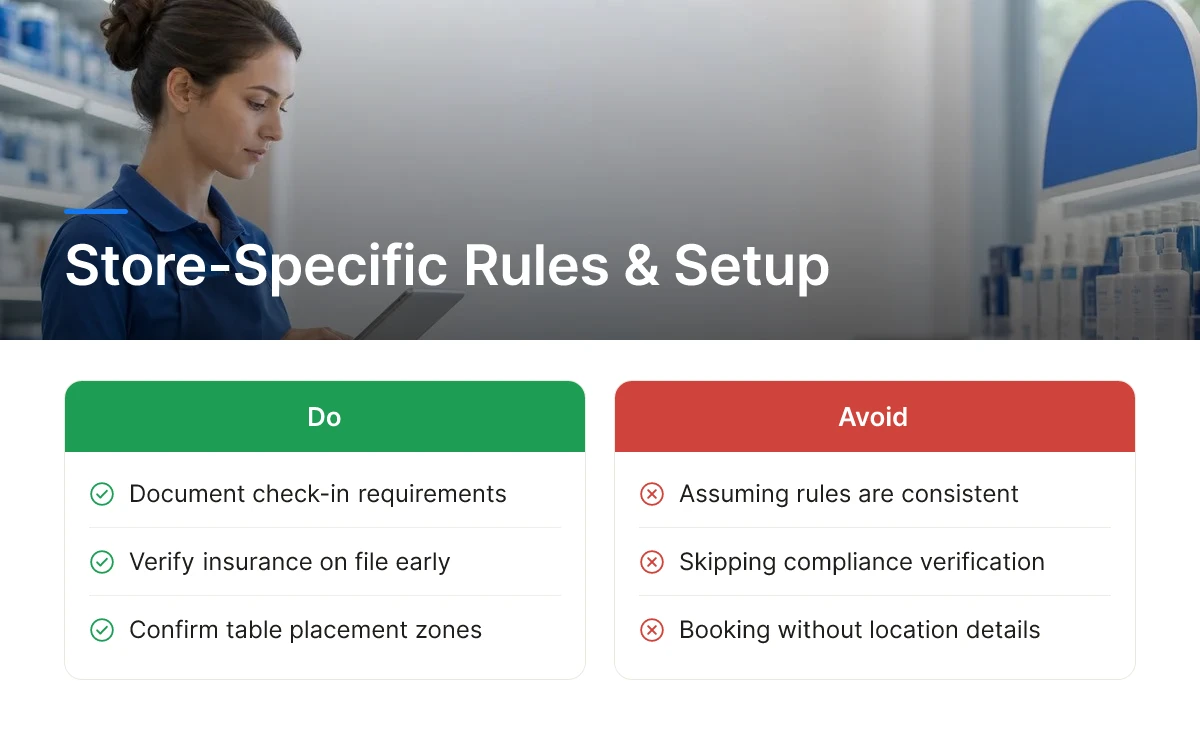
Store-specific rules on check-in, setup, and insurance vary by retail banner and even by individual location, adding a layer of difficulty beyond pure calendar logistics.
One retail banner requires ambassadors to check in at customer service before setup; another requires a signed certificate of insurance on file before the demo date is even approved. Table placement rules differ too, some stores permit end-cap setups, others restrict demos to designated zones near the deli or entrance. None of this is optional, and none of it is consistent store to store.
Demo timing has to work around peak shopping hours so ambassadors don't block aisles or slow down checkout lines during a store's busiest windows, the same windows that typically drive the highest sampling traffic. Getting that balance wrong risks disrupting regular store operations, which damages the retailer relationship regardless of how well the demo itself performs.
Compliance failures discovered after the fact, the wrong table setup, a missed check-in, an expired insurance document, waste the entire demo slot, since there's usually no way to recover it once the window has passed. Most operators treat compliance as a retailer checklist to satisfy after a slot is booked. It works better as a scheduling input from the start: a filter that determines which time slots and store zones are valid before a booking is even made.
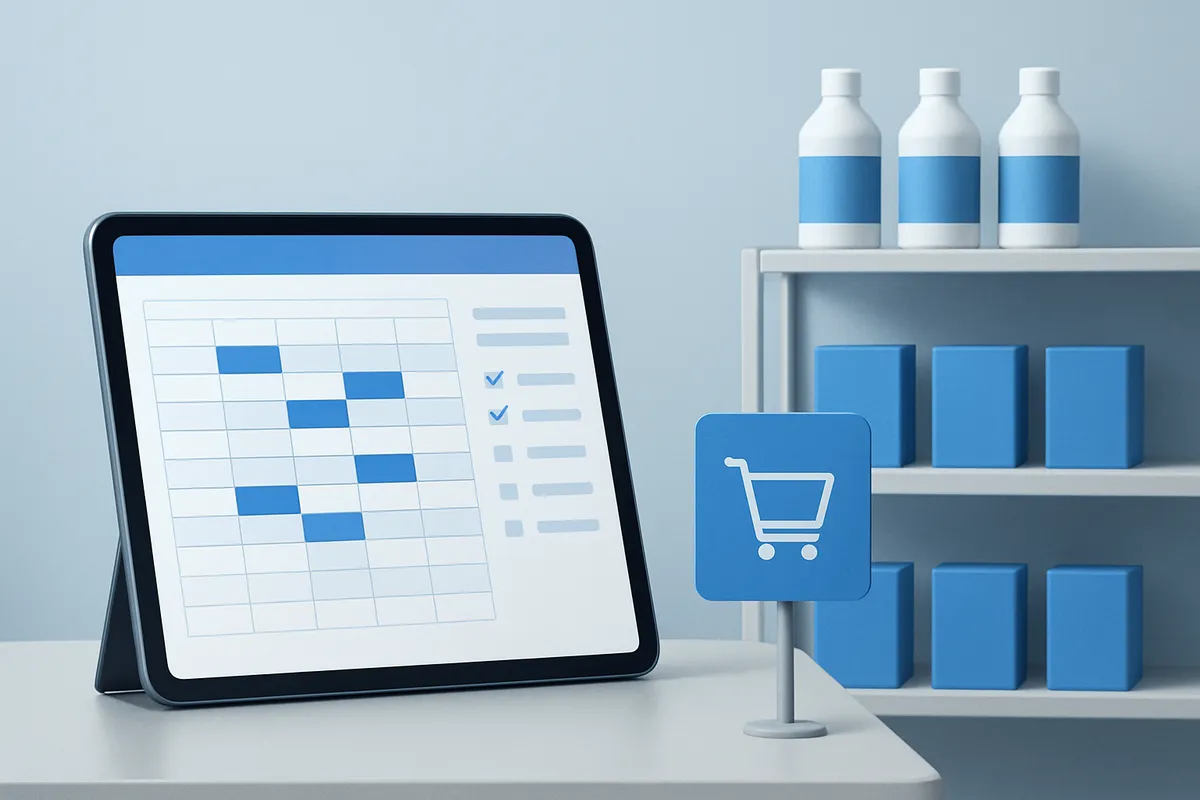
Most teams cannot see scheduled, confirmed, and completed demos in one place, so double-booking and unstaffed slots happen without anyone noticing until it's too late. This fragmented view is a core reason why is demo scheduling difficult for brands running activations across dozens or hundreds of stores.
Without a single source of truth, a retailer's marketing team and a CPG brand's agency can each book the same Saturday slot independently, or both assume the other covered it and leave it empty. Spreadsheets and email threads don't reconcile in real time, so conflicts surface only when an ambassador shows up to a store that already has a demo running, or no one shows up at all. Either outcome wastes labor hours and burns goodwill with the retail partner.
Visibility gaps hide which demos actually happened versus which were only planned, so a no-show can go undetected for weeks. That delay blocks corrective action and lets the problem repeat across the next scheduling cycle. It also creates an ROI tracking gap: when completion and sales-lift data aren't captured systematically at the demo level, brands lose the ability to tell which stores, times, or ambassadors actually drove purchases. Without consistent records tied to each event, planning next quarter's activation calendar becomes guesswork rather than a data-driven decision.
Pick a system built around one shared calendar, automated confirmations, and compliance checklists, then match its feature depth to your location count and campaign volume.
A scalable system needs three things working together: a centralized calendar visible to the brand, the retailer, and every ambassador in the field; automated confirmations that replace manual chasing; and compliance checklists tied directly to each scheduled time slot so setup, signage, and sampling rules are verified on-site rather than assumed. Demo Wizard structures its scheduling around this model, coordinating bookings across locations while feeding completion data straight into ROI reporting rather than a separate spreadsheet.
Automation removes the manual back-and-forth that causes most scheduling breakdowns, instead of email chains between brand, agency, and store manager, everyone sees the same status update the moment a demo is confirmed, staffed, or completed. For retailers specifically, this eliminates disruption to store employees: staff no longer field phone calls from vendors and distributors trying to confirm a Tuesday time slot, because the schedule and ambassador assignment are already visible in one shared view.
Weigh cost qualitatively against scale: a budget-friendly tool may suit a single brand running a handful of monthly demos, while multi-location campaigns or agencies managing several brands usually justify a mid-range or premium platform with per-demo pricing that scales without per-user fees. Single-brand teams should prioritize ambassador scheduling and payroll first, since staffing gaps are their biggest cost. Multi-brand agencies should prioritize retailer-facing visibility first, since store-level trust and compliance drive contract renewals.
Every added store multiplies the coordination work of matching ambassador availability, travel radius, and shift length against retailer time windows. A 20-store campaign is manageable by hand; a 200-store campaign creates thousands of possible pairings, and one coordinator working spreadsheets simply cannot track call-outs, swaps, and gaps at that scale without errors.
Store staff, ambassadors, and brand managers end up working from different versions of the truth, causing missed setups and no-shows. A confirmed slot that changes by phone or text often never reaches the retail team, so an employee expects a demo that was rescheduled or canceled.
A shared calendar lets store managers see every scheduled activation without chasing vendors or distributors for updates. It removes the burden of manually tracking which brand is showing up, when, and where inside the store, cutting the back-and-forth that otherwise falls on already-stretched store staff, while giving the retailer visibility to prevent double-booked aisles or overlapping activations on the same weekend.
Booking confirmations, ambassador assignment, availability matching, and payroll triggers tied to completed demos can all run without manual intervention. Platforms like Demo Wizard also automate performance reporting by store and time period, so coordinators spend time analyzing which activations convert rather than chasing schedules across spreadsheets and email threads.
It's primarily a process problem that technology can solve. The underlying issue is that no shared source of truth exists across brands, retailers, distributors, and ambassadors, so information gets stale between handoffs. A scheduling platform fixes this by giving every party the same live view, but the root cause is structural, not a lack of tools alone.
Demo scheduling gets difficult for three concrete reasons: fragmented communication across brands, distributors, and store staff; staffing coordination that doesn't scale linearly with store count; and no shared system for tracking what's confirmed versus what's changed. Fixing this doesn't require more headcount, it requires centralizing the calendar, ambassador assignments, and confirmations in one place everyone can see.
Start by mapping how many hours your team currently spends per week on manual scheduling and confirmation calls. That number is the clearest case for automating the process before your next multi-store campaign launches.
Explore more from our content library:
Demo Wizard is the Ultimate Store Sampling & Demonstration management software for Brick and Mortar Retailers and CPG Vendors.
Chat with usPhone