
Demo Wizard is the Ultimate Store Sampling & Demonstration management software for Brick and Mortar Retailers and CPG Vendors.
Chat with us

Phone
Copyright © 2026 Demo Wizard
Understanding demo compliance retail limitations is essential. Demo compliance in retail means making sure every in-store product demonstration follows the retailer's operational rules, local health and safety regulations, and the brand's own execution standards, at every location, every time. This matters because a single missed permit, an unsafe food-handling setup, or an ambassador who ignores a store's aisle-blocking rules can get a brand banned from a retailer's demo program entirely. For multi-location CPG brands, compliance breaks down not from bad intentions but from manual coordination: phone calls, spreadsheets, and email chains that can't keep pace with dozens or hundreds of stores. Centralized scheduling and real-time visibility close that gap.
Every compliant in-store demo has to satisfy three separate rulebooks at once: what the retailer allows, what the local government requires, and what the brand expects, and none of them can be skipped. Demo compliance retail work fails most often not because one rule was broken outright, but because these three layers were never checked against each other before an ambassador set up a table.
The first layer is retailer-specific: aisle or end-cap placement, footprint size limits, required certificates of insurance, and check-in procedures with store management before setup begins. Miss a certificate of insurance and a store manager can turn an ambassador away at the door, no matter how well the campaign was planned. This is particularly relevant for demo compliance retail.
The second layer is local and municipal regulation, and it's where food and beverage demos carry a heavier burden than almost any other category. Sampling perishable food or beverages typically means food handling permits, health department sign-off, allergen labeling, and rules governing sample sizes and temperature control, requirements that don't apply to a household goods or beauty demo set up two aisles over.
The third layer is the brand's own execution standard: approved messaging, signage specs, and product handling procedures designed to keep the in-store experience consistent whether the demo runs in Ohio or Oregon. A brand ambassador who improvises the pitch or swaps in unapproved signage breaks this layer even if the retailer and the health department have no objection at all.
These three layers frequently pull in different directions, and when they do, the store's rule wins. A brand might want six hours of sampling to maximize trial, but if the retailer caps demo duration at four hours, the shorter window governs, full stop.
Non-compliance shows up in specific, avoidable ways: a demo table blocking a fire exit, an ambassador sampling alcohol or open food without the required local license, or a coordinator who never secured the certificate of insurance the retailer's loss-prevention team asked for. Any one of these can end with a brand being pulled from that store's demo program, not just for a day, but for good.
Most demo compliance retail failures trace back to one root cause: nobody owns a single, shared record of what's supposed to happen, where, and when. Once a brand runs more than a handful of stores, phone calls and spreadsheets stop being a coordination method and start being a liability.
A scheduling process built on email chains and phone calls creates blind spots the moment a program grows past a few locations. A brand's regional manager might believe a demo is confirmed at Store 42, while the store manager never received the notice and the ambassador shows up to a locked-out sampling table. When considering demo compliance retail, this point stands out.
Store staff absorb the cost of that gap. Employees who should be stocking shelves or ringing up customers instead field vendor calls, approve table setups on the fly, and chase down paperwork that should have arrived days earlier. This is the exact disruption grocery retailers most want eliminated, every hour a manager spends confirming demo logistics is an hour not spent running the store.
Vendor accountability breaks down alongside it. Brands that rely on third-party demo companies or independent ambassadors often have no centralized check-in system to confirm who actually showed up, whether they followed the approved setup, or whether they left the area compliant with store policy. Without that verification layer, a brand cannot prove a demo happened as agreed, only that someone said it did.
In practice, many retailers still rely on a paper sign-up sheet at customer service or a shared inbox that nobody fully owns. That approach cannot prevent double-booked demo spaces, and it's common for two brands to arrive on the same Saturday expecting the same end-cap.
Stockouts compound the problem. A demo can be fully approved and compliant on paper, but if the product never arrives because nobody cross-checked inventory against the schedule, the sampling event undercuts itself and wastes the shelf space the retailer allocated.
Geography adds another layer. A sampling rule that satisfies compliance in one state, alcohol sampling permits are a common example, may not transfer to a neighboring region with different licensing requirements. A brand running 20 states of activations is effectively managing 20 sets of rules with the same spreadsheet built for one. For those exploring demo compliance retail, this matters.
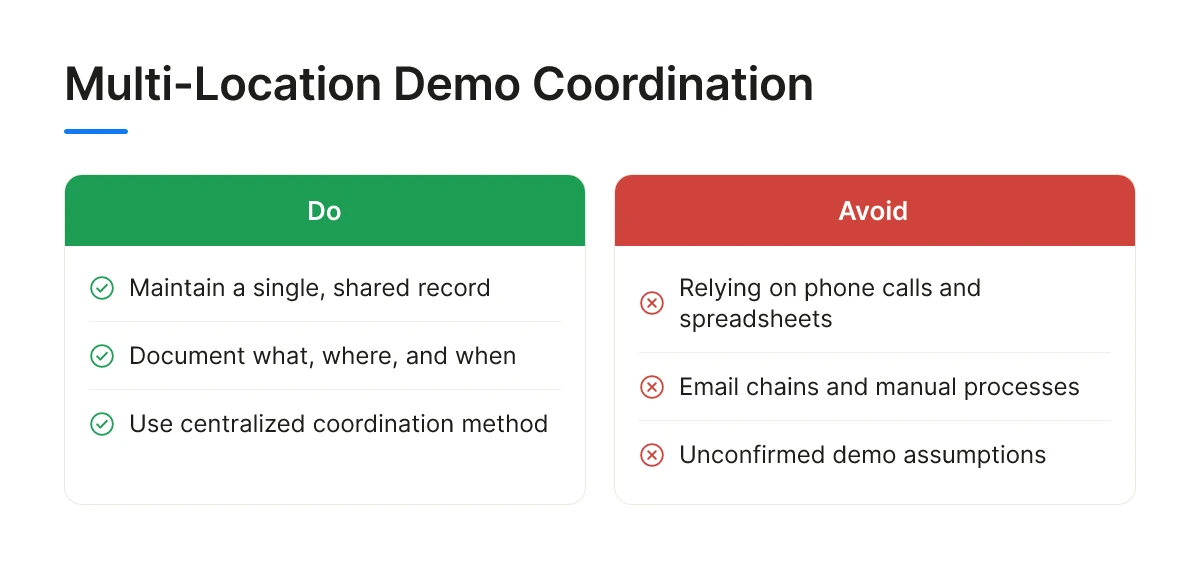
Automating demo compliance retail workflows means replacing phone calls, email chains, and paper sign-off sheets with one shared system that schedules the event, verifies it happened correctly, and records proof automatically. The mechanics are straightforward: a central calendar, a check-in step tied to location and time, and a dashboard that any authorized party can view without asking someone else for an update.
A centralized calendar is the starting point. When brand teams, retailers, and store staff all see the same schedule, there's no need for a coordinator to call a store manager to confirm a Saturday slot is still open, and no risk of two brands showing up for the same end-cap. Double-booking and unapproved setups happen when scheduling lives in separate spreadsheets and inboxes, a shared calendar closes that gap by design, not by extra effort from any one party.
It removes the back-and-forth that used to consume a store employee's morning: fielding vendor calls, manually approving each demo request, and verifying setup after the fact based on a phone photo texted to a manager. Compliance rules, approved footprint, time window, signage requirements, get encoded into the platform ahead of time. Ambassadors check in with photo proof at arrival, the system confirms the setup location matches the approved footprint, and start and end times are time-stamped against the store's approved window. None of that requires a store employee to intervene; the verification happens before and during the event, not after a complaint.
A shared platform gives store managers a live view of who is demoing what, where, and when, across every location in a chain, without requiring them to manage the schedule themselves. This is a coordination and verification layer built for ambassadors, store staff, and brand teams, it doesn't message or track individual shoppers, and it isn't a consumer engagement tool. Demo Wizard applies this model by combining scheduling, ambassador check-ins, and store-level performance data in one dashboard, so a retailer's regional manager can confirm compliance across dozens of stores without a single phone call.
A compliant program pairs verified execution, permits, footprint, check-in logs, with sales data, so every uplift number can be traced back to a demo that actually happened as planned.
Picture a beverage brand running weekend sampling across 40 grocery stores in three states. Each location needs a valid health permit for open-product sampling, a pre-approved footprint (often near the entrance or an end-cap, per the retailer's floor plan), and a check-in log the store manager signs off on before the ambassador pours a single sample. This directly impacts demo compliance retail outcomes.
None of that is optional paperwork. If a permit lapses in one county or an ambassador sets up in an aisle the store didn't approve, the retailer can shut the demo down mid-shift, and the brand loses the weekend's sampling volume in that store. Demo compliance retail programs that survive scale treat permits and footprint approval as scheduling inputs, not afterthoughts checked the morning of.
Photo compliance closes the loop. A verified setup photo, table position, signage, product display, timestamped at check-in, plus a check-out photo showing the area was left clean, gives both the retailer and the brand a record that doesn't depend on anyone's memory of how the Saturday went.
Units-sold-per-hour data means little on its own. A spike in sales during a demo window only counts as proof if it's paired with check-in verification confirming an ambassador was on-site, at the approved spot, for those hours, otherwise the brand can't rule out a rogue or partial demo, or a coincidental promotion running elsewhere in the store.
Demo Wizard's approach ties these together at the platform level: scheduling data, ambassador check-in/check-out timestamps, and store-level sales performance sit in one system, so a brand activation manager can filter for high-converting store-and-time combinations that were also fully compliant, and drop the ones that weren't.
Consistency compounds. A retailer that sees clean check-in records and signage compliance quarter after quarter starts trusting the brand with better real estate, front-of-store slots, more frequent roadshow windows, longer booking horizons. That trust, more than any single weekend's uplift number, is what turns a demo program into a growth lever.
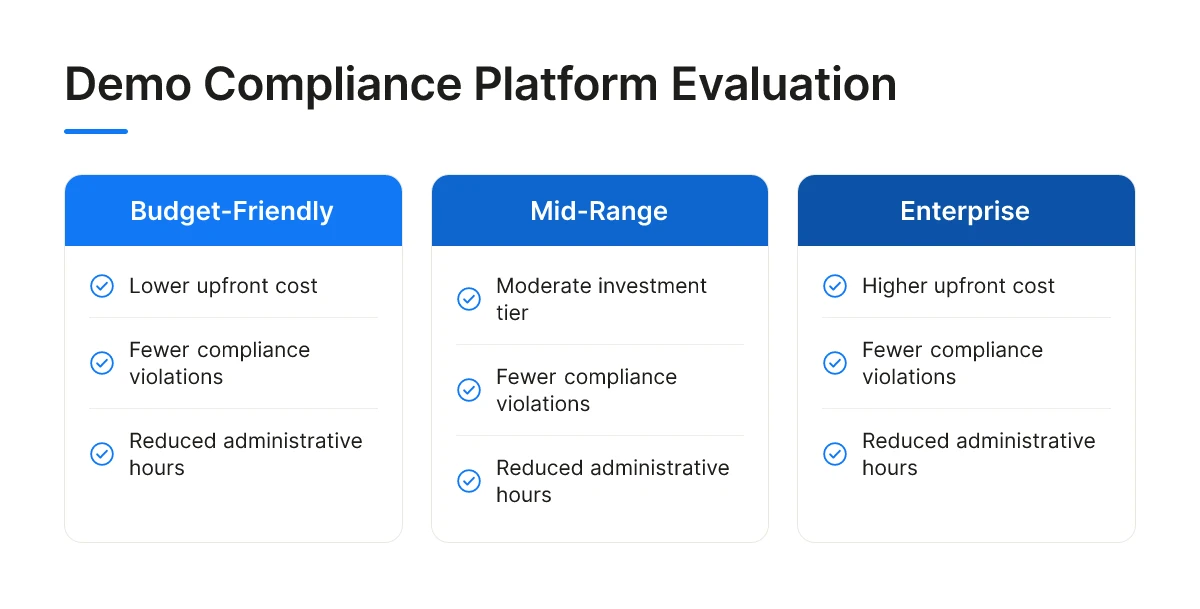
Compare platforms on cost tier against three returns: administrative hours saved, fewer compliance violations, and fewer canceled or reworked demos. That's the core framework for evaluating demo compliance retail investments, whether you're a mid-market CPG brand or an agency running events for multiple clients.
Start with the ongoing cost tier, budget-friendly, mid-range, or enterprise, and weigh it against what manual coordination actually costs today. A brand activation manager spending 15-plus hours a week on spreadsheets and phone calls is a real labor cost, even if it never shows up as a line item. This is particularly relevant for demo compliance retail.
Add in the cost of non-compliance: a demo that runs without required signage, an ambassador who shows up without the retailer's certificate of insurance on file, or a table set up in the wrong aisle. Each incident risks the retailer relationship, and repeated incidents can cost shelf space. Factor in canceled or reworked events too, a demo rescheduled because inventory didn't arrive or a store manager wasn't notified is money spent for zero sales lift.
Look at four functional areas rather than feature lists. First, real-time compliance verification, can the platform confirm a demo happened according to plan, not just that it was scheduled? Second, centralized visibility across every location, so a coordinator sees status for hundreds of stores in one view instead of checking in store by store.
Third, ambassador check-in and check-out tied to the actual store and time slot, which creates a verifiable record instead of a self-reported timesheet. Fourth, reporting that connects directly to sales data, conversion by store and time period, not just attendance counts. Demo Wizard's approach bundles these into one system: scheduling, ambassador management, and ROI tracking tied to experience-to-purchase conversion, so a single coordinator can manage hundreds of monthly events without hiring additional staff.
ROI on demo compliance retail tools shows up in three places: coordinator time freed up for strategy instead of logistics, fewer non-compliance flags that strain retailer relationships, and cleaner performance data to bring into renewal negotiations with retail partners. A generic all-in-one retail software suite can technically handle scheduling, but it wasn't built for the specifics of in-store demo logistics, inventory timing, ambassador payroll, per-store compliance rules. Tools built specifically for this use case reduce setup complexity because the workflows already match how demos actually run.
All three share responsibility, but the brand ultimately owns the risk when a demo goes wrong. Retailers set the rules (insurance, footprint, food handling), brand ambassadors execute them on the floor, and the CPG brand or agency that hired the ambassador is accountable for making sure those rules were communicated and followed in the first place.
Often yes, food and beverage sampling frequently requires health permits or food handler certifications that other product demos don't. Requirements vary by state, county, and retailer, so a hand-sanitizer demo and a cheese-sampling event at the same store can face very different documentation rules. When considering demo compliance retail, this point stands out.
Consequences range from a verbal warning to the store ending the demo on the spot and asking the ambassador to leave. Repeated violations can damage the brand's standing with that retailer, jeopardizing future shelf space or activation approvals well beyond the single event.
General retail compliance covers store-wide obligations like safety codes and labor law; demo compliance is narrower and event-specific. It's about whether a particular activation, on a particular day, at a particular store, followed that retailer's setup rules, local permit requirements, and the brand's own execution standards, not whether the store itself is operating lawfully.
Demo compliance breaks down in the gaps, between what a retailer expects, what an ambassador was told, and what a brand can actually prove happened. Closing those gaps means writing store-specific rules into every schedule, requiring photo and check-in verification at each event, and keeping a searchable record instead of scattered texts and spreadsheets.
Demo Wizard builds that record automatically: every scheduled event, ambassador assignment, and performance report lives in one place, so a coordinator can show a retailer exactly what happened at store level without digging through email threads. Start by auditing one multi-state campaign's compliance paperwork this week, if you can't produce it in under five minutes, that's the process to fix first.
Explore more from our content library:
About the Author
Written by the SaaS / Retail Marketing Technology experts at Demo Wizard. Our team brings years of hands-on experience helping businesses with SaaS / Retail Marketing Technology, delivering practical guidance grounded in real-world results.
Demo Wizard is the Ultimate Store Sampling & Demonstration management software for Brick and Mortar Retailers and CPG Vendors.
Chat with usPhone