
Demo Wizard is the Ultimate Store Sampling & Demonstration management software for Brick and Mortar Retailers and CPG Vendors.
Chat with us

Phone
Copyright © 2026 Demo Wizard
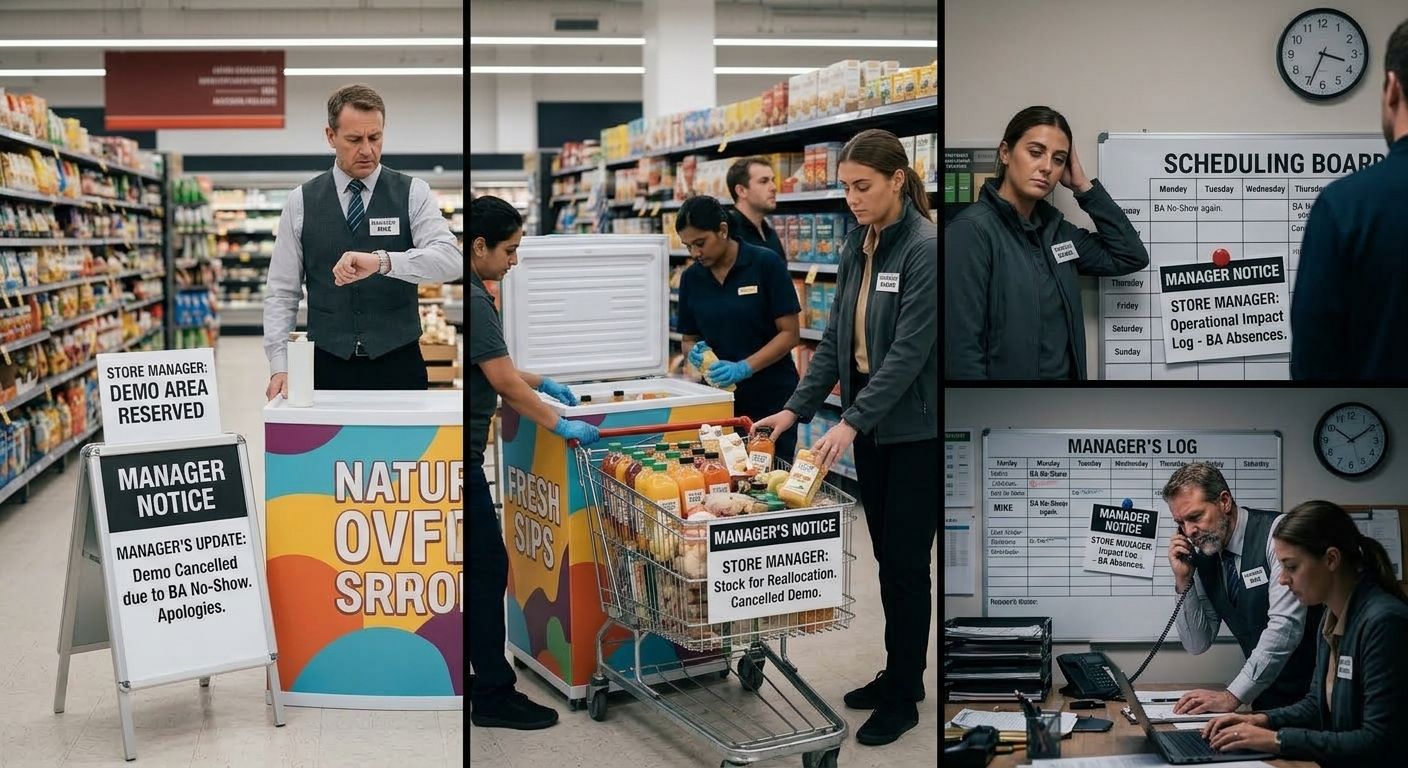
Demo staff no-shows happen when brand ambassadors fail to arrive for scheduled in-store product demonstrations, typically due to scheduling conflicts, last-minute cancellations, or breakdowns in communication between brands, distributors, and staffing agencies. Each no-show costs a CPG brand the demo day's labor spend, lost sampling-driven sales lift, and wasted perishable inventory, while leaving retailers with an unstaffed table and unplanned disruption to store operations. Centralized scheduling platforms with automated confirmations and real-time visibility reduce no-shows by closing the communication gaps that cause them.
Most demo staff no-shows trace back to fragmented scheduling and communication gaps between brands, distributors, and staffing agencies rather than staff unreliability.
The instinct is to treat a missed shift as a personnel problem, someone forgot, someone flaked. In practice, the root cause is usually structural. Brands, brokers, demo agencies, and retailers each operate their own calendars, spreadsheets, and messaging threads, and none of them talk to each other. A shift can look confirmed in one system and unassigned in another, and nobody finds out until a table sits empty on a Saturday morning.
Scheduling conflicts happen because brands, distributors, and staffing agencies each keep a separate calendar with no shared source of truth for who is booked where and when. A brand ambassador can be marked available in an agency's spreadsheet while a distributor has already penciled her into a competing account for the same time slot.
Retailers compound the problem by changing plans on short notice, moving a demo table from the front lobby to a back aisle, or issuing a blackout date because of an unrelated store event. That change has to pass through several manual handoffs, a retailer email to a broker, a text from the broker to a field manager, a phone call from the field manager to the ambassador, before it reaches the person actually walking in the door. Any one of those handoffs can drop the message, and demo staff no-shows are often just the last link in that chain failing.
Without a live view of who's confirmed for which shift, a brand or agency typically doesn't discover a table is unstaffed until the scheduled start time comes and goes with no check-in. By then it's too late to send a replacement, and the perishable inventory staged for that day goes unsold.
Two factors make this worse. First, most in-store demo staffing runs on an independent contractor or gig model, which means ambassadors routinely work for multiple brands and agencies in the same week, raising the odds of accidental double-booking when nobody has cross-visibility into their full schedule. Second, without automated reminders or a confirmation step built into the workflow, a shift can drift from "assigned" to effectively forgotten with no alert firing for anyone. Attack Marketing's review of common in-store demo mistakes points to poorly staffed or unenthusiastic execution as a recurring failure point in retail activations [1], and an unconfirmed, unmonitored shift is often the upstream cause.
A missed demo drains the brand's budget on sunk costs, kills that day's sales lift, and forces store staff to absorb work they never signed up for. Left unmanaged across dozens of stores, demo staff no-shows stop being an isolated inconvenience and start compounding into a real drag on campaign margins and retailer trust.
The direct costs hit whether or not an ambassador shows up. The brand has already shipped product to the store, paid for staging materials like tables, signage, and coolers, and in many cases paid the retailer a booking fee to reserve the slot. None of that is refundable just because the person scheduled to run the table never arrived.
The bigger loss is often the sales lift that never happened. In-store sampling exists to convert foot traffic into trial and purchase on the spot, a Saturday afternoon slot at a high-traffic store carries far more potential lift than a Tuesday morning. When demo staff no-shows fall on exactly those premium weekend windows, the brand loses its highest-value opportunity for that market, not an average one.
Poor execution also compounds the cost indirectly. Industry guidance on common in-store demo mistakes points to unclear objectives and weak measurement as recurring reasons campaigns underdeliver [1], a no-show is the most extreme version of that failure, since there is no execution to measure at all.
The retailer absorbs a share of the fallout too. Store associates who had nothing to do with booking the demo end up fielding shopper questions about the empty table, clearing away signage and leftover product, and sometimes storing or returning inventory the brand shipped in advance. That's time pulled from stocking shelves, running registers, or helping other customers.
Repeated no-shows change how a retailer views the brand relationship. A store manager who has dealt with several no-shows becomes reluctant to grant that brand prime real estate, entrance tables, end-caps, high-traffic weekend slots, because the retailer's own operations took the hit last time.
These costs scale badly under fragmented coordination. A brand running a handful of demos a month might absorb one no-show without much notice. A brand or agency coordinating hundreds of monthly events across spreadsheets and phone calls has far less visibility into which ambassador is confirmed where, and no early warning system when someone drops out. Demo Wizard's scheduling and ambassador management tools address this by giving a single coordinator visibility into every location's staffing status, so a gap gets caught and backfilled before it becomes a wasted shipment and a frustrated store manager.

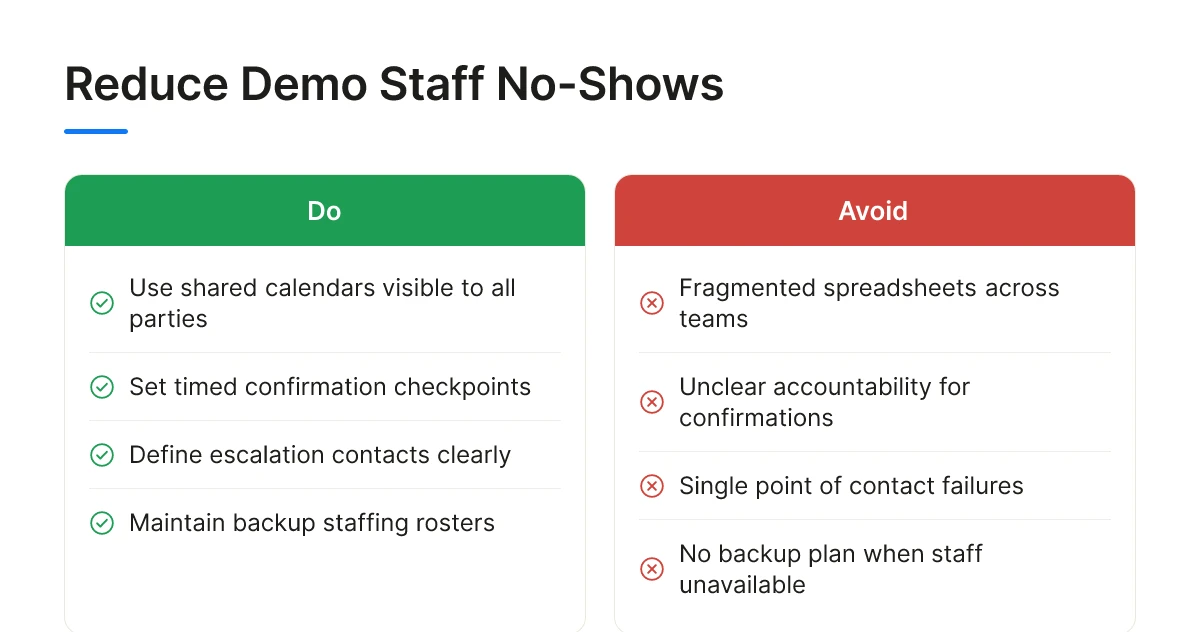
Five coordination practices close most of the communication gaps that cause demo staff no-shows: shared calendars, timed confirmations, defined escalation contacts, backup staffing, and immediate flagging when someone doesn't show.
A shared calendar visible to the brand, distributor, agency, and store manager removes the version-control problem that fragmented spreadsheets create. When a CPG brand's regional manager, a broker's field coordinator, and a store's department head each keep their own copy of the schedule, discrepancies surface only after an ambassador fails to appear. A single source of truth means everyone, including the retailer, sees the same confirmed slot, the same ambassador name, and the same status update in real time.
Automated confirmation requests add a second layer of accountability. Sending a confirmation request several days before a shift, followed by a same-day reminder, forces an explicit accept or decline rather than assuming silence means commitment. An ambassador who declines 48 hours out gives the coordinator time to fill the slot; one who never responds at all is a signal worth flagging before the shift, not after the display sits empty.
A defined protocol specifying exactly who contacts whom when a conflict arises stops cancellations from falling into the gap between distributor and store. Without that clarity, an ambassador might notify the staffing agency, which assumes the store has been told, while the store manager only discovers the empty table at the scheduled start time, a breakdown identified as a root cause of poor in-store demo execution [1].
Two additional practices reduce the operational damage once a gap appears. First, a bench of pre-vetted backup ambassadors, screened and trained in advance, lets a coordinator trigger a replacement within minutes instead of scrambling to recruit someone unfamiliar with the product. Second, a clear escalation path lets the store manager flag a no-show the moment it's discovered, a direct line to a named coordinator, not a generic inbox, so a Saturday morning gap gets addressed before peak foot traffic rather than after the weekend roadshow has already lost its window.
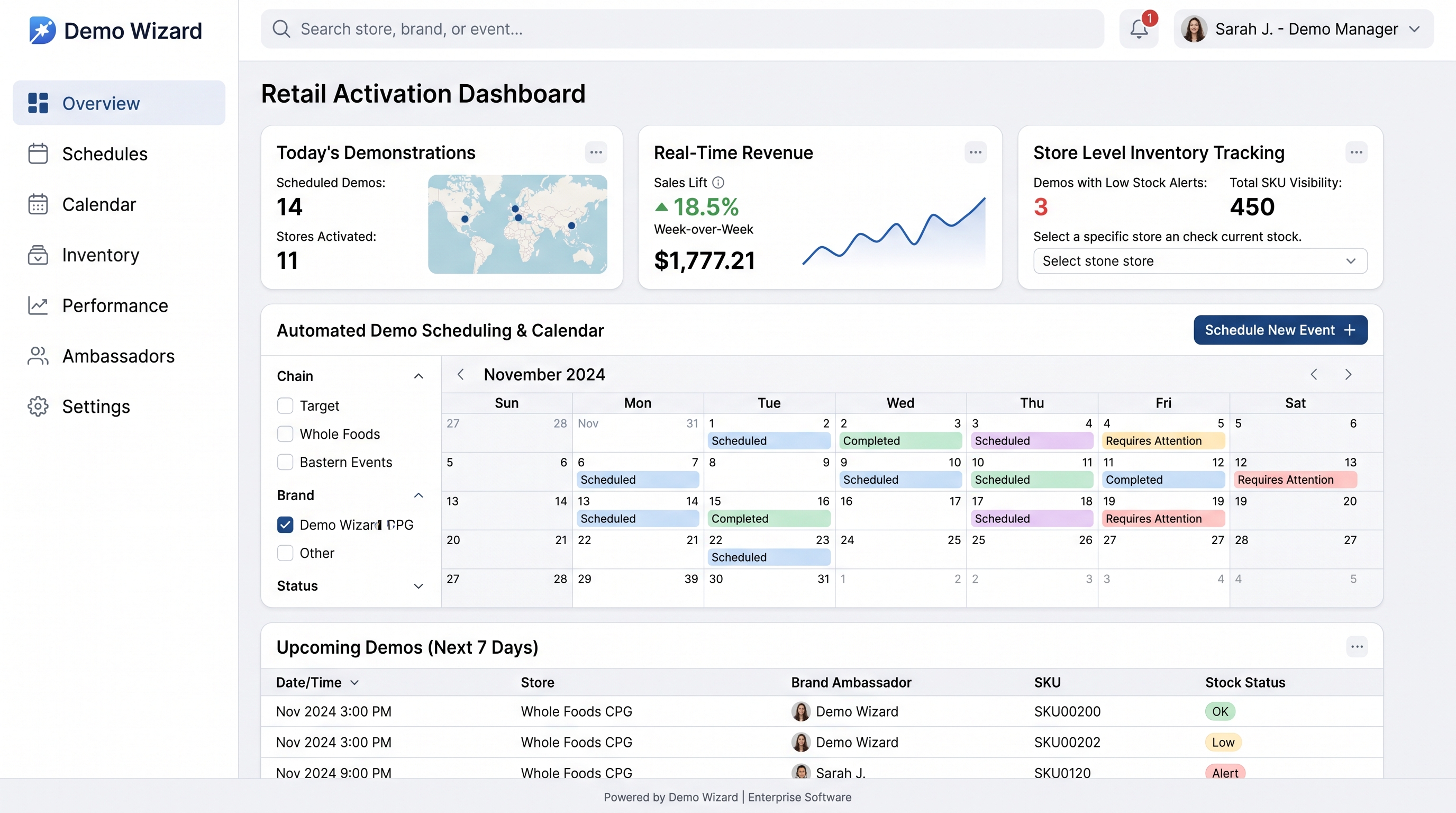
Coordination software prevents demo staff no-shows by replacing manual chasing with automated reminders, real-time check-ins, and one shared schedule everyone can see.
The prior section covered the practices, buffer scheduling, backup rosters, confirmation calls. The question is what mechanically enforces those practices when a coordinator is managing 40 stores instead of four. That's the gap software closes: not by adding people, but by removing the manual steps where things fall through.
A single coordination system lets one person manage hundreds of monthly demo events across many stores without hiring additional staff to handle the logistics. Demo Wizard is built around exactly this scope: scheduling, ambassador management, and payroll processing in one platform, so a brand activation manager doesn't need a spreadsheet for scheduling, a separate phone tree for confirmations, and a third system for payroll.
When those functions live in one place, there's no gap between "the ambassador was assigned" and "the ambassador knows and confirmed." That gap, not lack of effort, is where most missed shifts originate. Consolidating the workflow doesn't just save time; it removes the specific handoff points where a shift assignment gets lost in an inbox or a text thread.
Automated reminders sent ahead of a scheduled shift replace the manual phone and email chasing that coordinators previously did one ambassador at a time. Instead of a coordinator working down a call list the night before an event, the system pushes reminders automatically and flags anyone who hasn't acknowledged the shift.
Geo-based or app-based check-in adds the second layer: confirmation that an ambassador is physically on-site when the shift starts. If a shift goes unstaffed, the brand and the store manager get an alert immediately rather than discovering the empty table an hour into a Saturday roadshow.
For retailers, centralized visibility matters as much as the alert itself. A shared calendar showing every vendor's demo activity in one location, instead of a string of one-off calls from different brands and brokers, reduces disruption for store staff and gives management a single reference point for what's happening on their floor each week.
The net effect is a shift from reactive firefighting to proactive prevention: problems surface before the shopper notices, not after the campaign report shows a dead Saturday.
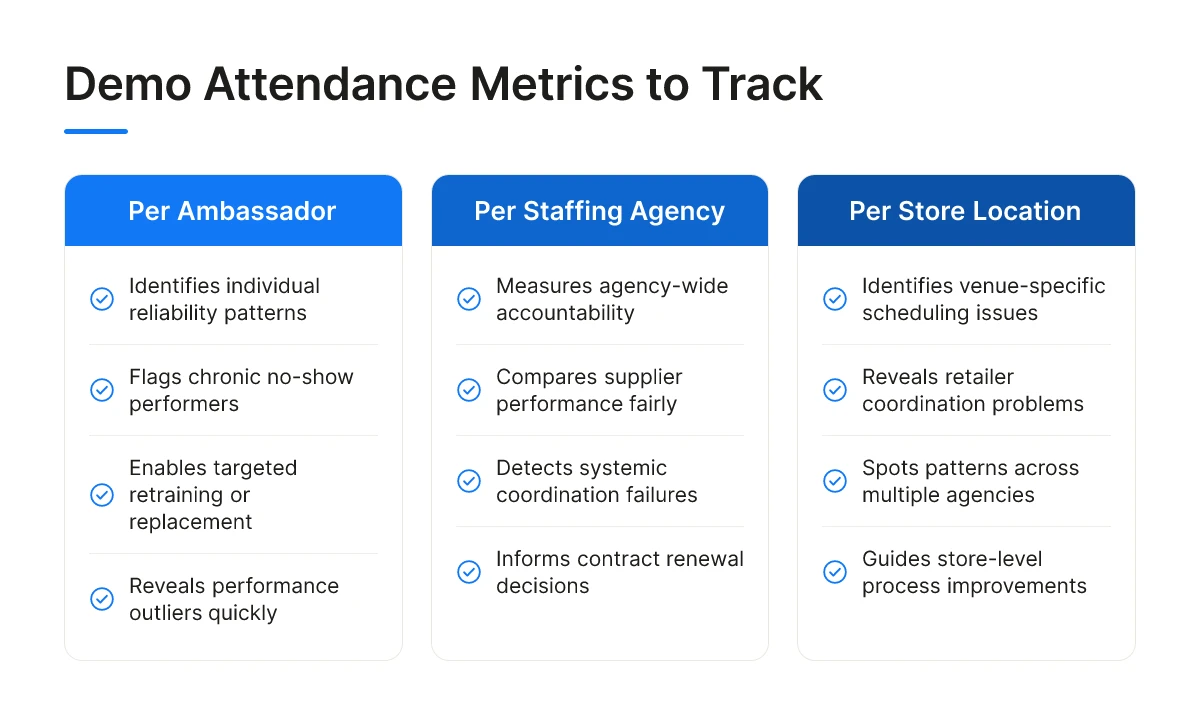
Four metrics turn demo staff no-shows from a recurring frustration into a measurable, budgetable line item: attendance rate, no-show frequency over time, sales lift correlation, and check-in compliance.
Attendance rate is the starting point: the share of scheduled demo shifts that were actually staffed and completed. Track it three ways, per ambassador, per staffing agency, and per store, because a single blended number hides which layer of the operation is failing. An ambassador with a 70% attendance rate dragging down an otherwise reliable agency average looks very different from a store location where three different agencies all struggle to keep shifts covered.
No-show frequency only becomes useful when trended, not counted as isolated incidents. A single Saturday miss at one store is a scheduling hiccup; a pattern of Friday-afternoon no-shows across five stores staffed by the same partner is an operational problem worth escalating. Trending by day of week, location, and staffing partner surfaces patterns that a monthly total obscures.
The metric that makes this concrete for a budget conversation is sales lift correlation, comparing units sold on fully staffed demo days against days when the demo was unstaffed or started late. Brands running roadshows and high-volume sampling events already track units sold per hour as a matter of course; applying that same lens to no-show days quantifies exactly what a missed shift costs, rather than treating it as a soft inconvenience. Attack Marketing's review of common in-store demo mistakes points to poorly staffed or unenthusiastic execution as a recurring driver of underperforming activations [1], which is the same failure mode a no-show produces at the extreme.
Photo and check-in compliance rounds out the picture as a proxy for execution quality. A completed shift isn't automatically a well-run one, geo-tagged check-ins and photo confirmation show whether the display was set up correctly, inventory was staged, and the ambassador followed the brand's standard, not just that someone clocked in.
A single universal attendance target misreads the differences between channels. Club stores run longer, higher-traffic events with more inventory staging and different staffing models than a grocery chain's weekend sampling slot or a specialty retailer's smaller-footprint activation. Benchmarking reliability separately by channel, club, grocery, specialty, lets brands and coordination platforms like Demo Wizard set realistic targets and flag underperformance against the right baseline, rather than penalizing a channel for structural differences that have nothing to do with staffing discipline.
Yes, one missed demo can cost a brand the shelf space or event slot it took months to negotiate. Retail buyers track vendor reliability, and an empty table during a promised activation signals poor execution. Repeated no-shows, even at a single store, often surface in the next line review.
A backup pool works better than routine overstaffing, which raises costs without guaranteeing coverage. Brands and agencies get more value from maintaining a bench of trained, on-call ambassadors tied to a scheduling system that can reassign a shift within hours rather than paying for redundant staff at every event.
Ideally within minutes of the scheduled start time, not hours later. A check-in system that flags a missed arrival immediately gives coordinators time to notify the store and, where possible, dispatch a replacement before the shift window closes.
Often yes, because smaller brands typically rely on fewer ambassadors and lack backup staffing arrangements. Without a scheduling system to track availability and confirm coverage in advance, a single cancellation can leave a small brand with no one to run the event.
Demo staff no-shows are a scheduling and visibility problem before they're a staffing problem. Brands and retailers that catch a cancellation early, keep a backup ambassador pool, and track attendance by store and time period lose far less revenue than those relying on spreadsheets and phone calls. Demo Wizard's scheduling and ambassador management tools give coordinators that visibility without adding headcount. Start by auditing your last quarter of scheduled demos against completed ones, that gap is your real no-show cost, and it's the number that should shape your next staffing decision.
Explore more from our content library:
About the Author
Written by the SaaS / Retail Marketing Technology experts at Demo Wizard. Our team brings years of hands-on experience helping businesses with SaaS / Retail Marketing Technology, delivering practical guidance grounded in real-world results.
Demo Wizard is the Ultimate Store Sampling & Demonstration management software for Brick and Mortar Retailers and CPG Vendors.
Chat with usPhone