
Demo Wizard is the Ultimate Store Sampling & Demonstration management software for Brick and Mortar Retailers and CPG Vendors.
Chat with us

Phone
Copyright © 2026 Demo Wizard
Understanding cost per sample retail is essential. The cost per sample in a retail demo program is the total expense of executing one in-store product demonstration divided by the number of consumers sampled or units distributed during that event. It includes labor for the brand ambassador, product cost, equipment and materials, scheduling or coordination overhead, and any retailer fees, not just the price of the sample itself. Brands that track this figure accurately can compare demo events across stores, spot where coordination inefficiencies are inflating costs, and tie spending directly to sales lift and conversion.
Cost per sample is a simple ratio: total demo event cost divided by the number of consumers reached or units distributed during that event. It is not a pricing formula, a markup calculation, or anything a shopper sees on a shelf tag, it is an internal operations number a CPG brand uses to judge how efficiently a demo spent its budget.
The "total cost" side of that ratio covers more than the sample itself. It includes brand ambassador labor, product given away, table or equipment rental, scheduling and coordination overhead, and any fees the retailer charges to host the event. A demo that hands out 300 samples for a fixed budget has a very different cost per sample than one that hands out 80 samples for the same spend, even if the product and staffing look identical on paper.
Retail pricing and markup formulas answer a completely different question: what should a shopper pay for the product on the shelf. Those calculations factor in wholesale cost, retailer margin requirements, and competitive positioning, none of which touch what it costs the brand to run a demo event.
Cost per sample retail tracking, by contrast, never touches the shelf price at all. It measures execution efficiency: how much a brand spent internally to get product into a consumer's hands during a live demonstration. A brand can sell a product at a healthy retail margin and still run demo events with a bloated cost per sample if scheduling breakdowns, no-show ambassadors, or wasted product inflate the operational side of the equation.
Brands track cost per sample because it creates an apples-to-apples comparison across stores, regions, and time periods. Without it, a brand activation manager running demos in 40 stores has no consistent way to tell whether a Saturday event at one Costco outperformed a Tuesday event at another, the raw dollars spent mean nothing without a per-sample denominator attached [5].
Retailers have a stake in this number too, even though the brand usually pays for the event. A demo with a high cost per sample often signals deeper problems, understaffing, poor scheduling, or product waste, and those problems tend to show up as disruption on the retail floor: blocked aisles, confused store employees, or coordination requests that pull staff away from other duties. An efficient demo program, tracked and compared consistently, reduces that friction for everyone involved, which is part of why platforms like Demo Wizard build cost and performance tracking into the scheduling process rather than treating it as an afterthought.
True cost per sample retail equals total direct costs plus allocated overhead, divided by samples distributed, not just the price of the product given away.
Most brand managers start and stop at product cost: a case of yogurt cups divided by the number of samples poured. That number looks clean on a spreadsheet, but it has almost nothing to do with what the event actually cost the brand. A demo that "costs" 20 cents a sample in product can easily run $8 to $12 a sample once every input is counted.
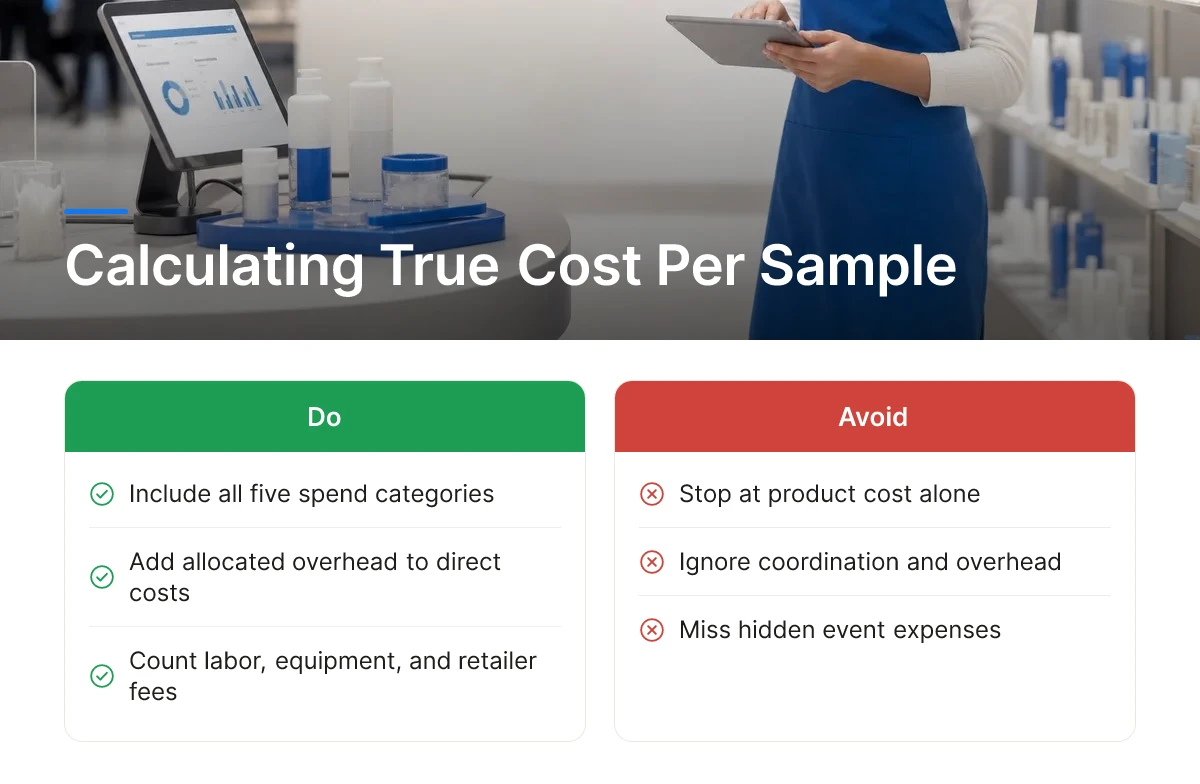
A complete calculation pulls in five categories of spend, not one.
Skip any one of these and the resulting figure understates the real cost of the event, sometimes by a wide margin. Industry guides on in-store demo pricing note that a full program includes trained specialist demonstrators, not just a body behind a table, which is itself a labor cost most naive calculations omit entirely [1].
Coordination overhead is the piece brands most often forget, and it's frequently the largest hidden line item in the whole calculation.
Every demo event generates a string of phone calls to confirm store availability, email chains with the ambassador about start times, and paperwork reconciliation with the distributor over units shipped versus units used. None of that shows up on a receipt, so it never makes it into a spreadsheet, but the hours are real and they belong to someone's salary. A brand running 40 events a month with a coordinator spending even 20 minutes per event on logistics has absorbed a full workweek of unallocated labor before a single sample is poured.
The formula, stated plainly: (ambassador wages + product and consumables + equipment + transportation + allocated coordination hours) ÷ samples distributed or shoppers engaged. Run that math across a full campaign, not a single event, and the gap between the naive product-only figure and the true cost per sample retail becomes hard to ignore.
Four variables move cost per sample retail more than any others: where the demo happens, how long it runs, whether staffing goes smoothly, and how many locations a brand is trying to coordinate at once.
Placement changes the denominator in the cost-per-sample equation without changing the numerator. A demo station positioned near the entrance or on a high-traffic endcap exposes the product to far more shoppers per hour than a table tucked in a back aisle, and a demonstrator working a busy Costco floor can drive thousands of dollars in product sales during a single shift, while an identically staffed, identically priced demo in a slow-traffic zone can produce almost nothing [5]. Same cost. Wildly different result. That gap is why negotiating for prime real estate, near checkout queues or store entrances, matters as much as the demo itself, since foot traffic determines how many samples get distributed for the same fixed labor cost.
Duration works differently. Every demo carries fixed costs: setup, breakdown, table rental, signage, and the first 15-20 minutes of a demonstrator getting shoppers to stop. A two-hour demo spreads those fixed costs over relatively few samples, pushing cost per sample higher. A four- to eight-hour shift dilutes that same fixed cost across many more interactions, which is part of why longer, well-staffed demo shifts tend to outperform short ones on a per-sample basis [3]. Multi-day roadshow-style activations dilute fixed costs even further, but they raise total campaign spend and staffing complexity, more shifts to fill, more inventory to forecast, more chances for something to go wrong mid-run.
An ambassador who no-shows doesn't just cost a wasted booking, it can zero out an entire event's sample count while the fixed costs (product, table, retailer coordination time) still land on the invoice. Last-minute staffing scrambles, rebooking cycles, and the phone calls needed to find a replacement all add coordination hours that never show up in the demo budget line but absolutely show up in the cost-per-sample math. Effective in-store demo programs treat scheduling and dynamic staffing as core execution risk, not an afterthought [2].
The overhead compounds as brands scale. Coordinating five demos across five stores by phone, email, and spreadsheet is manageable; coordinating 200 monthly events across 20 states through the same fragmented channels multiplies communication touchpoints between the brand, distributors, retail store managers, and ambassadors, and every extra touchpoint is a place where a schedule slips or a sample count goes unreported. Platforms like Demo Wizard address this directly by centralizing scheduling, ambassador assignment, and payroll in one system, letting a single coordinator manage hundreds of monthly events without the fragmented back-and-forth that inflates cost per sample as campaigns grow.
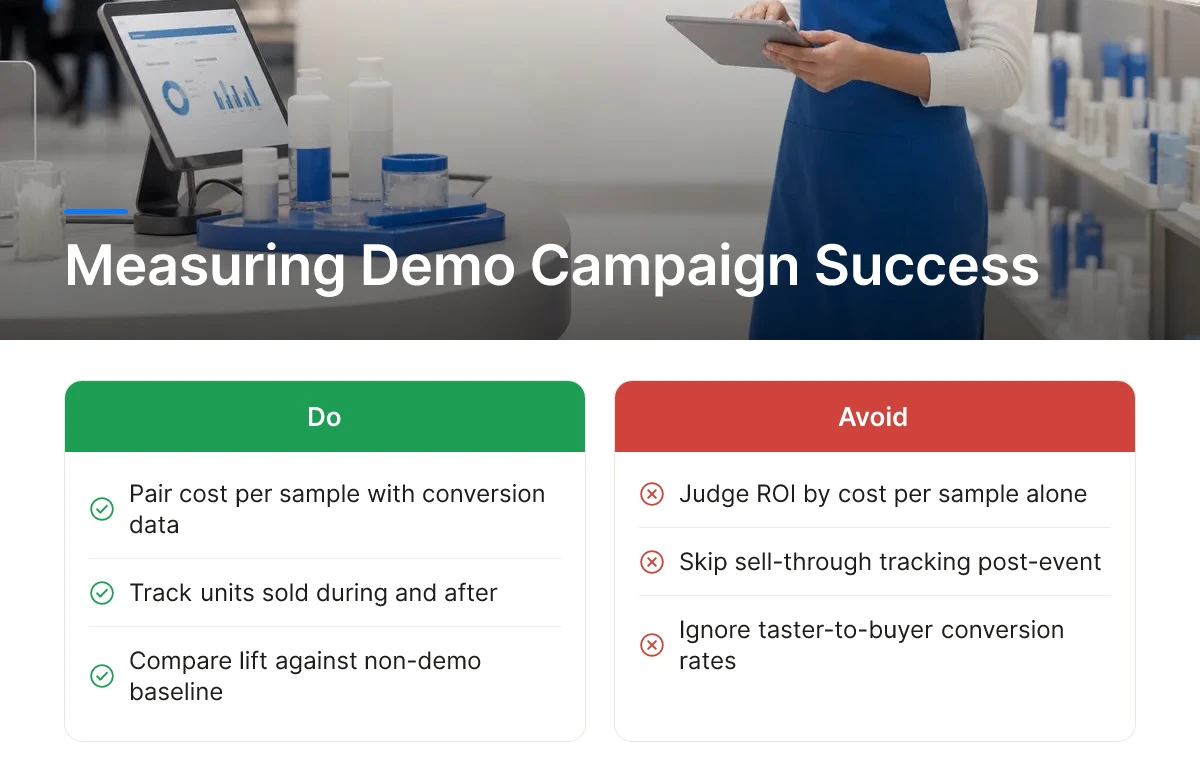
Cost per sample retail only tells half the story, the number becomes meaningful once it's paired with conversion data showing units sold during and after the demo.
A brand spending more per sample but converting a higher share of tasters into buyers is outperforming a cheaper program with weak follow-through. Cost alone can't answer that question. It takes a demo team logging units moved, tracking sell-through in the days after the event, and comparing that lift against what the same store sold without a demo running.
No universal number defines an acceptable cost per sample, because store format, category, and region all shift the math too much for one benchmark to apply everywhere. A premium frozen food demo at a warehouse club draws a different crowd and a different labor cost than a snack sample at a regional grocery chain. Rather than chasing an industry-wide figure, brands get more value building an internal baseline: track cost per sample across their own store types, categories, and seasons, then compare campaigns against that history rather than against a competitor's number. A brand running demos in 40 stores over a year builds a dataset showing which chains, which weekends, and which product lines return the strongest conversion per dollar spent, and that internal comparison matters more than any published average.
The mechanism is straightforward: placing the sample next to the buyable product removes the gap between trying something and buying it. Sampling that requires a shopper to remember the product later and find it on a different aisle loses much of its conversion power. In-store demonstrations convert engaged shoppers at rates far above typical retail and e-commerce benchmarks [3], and that lift depends heavily on how short the path from taste to cart actually is. A higher cost per sample next to a well-stocked display can still deliver stronger ROI than a cheaper demo that separates trial from purchase.
Day-of unit counts also miss the fuller picture. Tracking repeat purchase behavior in the weeks following a sampling event, whether through loyalty card data, retailer POS reports, or distributor sell-through, shows whether the demo created a habit or just a one-time bump. Platforms like Demo Wizard support this by tying store-level and time-of-day performance data to ROI metrics, so brand teams can see not just what a demo cost, but what it produced over time.
The fastest way to lower cost per sample retail is to cut the administrative hours spent coordinating each event, not the labor or product quality at the table. Most of that cost hides in scheduling, not staffing.
Manual coordination, phone calls to ambassadors, spreadsheets shared over email, and back-and-forth between brand, distributor, and store manager, is one of the biggest hidden cost drivers in a demo program. Every reschedule or miscommunication adds hours that never show up on a per-event budget line but still get paid for somewhere.
Scheduling and tracking software removes most of that overhead by putting availability, assignments, and store details in one system instead of three inboxes. A brand activation manager coordinating 50 demos a month can confirm ambassadors, send store-specific instructions, and log completed visits without a chain of individual phone calls for each one.
Centralized visibility into a shared demo calendar also prevents the specific failures that inflate per-event cost: double-booked ambassadors, no-shows nobody catches until the shift starts, and last-minute scrambles to find a replacement. Each of those failures either wastes a paid shift entirely or forces a rushed, lower-quality substitute, both push cost per sample up without adding any sales lift to offset it.
Three practices consistently lower cost per sample without cutting corners on the shopper experience.
Demo Wizard fits into this by helping CPG brands, retailers, and demo companies schedule, coordinate, and track the ROI of in-store demos and activations. It coordinates ambassadors and events, confirming who is working which store and when, and reporting back on performance by location and time, not communication with individual shoppers.
Retailers see a parallel benefit. When a coordination platform handles vendor communication and enforces compliance automatically, store employees stop absorbing the burden of managing brand ambassador schedules, chasing paperwork, and fielding distributor calls. That removes labor cost from the retailer's side of the equation, even though the retailer never pays directly for the sample itself.
No, a higher cost per sample can still deliver better ROI if conversion rates and basket size rise enough to offset it. A $6 demonstrator shift that drives a purchase from one in three shoppers often outperforms a cheap table where no one buys anything, as seen in demo stations that generate zero conversions despite steady sample volume [5].
Not directly, the two channels measure different behaviors and rarely convert at comparable rates. In-store demos let shoppers taste, touch, or test a product at the point of decision, which digital sampling cannot replicate [2], so comparing raw cost per unit without accounting for conversion context misleads more than it clarifies.
Recalculate after every campaign cycle, and immediately after any change in staffing, store mix, or product cost. Brands running frequent multi-store programs benefit from reviewing performance by store and time period to catch cost drift before it compounds across dozens of locations.
Yes, retailers influence cost per sample through logistics even when they don't control brand spend. Centralizing demo scheduling, reducing scheduling conflicts, and cutting the staff time spent coordinating with vendors and ambassadors lowers the operational overhead layered on top of the brand's own demo costs.
Cost per sample only means something next to conversion data, a cheap demo that moves no product costs more than an expensive one that sells out. Brands should track cost alongside units sold per shift, not in isolation, and retailers should treat scheduling and coordination overhead as a real cost driver, not overhead they can ignore.
Platforms like Demo Wizard address this by pairing demo scheduling with post-demo conversion tracking, so a coordinator managing hundreds of monthly events can see which stores and time slots justify their cost. Start by pulling last quarter's demo spend against store-level sales lift to find your worst-performing location.
Explore more from our content library:
Demo Wizard is the Ultimate Store Sampling & Demonstration management software for Brick and Mortar Retailers and CPG Vendors.
Chat with usPhone