
Demo Wizard is the Ultimate Store Sampling & Demonstration management software for Brick and Mortar Retailers and CPG Vendors.
Chat with us

Phone
Copyright © 2026 Demo Wizard
Understanding proof of execution retail demos is essential. Proof of execution in retail demos means having timestamped photos, location data, and structured reports that confirm a demo happened on schedule, at the right store, and matched brand standards for setup and staffing. Brands now demand this because verbal or paper reports from ambassadors and demo companies can't be audited, leaving gaps between what was planned and what shoppers actually saw. Photo verification and automated documentation close that gap, turning demo execution into data brands can tie to sales and use to hold agencies accountable.
A verbal recap tells a brand manager what an ambassador remembers; documented proof tells them what a camera and a timestamp recorded. That difference is the entire problem proof of execution retail demos is meant to solve.
Picture the two versions of the same Saturday activation. Version one: an ambassador texts the regional manager, "Demo went well, sampled about 200 people, store was busy." Version two: a photo of the fully stocked sampling station at 10:02 a.m., a geolocated check-in confirming the ambassador was physically at the correct Kroger on Route 9, and a closing photo at 2:00 p.m. showing depleted inventory. The first is a claim. The second is a record a brand can audit, compare across stores, and defend if a retailer or finance partner asks for evidence.
Without that record, brands are trusting secondhand reports from people who are sometimes paid based on those same reports, a structural conflict of interest that has nothing to do with anyone's honesty and everything to do with incentives.
Three mistakes show up repeatedly when brands rely on unverified reporting. Brands pay ambassadors or agencies for demos that never happened, a no-show gets logged as completed because nobody was there to check. Sampling counts get rounded up or estimated, so a brand budgets against 200 consumer trials that were actually closer to 80. Setup errors go unnoticed entirely: wrong signage, a table placed near the back exit instead of the endcap, missing badges or uniforms that make the activation look unofficial to shoppers walking by.
Each of these mistakes is invisible in a text message or a weekly recap email. They only surface once sales data comes in flat and nobody can explain why.
Traditional store audits check a sample of locations after the fact, not every activation while it's happening. A regional team might audit 10% of stores once a quarter, which means the other 90% of demos run entirely on trust [1]. By the time an auditor visits, the roadshow is over, the pallet is gone, and any execution failure has already cost the brand a weekend of lost conversion.
Real proof covers the specifics brand standards actually spell out: signage in the agreed location, staff wearing the correct uniform and badge, product displayed per the merchandising guide, and the sampling station set up with the right inventory and layout. Each element needs its own visual record because a single photo of a smiling ambassador proves nothing about whether the rest of the setup matched what the brand paid for [4].
A structured sequence of check-in, photo capture, and timestamped recap turns a demo from a story someone tells you into a record you can check yourself. That sequence is the actual mechanism behind proof of execution retail demos, and it works the same way whether the event is a single Saturday sampling table or a full roadshow.
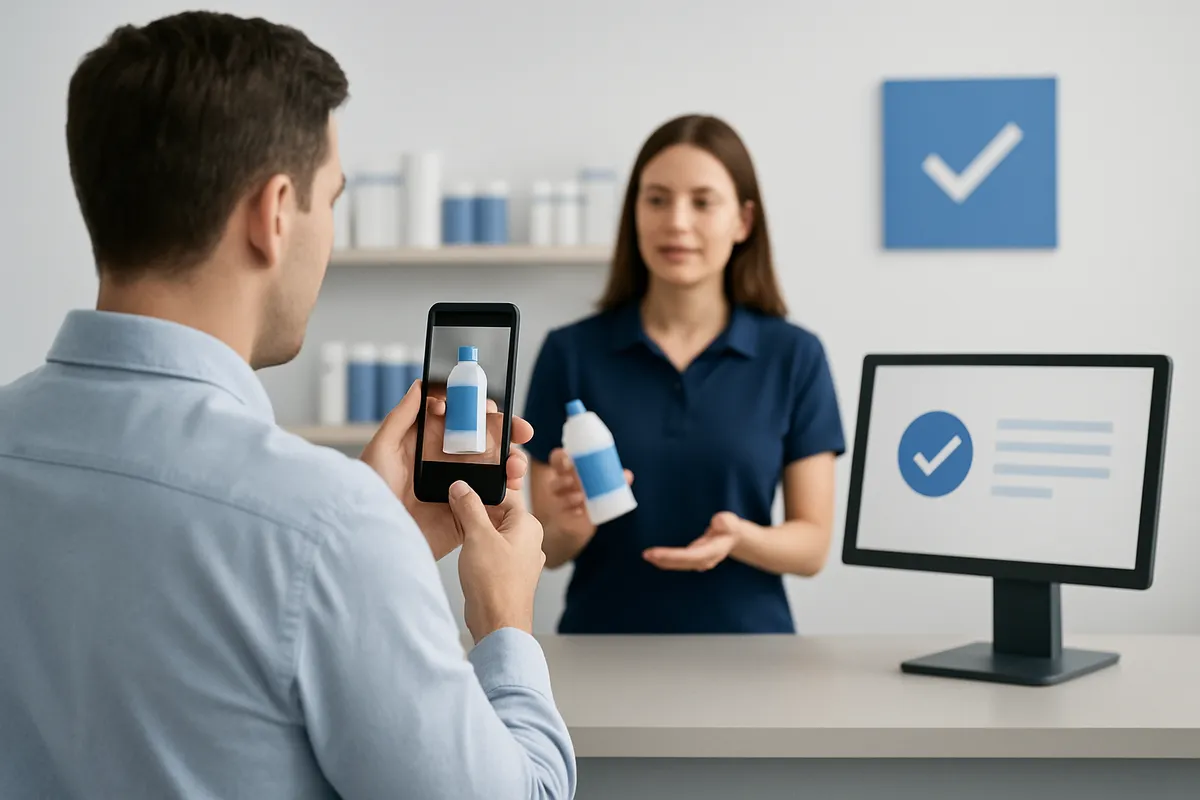
The mechanism is straightforward. A brand ambassador opens the app at the assigned store and checks in, which timestamps and geolocates the start of the shift. Before setup and again once the table or display is live, the ambassador photographs the station, signage, product stock, and placement all visible in frame. At the end of the shift, the ambassador submits a structured recap: units sampled, shopper interactions, stock remaining, any issues encountered. Every piece ties back to a specific store, date, and time slot, not a generic weekly summary.
Traditional store audits confirm that a visit happened, not what the shopper actually experienced [1]. The same gap shows up in demo programs that rely on assumed execution: a coordinator schedules the event, staffs it, and moves on, trusting that a completed booking means a completed demo.
Flagging a missed check-in or a missing photo the same day changes what that failure costs. If an ambassador no-shows on a Tuesday and nobody notices until the month-end report, the brand has lost a full week of planned activations across possibly a dozen stores before anyone corrects course. Same-day detection means a coordinator can rebook the slot, alert the distributor, or adjust inventory before the next scheduled visit, catching a small problem before it becomes a wasted campaign week.
A shared, timestamped record replaces four separate versions of what happened with one version everyone can see. The distributor confirms product arrived and was delivered on schedule. The ambassador's photos confirm the setup matched brand standards. The retailer can check the same log to confirm shelf placement and that the activation didn't disrupt store operations. No party has to take another party's word for it, because the record, photo, timestamp, location, is the same one all four groups pull from.
No federal agency or industry board certifies demo documentation, the rules come from individual retailer policies and each brand's own compliance team, which is why standards vary so much store to store.
A grocery chain's aisle-blocking rules matter as much as any external regulation. Retailers set physical limits on where a demo table can sit, how much walkway space it can occupy, and which entrances or end-caps stay clear for other traffic. Layer on food safety and sampling permits for anything perishable, plus certificates of insurance that most retail partners require before an ambassador ever sets foot in the store, and "compliance" starts to look like a checklist assembled by the retailer, not a government mandate.
Brand compliance teams add their own layer on top. A CPG brand running a roadshow across 40 stores in a weekend wants proof that signage matched approved creative, that the dedicated footprint was actually dedicated, and that ambassadors stuck to the trained talking points. None of this is written into law. It's written into the vendor agreement and the brand's internal playbook, and proof of execution retail demos data is what turns those internal rules into something enforceable.
Automated platforms compare what a demo was supposed to look like against what actually happened, flagging mismatches without requiring a district manager to review every report by hand. A photo geotagged outside the approved zone, or timestamped an hour before the scheduled slot, gets surfaced automatically rather than buried in a folder no one opens. This mirrors what photo verification tools in adjacent field-execution categories already do, checking location, time, and image content against the plan rather than trusting the image at face value [4].
The recurring documentation retailers ask for tends to repeat across accounts: proof of a valid health permit for food and beverage sampling, proof of active insurance, and confirmation that the assigned time slot was honored start to finish. Food and beverage demos carry a heavier compliance burden, handling temperatures, allergen disclosures, sampling permits, while demonstrations for non-perishable goods like appliances or household products face lighter documentation requirements, mostly centered on space use and schedule adherence.
A verified demo record only becomes an ROI figure once you match it against sales data for the same store, date, and time window. Proof of execution retail demos matter because they give brands a clean starting point, a confirmed record of what happened and when, but the ROI math still has to happen separately, against point-of-sale numbers.
Confirming a demo occurred is the floor, not the finish line. Brands trying to prove real impact need to track a fuller set of numbers alongside the check-in photo and timestamp:
Without that baseline, a strong sales day and a strong demo look identical on paper. Attack! Marketing's guidance on in-store activations notes that sampled products often sell markedly better than non-sampled ones [2], but that comparison only holds when the baseline period is chosen carefully.
The mechanism is matching, not magic: pull the store ID, date, and exact time window from the verified demo record, then query POS sales for that same SKU in that same store across that same window. The difference between demo-window sales and the baseline period is the attributable lift. This is the same logic behind modern store audit systems, which aim to move past activity tracking and into outcome validation [1].
Attribution has real limits. Seasonality skews weekend numbers, a concurrent price promotion can inflate sales independent of the demo, and a single before/after glance can't separate those effects from the activation itself. Isolating a demo's actual contribution requires comparing against a clean baseline, the same store, a similar day of week, no other promotions running, not just last week's total.
The bigger payoff comes from volume. When proof records are consistent across dozens or hundreds of stores, brands can compare which locations and which ambassadors reliably outperform, rather than drawing conclusions from one weekend at one table. That pattern, not any single event, is what should guide where a brand reinvests its demo budget.
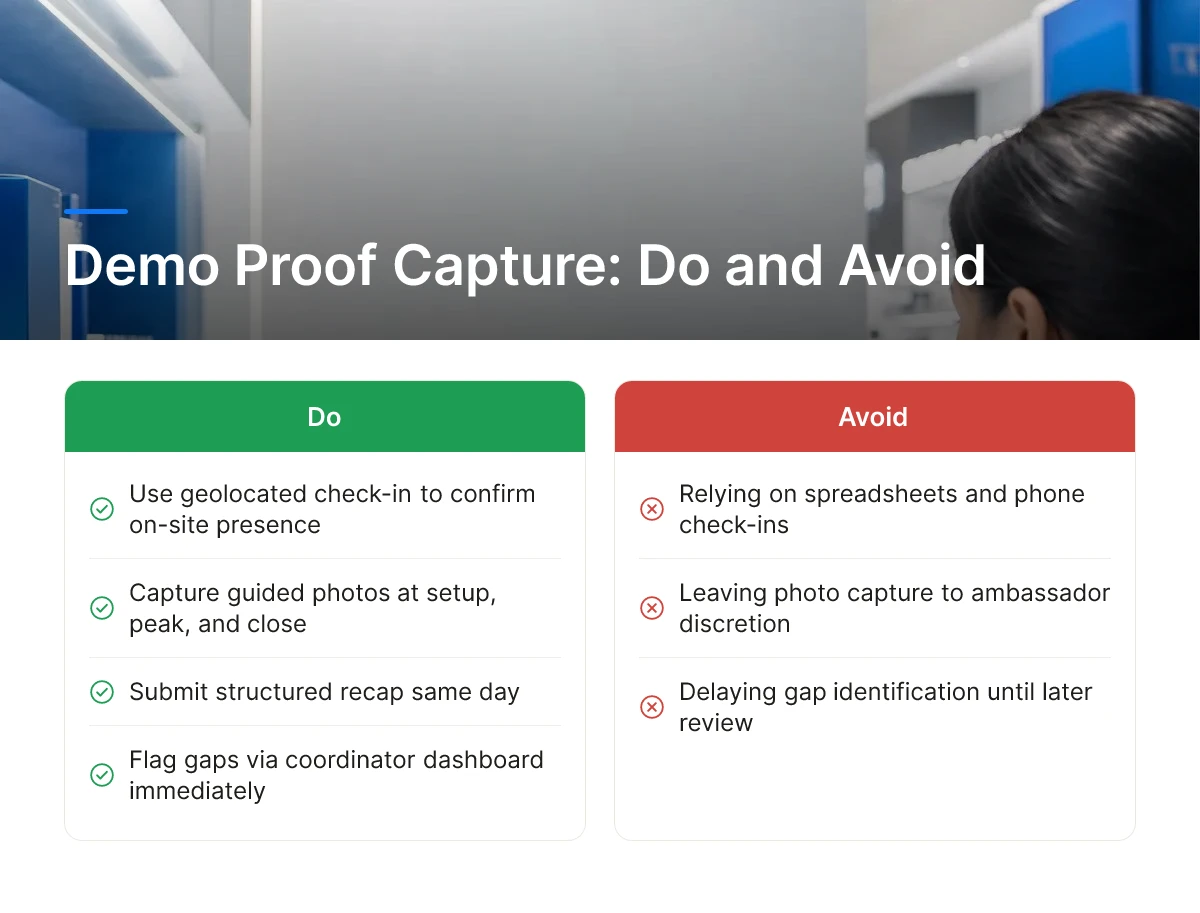
A working system for proof of execution retail demos runs on four steps: geolocated check-in, guided photo capture, structured recap submission, and a coordinator dashboard that flags gaps the same day. Each step closes a hole that spreadsheets and phone-call check-ins leave open.
The ambassador arrives at the store and checks in through a mobile app that logs location and time, confirming they were actually on-site rather than reporting from home. A checklist then prompts specific photos, the display before setup, the display during peak traffic, the shelf tag, the sample table, instead of leaving the ambassador to guess what matters. A recap form captures units sampled, stock issues, and shopper reactions in the same fields every time, so a brand manager reviewing forty stores sees forty consistent records, not forty improvised ones. On the coordinator side, a dashboard surfaces which locations are missing photos or recaps within hours, not at month-end reconciliation.
Grocery backrooms and big-box loading docks often have weak signal, so the app has to capture data offline and sync once connectivity returns rather than blocking the ambassador's workflow. Guided prompts matter as much as the camera itself, an ambassador told exactly what to photograph produces usable evidence, while an open-ended "upload a photo" instruction produces the inconsistent, undated images that make photos alone unreliable as proof [4]. Role-based access rounds this out: a retailer's store manager sees only activity in their location, a brand sees performance across its own campaign, and an agency sees the full multi-client picture, each partner gets visibility without wading through data that isn't theirs.
A centralized calendar, visible to store staff, brand coordinators, and agency partners at once, replaces the email chains that otherwise accompany every schedule change. Store employees see what's happening in their aisle without fielding a phone call, and vendors stop guessing whether a slot is confirmed. This is what turns proof of execution retail demos from a single-store exercise into an operational habit rather than a one-off audit.
Scaling past one region requires standardizing the checklist and recap template before adding volume. A hundred demos running the same weekend need to produce a hundred comparable records, same photo angles, same recap fields, or the resulting data becomes unusable for cross-market comparison. Demo Wizard's platform builds this in through scheduling, ambassador management, and performance reporting bundled into one system, letting a single coordinator manage hundreds of monthly events across states without hiring additional staff to reconcile mismatched formats.
All three review it, but for different reasons and at different stages. The demo agency or coordinator checks proof first, right after the event, to catch problems while they're still fixable. The brand reviews aggregated data to judge ROI and compliance across markets. Retailers see it mainly when a brand or agency shares it to justify continued shelf space or event access [1].
No, photo verification supplements audits but doesn't fully replace them for high-stakes accounts. Photos scale well and catch most compliance gaps, but timestamp and location metadata matter more than the image itself [4]. Periodic in-person audits still catch what photos alone miss, like shopper reactions or ambassador conduct.
A flagged photo should trigger a documented correction, not just a lower score on a report. Brands using platforms like Demo Wizard can route the flagged event to a coordinator for same-day follow-up, a call to the ambassador, a resupply request, or a note attached to that store's performance history. Without that loop, photo evidence just becomes an archive of unresolved problems instead of a tool for fixing them.
Yes, and it's becoming one of the more persuasive tools brands have in shelf-space negotiations. Retail buyers increasingly ask for proof of conversion impact before renewing shelf commitments [1], so pairing photo verification with store-level sales data gives brands a documented case, not just a claim, that the activation earned its spot.
Proof of execution turns in-store demos from a line-item expense into a documented, defensible investment. The three moves that matter most: pair every photo with timestamp and location data so it holds up as evidence, route flagged events back to a coordinator the same day instead of filing them away, and package store-level results before your next retailer negotiation instead of after. Brands and agencies running hundreds of monthly events can't do this manually without adding headcount. Start by auditing your last 30 days of demo photos, if you can't tell which stores underperformed and why within five minutes, your proof system needs rebuilding before your next renewal conversation.
Explore more from our content library:
Demo Wizard is the Ultimate Store Sampling & Demonstration management software for Brick and Mortar Retailers and CPG Vendors.
Chat with usPhone