
Demo Wizard is the Ultimate Store Sampling & Demonstration management software for Brick and Mortar Retailers and CPG Vendors.
Chat with us

Phone
Copyright © 2026 Demo Wizard
CPG brands and retailers coordinate in-store demonstrations at scale by replacing spreadsheets, calls, and emails with field sales software built specifically for demo scheduling, staffing, and ROI tracking. This kind of platform gives brands, retailers, agencies, and brand ambassadors shared visibility into a single calendar, so every activation is scheduled, staffed, and measured without the back-and-forth that causes no-shows and missed sales windows. The result is fewer disruptions for store teams and faster, more reliable proof of which demos actually drive purchases.
Field sales software coordinates in-store demos by replacing scattered spreadsheets and email chains with one shared schedule every party can see and trust.
A single brand running a handful of demos a month can usually get by with a shared spreadsheet and a few phone calls. That breaks down fast once the program scales to dozens or hundreds of stores across multiple states.
Spreadsheets get duplicated and edited in parallel, so two coordinators end up booking the same ambassador for two different stores on the same Saturday. Confirmation emails get buried, a distributor never learns the date changed, and nobody notices until the ambassador shows up to a store that wasn't expecting them. There's no single source of truth, so when a retail partner asks "which stores had a demo last weekend," the answer takes hours to assemble instead of seconds.
This is the exact coordination gap purpose-built scheduling software closes. Demo Wizard, for example, replaces the spreadsheet-and-email workflow with one scheduling system that covers booking, ambassador assignment, and payroll in a single place, so a brand's activation calendar isn't scattered across a dozen inboxes.
A centralized calendar that store managers, brand ambassadors, distributors, and brand headquarters can all view removes most of the back-and-forth that causes scheduling errors in the first place. Instead of a coordinator calling a store manager to confirm a Thursday slot and then separately emailing the ambassador and distributor, everyone works off the same record.
Store employees benefit the most from this shift. Rather than being surprised by a vendor arriving unannounced during a busy shift, a store manager can see upcoming demos days or weeks ahead, plan floor space, and brief staff accordingly. In-store demos already carry heavy lift when they're disorganized, the market's own research shows well-run demos sell product meaningfully better than unsampled items [1], and that lift depends on execution going smoothly, not on the store team scrambling. For a deeper look at what separates a well-run activation from a wasted one, see this guide to winning at in-store demos.
Single-brand coordination is hard enough. Multi-brand, multi-location coordination, the reality for distributors and agencies running activations for several CPG clients at once, compounds the manual overhead with every store added, which is why shared, software-driven visibility matters more as programs scale rather than less.
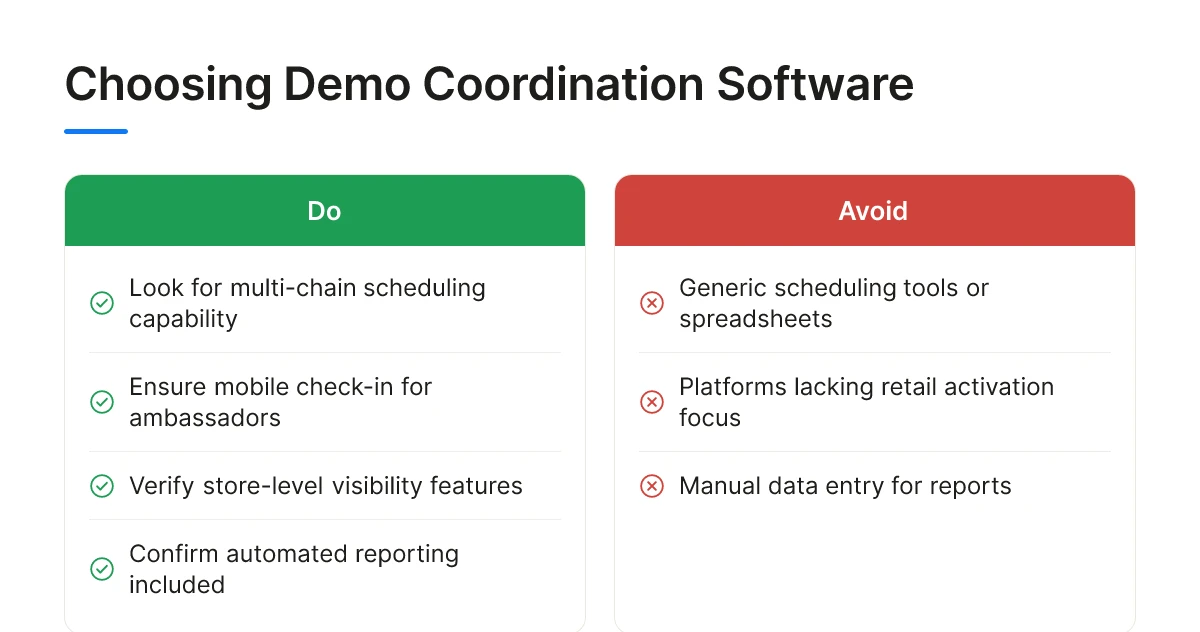
The right platform makes scheduling across chains easy, gives ambassadors a simple mobile check-in, shows store managers what's happening on their floor, and produces reports without manual data entry.
Those four criteria, multi-chain scheduling, mobile check-in, store-level visibility, and automated reporting, separate field sales software built for retail activation from generic scheduling tools. A spreadsheet or calendar app can handle a handful of events. Neither can handle 200 demos a month across a dozen retail chains, each with different store hours, approval chains, and reporting formats. Evaluate any platform against how it performs at that volume, not how it looks in a five-store pilot.
Weigh platform cost against location count, demo frequency, and whether the business needs multi-brand or multi-retailer support, rather than comparing sticker prices alone.
Think in tiers instead of exact dollar figures. A budget-friendly tool might suit a single-region brand running a dozen demos a month. A mid-range platform fits an agency juggling several CPG clients across regional chains. An enterprise-grade setup makes sense for a national brand running activations in hundreds of doors simultaneously. Demo Wizard, for example, prices per demo rather than per user or per location, a structure worth comparing against because it removes the penalty for adding stores or ambassadors as a program scales. Match the pricing model to the actual shape of the program: frequency, footprint, and whether one brand or many need to run through the same system. For a side-by-side look at how different platforms stack up, this ranking of field sales software by review grades is a useful starting point.
Compliance should be enforced automatically through geo-based check-ins, required photo uploads, and timestamped arrivals, not left to store staff to monitor.
Store managers already have enough to do without playing referee for every vendor that walks in. A platform worth adopting confirms an ambassador actually arrived at the right location and time through geolocation, requires a photo of the setup before the event counts as complete, and timestamps every check-in automatically. This matters because in-store demos sell best when they're staffed correctly and set up to spec, sampled products often outsell non-sampled items by a wide margin when execution goes right [1]. Automated compliance removes the guesswork and gives brands a defensible record if a retailer questions whether an activation happened as planned.
Finally, the system has to work for everyone touching it, retailer, brand, agency, and ambassador, not just the party that bought the license. A store manager needs a clear view of what's scheduled in their location. A brand needs conversion data by store and time. An agency needs a single dashboard across every client it serves. An ambassador needs an app simple enough to use without training. Platforms that only serve one side of that relationship tend to get rejected by the others, which is where most coordination breakdowns start.
Automated platforms replace the end-of-week recap with point-of-demo data capture, turning each event into a comparable record of units sold, shoppers engaged, and conversion rate. Instead of an ambassador texting a manager a rough headcount on Friday, the system logs activity as it happens, so brand managers see results while the campaign is still running, not after the opportunity to adjust has passed.
That shift matters because in-store demos already outperform non-sampled products by a wide margin, Attack! Marketing cites sales lifts over 40% for items featured in retail demos [1], and T-ROC puts category conversion gains from brand activation at 20-40% [2]. The gap most brands can't close without better data is knowing which specific stores and time slots produce those numbers, versus which ones quietly underperform. Real-time dashboards solve this by letting a coordinator compare store-by-store and region-by-region results side by side, then shift next month's schedule toward the locations and dayparts that actually convert. T-ROC's breakdown of in-store brand activation strategies covers several of the tactics behind those conversion gains in more depth.
Four data points separate a useful demo report from a vanity metric:
Manual tracking caps how many events one person can oversee, because every added store means more spreadsheets, more follow-up calls, and more chances for data to go missing. Field sales software built for retail demos removes that ceiling by automating data collection across every location at once, so a single coordinator can manage a growing roster of monthly events without hiring proportionally. Demo Wizard applies this directly to in-store sampling: its ROI tracking and analytics measure experience-to-purchase conversion by store and time period, giving one coordinator the visibility to run hundreds of monthly events without adding headcount.
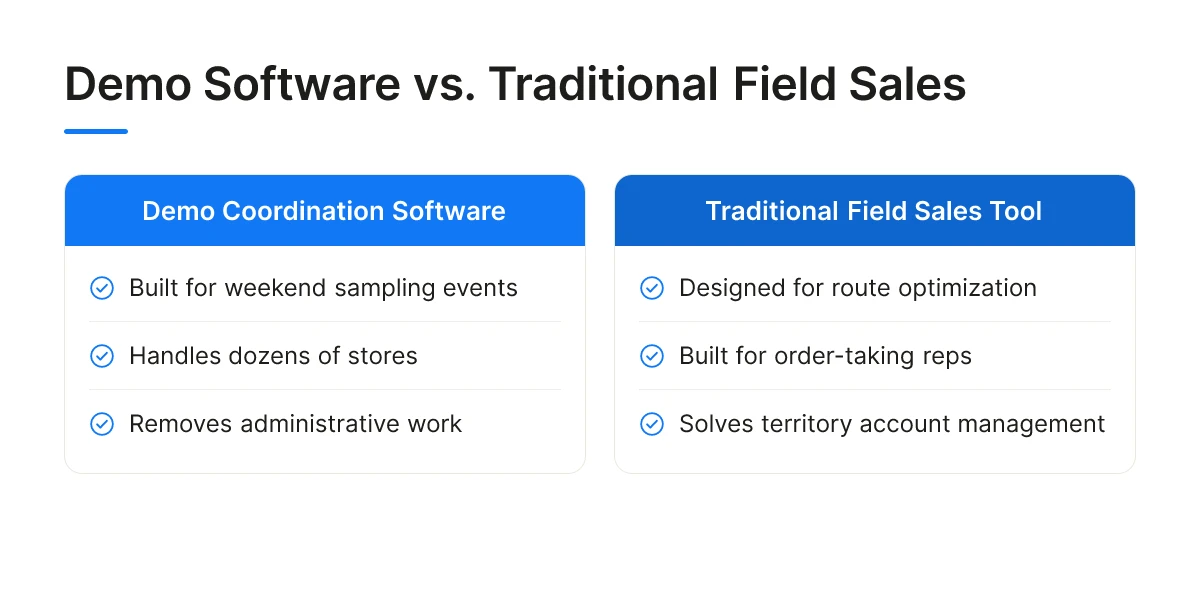
Traditional field sales software is built for outside reps who drive routes and take orders, not for coordinating weekend sampling events across dozens of stores. The two tools solve different problems, and using the wrong one creates administrative work instead of removing it.
Field sales software was designed around route optimization, order-taking, and account visit logging for reps who call on the same stores week after week [3]. That's the right toolset for a rep managing a territory of 40 accounts and submitting purchase orders. It's the wrong toolset for a brand activation manager running 15 sampling events across three states this Saturday. Apollo's overview of what field sales software covers, from mobile tools to ROI tracking, is a useful reference for understanding where general platforms stop and demo-specific needs begin.
A CPG brand running a weekend demo program doesn't need a tool to plan driving routes between stops. It needs a system that can schedule ambassador shifts for a specific four-hour window, assign the right person to the right store, and tie the sales lift from that exact event to the dollars spent on it. Demo Wizard builds around that narrower job: in-store demo scheduling, ambassador deployment, and experience-to-purchase conversion tracking by store and time period, rather than territory mapping or order management a demo coordinator will never use.
A single demo coordination platform has to satisfy three audiences at once, and each one needs something different from the same data. Retailers want a calendar that shows every scheduled activation in their store so nothing disrupts foot traffic or conflicts with another vendor. Brands want ROI data broken down by location and time slot, so they know which stores and which weekends are worth repeating. Ambassadors want a clear shift schedule, their assignment details, and a simple way to check in and confirm they showed up.
General field sales platforms weren't built to split that three-way view. When brands try to force one to handle demo scheduling, the parts it wasn't designed for, retailer-facing calendars, ambassador payroll tied to specific shifts, sales-lift attribution by event, usually end up bolted on through spreadsheets anyway. That defeats the point of buying software in the first place: the coordinator is back to manually reconciling three systems instead of running one.
Roll out field sales software in phases, starting with a pilot banner or a handful of stores, rather than switching your entire footprint over in one move.
A pilot of 10 to 20 stores within a single retail banner gives a coordinator enough volume to stress-test scheduling workflows without creating chaos if something breaks. Pick stores with a mix of traffic patterns and at least one supportive store manager who'll give honest feedback. Use the pilot to confirm the basics work: ambassadors get assigned correctly, schedules sync with store hours, and conversion data actually flows back after each demo.
The biggest adoption risk isn't the software, it's store teams treating it as one more vendor system they have to tolerate. Loop in store operations managers before the pilot starts, not after, and ask them where demo scheduling currently breaks down for their staff. When the shared calendar becomes the agreed system of record that store managers, brand ambassadors, and brand coordinators all check, it stops feeling like an imposed tool and starts functioning as shared infrastructure. That buy-in is what prevents the spreadsheet-and-phone-call workarounds that undermine any new system in the first few weeks.
Don't train your entire ambassador roster on day one. Stagger onboarding by region or by pilot wave, and lean on mobile-first tools, short video walkthroughs, in-app checklists, so training happens between shifts rather than requiring a separate session. This matters more as programs scale: a coordinator managing hundreds of monthly events across multiple states can't individually onboard every ambassador by phone.
Platforms built for this, including Demo Wizard, bundle scheduling, ambassador management, and ROI tracking into one system priced per demo rather than per user or location, which removes the cost penalty of adding stores gradually. Once the pilot proves out, expand banner by banner, using each phase's performance data to refine store and time selection before the next rollout. Treat coordination and ROI tracking as core infrastructure from the start, and scaling becomes a matter of repetition, not reinvention. For additional comparisons of how different tools handle this kind of rollout, this list of top field sales software options is worth reviewing.
Small CPG brands can use this software, and the per-demo pricing model is built for that scale. Demo Wizard charges starting at $3 per demo rather than per user or per location, so a brand running ten demos a month pays for ten demos, not a flat enterprise license sized for a national rollout.
Yes, a centralized calendar lets a retailer see every brand's demo requests for a given store without juggling separate emails or spreadsheets per vendor. This matters most for grocery chains coordinating several CPG brands in the same week, since overlapping requests for the same end-cap or table slot are easy to miss without one shared view.
Most teams load store locations, ambassador rosters, and campaign details within days, not weeks, since there's no hardware to install. The bigger time factor is usually internal: getting store lists finalized and ambassador availability confirmed before the first batch of events goes on the calendar.
The platform logs the actual event outcome, completed, shortened, or cancelled, rather than just the original booking. That distinction matters for ROI tracking, since a cancelled shift and a completed one shouldn't count the same way when a brand is measuring experience-to-purchase conversion by store.
Many platforms support integrations with retailer portals or distributor systems so scheduling and sales data don't live in isolation, though the depth of integration varies by vendor. Brands with existing retailer reporting requirements should confirm what a given platform supports before committing, since manual data re-entry defeats much of the purpose of automating scheduling in the first place.
Coordinating in-store demos at scale comes down to three things: a shared schedule everyone can see, data that ties each event to actual sales impact, and a pricing model that doesn't punish growth. Spreadsheets and email chains break down once a brand or retailer passes a few dozen monthly events, not because the team is careless, but because the coordination load grows faster than any one coordinator can track manually.
If you're currently managing demos through spreadsheets, start by auditing one month of activity: count how many hours went to scheduling versus analyzing which stores actually converted. That gap is the clearest sign of whether it's time to automate.
Explore more from our content library:
Demo Wizard is the Ultimate Store Sampling & Demonstration management software for Brick and Mortar Retailers and CPG Vendors.
Chat with usPhone