
Demo Wizard is the Ultimate Store Sampling & Demonstration management software for Brick and Mortar Retailers and CPG Vendors.
Chat with us

Phone
Copyright © 2026 Demo Wizard
A reliable demo backup staffing plan pairs every scheduled brand ambassador with a pre-vetted replacement pool, a defined notice window, and a fast reassignment workflow so a cancellation never becomes an empty table. The mechanism that prevents no-shows isn't more staff—it's visibility: knowing 48-72 hours out who's confirmed, who's at risk, and who can step in, so coordinators can act before the retailer ever notices a gap.
Most demo no-shows trace back to four preventable causes, not bad luck: late call-outs, double-booked staff, missing store contacts, and last-minute retailer changes. A demo backup staffing plan only works if it's built to close these specific gaps rather than guard against a vague sense of things going wrong.
Late call-outs happen when an ambassador confirms a shift days out but cancels within hours of the event, often for the same reasons that drive absenteeism in any hourly field role: illness, transportation problems, or a scheduling conflict that surfaces too late [4]. Double-booking occurs when an agency juggling multiple CPG clients assigns the same ambassador to overlapping shifts across different stores. A third failure point is structural: nobody at the store has confirmed they're expecting the demo, so even a staffed event can stall at the door. And retailers themselves sometimes shift event dates or aisle placement inside a week of the scheduled date, leaving the original staffing plan built around conditions that no longer exist.
One no-show does more damage than one lost shift, it costs the brand retailer trust, wasted product pulled for the event, and a sales window inside that store that can't be rescheduled mid-campaign. Products featured in retail demos often sell over 40% better than non-sampled items [1], which is exactly why an empty table reads as a missed opportunity to a retail partner, not a minor scheduling hiccup. Repeated gaps signal an unreliable vendor, and that reputation follows the brand into the next shelf-space or promotional conversation.
The visible cost is the empty table. The hidden cost is the coordinator spending hours on the phone hunting for a replacement instead of planning next month's campaign. That manual scramble, calling around store by store, is a coordination tax that scales badly.
A single-store gap is a local problem. Across 50 or 100 doors, the same small failure rate compounds into a recurring reliability issue that retail partners start to track and question.
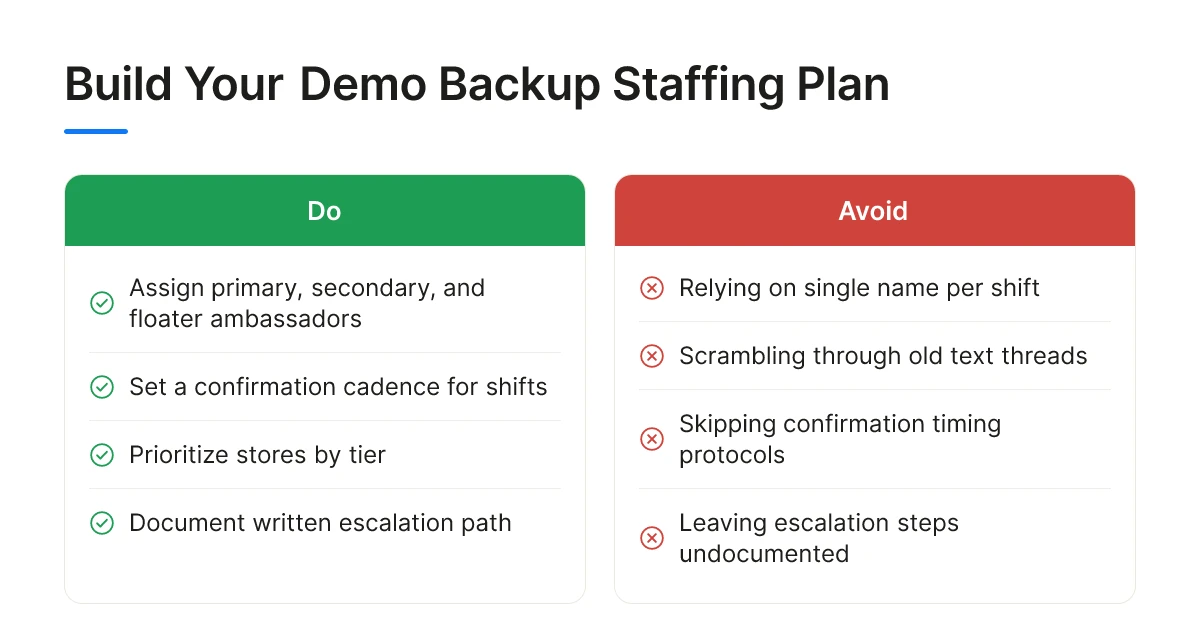
A working demo backup staffing plan needs four parts: a tiered roster, a confirmation cadence, store-tier prioritization, and a written escalation path.
Start with a tiered roster instead of a single name per shift. Assign a primary ambassador, a secondary on-call backup who already knows the product and store layout, and a pool of floaters who can cover several nearby stores on short notice. This structure means a single no-show never leaves a coordinator scrambling through old text threads to find someone available.
Confirmation timing matters as much as the roster itself. Most no-shows trace back to process gaps, a schedule published too late, a shift assigned without checking real availability, or no confirmation loop between booking and shift start [5]. Build a cadence with three checkpoints: an advance confirmation when the shift is booked, a 48-hour check-in, and a day-of check-in a few hours before the demo starts. Each checkpoint gives an at-risk shift enough runway to get filled by the secondary or a floater before it becomes a live gap on the sales floor.
Not every store deserves the same depth of backup coverage. A high-volume club store or a strategic retail partner that ties shelf space to demo performance warrants a full three-tier roster; a smaller independent grocer might only need a secondary on-call name. Matching backup depth to store priority keeps staffing costs proportional to what's actually at risk.
Peak seasons change the math. Holiday weekends and high-traffic retail windows pull from the same limited ambassador pool across every brand running activations, so bench strength needs to grow and confirmation windows need to move earlier, often a full week ahead instead of 48 hours. Building this extra cushion before the calendar gets tight, rather than after the first cancellation, is what separates a demo backup staffing plan from a reactive scramble.
Finally, put the escalation path in writing. Everyone involved, coordinators, agencies, and store contacts, should know exactly who gets called first, second, and third when a shift is at risk, removing the guesswork that turns a single absence into a lost sales day.
A strong demo backup staffing plan rarely relies on one labor source, it blends dedicated ambassadors, agency partners, and freelance coverage so no single gap can stall a schedule.
Dedicated, in-house brand ambassadors know the product cold. They understand ingredient sourcing, brand story, and how to handle objections in ways that build repeat customers, not just single-day sales lifts, the kind of depth trained demo specialists are built around [2]. But an in-house team has a ceiling: geographic reach. A brand running roadshows across 20 states cannot staff every store with employees on payroll without carrying significant overhead in markets that only need coverage a few weekends a year.
Agency and freelance staffing solve the reach problem. A demo company or field marketing agency can flex up for a busy Saturday or a multi-state launch far faster than an internal hiring process allows. The trade-off is consistency. Training quality varies by agency, and a rushed or under-briefed fill-in ambassador can undercut the same brand experience your core team spent months building.
A hybrid model works best for brands with a defined core footprint and a growing or seasonal periphery. Staff flagship markets and your highest-volume retail partners with in-house ambassadors who carry deep product knowledge. Route overflow shifts, new-market tests, and short-notice replacements through one or more demo company partners who already maintain trained, available talent pools.
Leaning on a single demo company, though, just relocates the single point of failure rather than removing it. If that one partner has a bad week, understaffed, overbooked, or dealing with its own no-show cluster, every store on your schedule feels it at once. Maintaining active relationships with more than one staffing partner, even at modest volume with each, keeps a deeper bench available when the primary partner comes up short.
Cost differences are qualitative more than they are precise. In-house staffing trades a higher fixed cost for tighter control over training and brand consistency; agency staffing trades some of that control for flexible, variable per-shift spending that scales with demand. Neither model is cheaper in absolute terms, each shifts where the cost and the risk sit.
Three numbers tell you whether a demo backup staffing plan is working: fill rate for backup requests, average time-to-fill an at-risk shift, and no-show rate broken out by store or market. Without these, "we have a backup plan" is just a claim, not a measured result.
Fill rate tracks the percentage of last-minute openings successfully covered by a standby ambassador rather than going empty. Time-to-fill measures how fast a coordinator moves from "ambassador flagged as at-risk" to "replacement confirmed", the shorter that window, the less disruption reaches the store. No-show rate, segmented by location, shows whether certain markets or retail partners have chronic reliability problems that a wider hiring pool or local backup roster needs to solve.
Maintaining a bench of standby ambassadors costs money, recruiting, minimal onboarding, and sometimes a retainer fee to keep people available on short notice. Weigh that against what a single cancelled demo actually costs: lost sampling volume, a wasted product shipment, and the reputational cost of leaving a retailer's end-cap empty on a Saturday. Products featured in retail and in-store demos often sell over 40% better than non-sampled items [1], which makes a cancelled Saturday roadshow a measurable revenue loss, not just an inconvenience. Run this comparison per market: if the bench costs less than the average lost-sales value of one prevented no-show per month, the backup plan pays for itself.
Once a contingency system is in place, track three comparison points against your pre-plan baseline: confirmation lead time (how far in advance ambassadors reconfirm before a shift), escalation response time (how fast a coordinator is alerted and acts when someone flags as unavailable), and coverage gap frequency (how often a shift still goes unfilled despite the backup process). A shrinking gap frequency month over month is the clearest proof the plan is working.
These metrics matter beyond internal reporting. Retailers remember which brands show up reliably and which leave tables empty, consistent coverage is often what earns a brand more shelf space and repeat invitations to future roadshows.
Scheduling software replaces phone trees and spreadsheets with one shared view of every shift, so a demo backup staffing plan stays current without constant manual checking.
.
Automated alerts for at-risk shifts do the work a manual phone tree used to handle. When an ambassador misses a confirmation window, the coordinator gets notified before the shift starts, not after a store manager calls asking where the demo staff is. This is what lets one coordinator manage backup coverage across a large multi-state footprint rather than hiring a second person just to make calls. Demo Wizard's
Retailers see a direct benefit too. A shared calendar of demo activity, visible to the store manager as well as the brand and the coordinator, cuts the back-and-forth that store employees currently absorb, fielding calls from vendors, confirming timing with distributors, chasing down who's actually showing up. When that calendar lives in one system instead of a chain of emails, store staff spend less time managing vendor logistics and more time running the floor.
The fix is structural, not heroic: build backup coverage into the normal scheduling workflow, not as a fire drill reserved for bad weeks.
Confirm primary ambassadors 48 to 72 hours before the shift, then run a second confirmation the morning of the event. Layering two confirmation checkpoints catches cancellations early enough to activate a backup without scrambling the retailer relationship or losing the demo slot entirely [5].
A scheduling platform shows every confirmed, unconfirmed, and backup-covered shift across all stores in one dashboard instead of scattered texts and spreadsheets. Demo Wizard, for example, coordinates ambassador assignments and availability across hundreds of monthly events, so a single coordinator can spot a coverage gap in one region without calling each store manager individually.
Yes, even a brand running demos in two or three states loses the same retailer trust from a single no-show as a national brand does. A short list of two or three trained backup ambassadors per market is enough to close most gaps without added overhead.
Overbooking pays for staff you may not use; a backup plan keeps a vetted, trained bench on standby and activates it only when needed. Overbooking raises labor cost on every shift, while a structured backup pool [3] keeps costs tied to actual coverage gaps, not guesswork.
A demo backup staffing plan works when it combines three things: confirmation checkpoints that catch cancellations early, a trained bench of backup ambassadors ready to step in, and a scheduling system that gives coordinators visibility across every store without constant phone calls. Brands that skip any one of these still lose shelf time and retailer trust to a single no-show. Start by auditing your last quarter of demo shifts for cancellation patterns, which markets, days, or ambassadors caused the most gaps, then build your backup pool around those specific weak points rather than staffing extra coverage everywhere at once.
Explore more from our content library:
About the Author
Written by the SaaS / Retail Marketing Technology experts at Demo Wizard. Our team brings years of hands-on experience helping businesses with SaaS / Retail Marketing Technology, delivering practical guidance grounded in real-world results.
Demo Wizard is the Ultimate Store Sampling & Demonstration management software for Brick and Mortar Retailers and CPG Vendors.
Chat with usPhone