
Demo Wizard is the Ultimate Store Sampling & Demonstration management software for Brick and Mortar Retailers and CPG Vendors.
Chat with us

Phone
Copyright © 2026 Demo Wizard
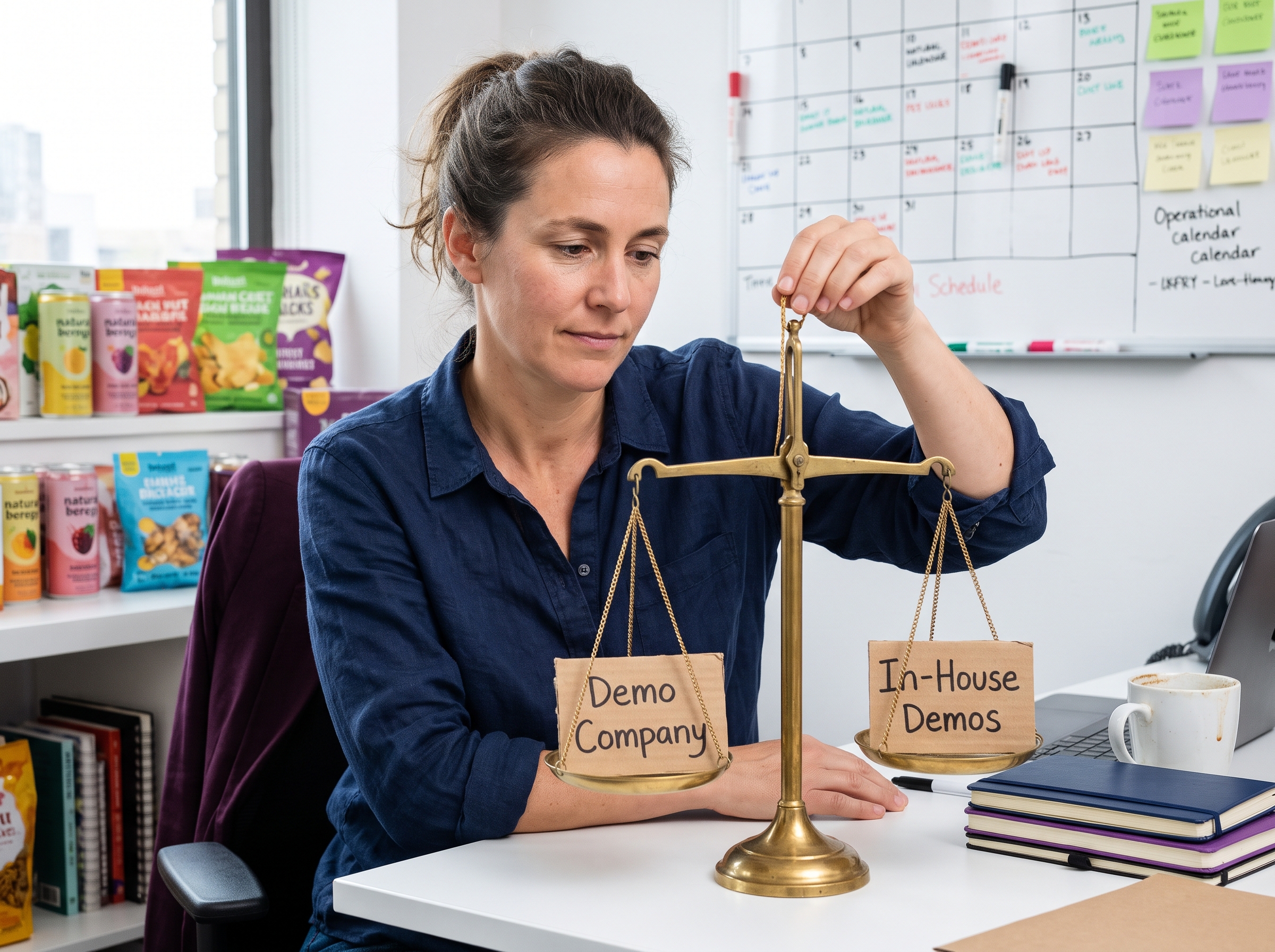
Treating in-store activations as a strict choice between in-house teams and third-party demo companies is a false binary. Most growing CPG brands naturally evolve into a hybrid model, keeping strategic flagship doors internal while leveraging agencies for regional scale. The real failure point isn't who staffs the floor, but operating without a unified system to schedule, track, and analyze performance across both channels in one view.
If you're weighing in-house demos against a demo company, here's the honest framing: run demos internally when you have a tight regional footprint, dedicated field staff, and need direct control over brand messaging. Outsource to a demo company when you're scaling across many stores, regions, or retailer formats at once. In practice, though, most CPG brands don't get to make that choice from a position of strength — they're short on experience, time, or budget to stand up an in-house activation program from day one, so outsourcing is often the realistic starting point, not a strategic afterthought. The best brand activation strategy usually evolves: lean on a demo company to get moving, then bring flagship or strategic accounts in-house once you've built the staff and playbook to do it well. Whichever model you're in today, formalized post-demo reporting is what actually determines ROI and informs the next move.
The choice comes down to geographic concentration and team capacity: tight regional footprints favor in-house staff, broad expansion favors a demo company. Get this match wrong and a brand activation strategy either stalls under administrative weight or loses the local control that made early activations work in the first place.
Internal teams work best for brands with a concentrated regional distribution footprint, a small number of retail doors, and ambassadors who already know the store managers by name. A founder-led beverage brand running demos in 15 grocery stores across one metro area doesn't need a vendor relationship, it needs a reliable part-time crew and a shared calendar.
Demo companies make more sense once a brand pushes into new regions or retailer formats it doesn't know well yet. Recruiting, training, and scheduling local ambassadors in a market you've never operated in is slow, and mistakes during a launch window are expensive. A specialized demo company already has vetted staff on the ground, which shortens the time between signing a retail agreement and getting a table in front of shoppers.
Smaller brands feel this gap most acutely. A team of two or three people handling marketing, sales, and operations rarely has the bandwidth to recruit ambassadors in five new states, run background checks, and build a training program from scratch. Outsourcing becomes a practical bridge, it buys scale without forcing an early hire.
Larger brands face a different calculation. Many keep in-house field marketing teams for flagship retail partners where brand consistency and relationship depth matter most, then outsource overflow events or secondary markets where volume matters more than white-glove execution. This hybrid approach lets a lean internal team stay focused on strategic accounts while a demo company absorbs the geographic sprawl.
Start with brand stage, then layer in geographic spread and the speed at which you need to activate. A brand still proving product-market fit in its home region benefits from deepening relationships at a handful of medium-traffic stores rather than chasing the busiest doors or spreading thin across unfamiliar territory. High-traffic locations look appealing on paper, but the volume can work against a brand that's still learning: shoppers move faster, ambassadors get less time per conversation, and the demo turns into tasting without a real read on who's actually buying. Medium-traffic stores give a demo enough steady foot traffic to produce a strong sample-to-purchase conversion rate, while leaving ambassadors enough time per shopper to gather the kind of feedback that tells you whether this product fits this store's demographic, not just whether people will take a free sample. A brand with distribution already secured in new retailer formats, club stores, regional grocery chains, specialty channels, needs a model that can activate dozens of doors at once without a hiring spree. The honest question is whether you're optimizing for depth at existing stores or breadth into new ones. Chasing both simultaneously with a single internal team usually means neither gets done well, which is why most growing brands eventually split the model rather than picking one side permanently.
An automated platform removes most of the reason the in-house-versus-outsourced tradeoff feels so stark in the first place: it strips the administrative load out of running demos internally, and it gives outsourced demos the same oversight an in-house team already has.
On the in-house side, the overhead that multiplies with every new store, ambassador scheduling, and compliance tracking is exactly the work a platform automates. A coordinator sets the rules once, and the system assists scheduling, sends confirmations, and flags gaps, instead of someone rebuilding a spreadsheet every week as store count grows.
On the outsourced side, the usual worry is visibility: once ambassadors work for an agency instead of the brand, a manager loses the day-to-day read on how demos actually ran. Routing every shift, in-house or agency, through the same check-in and recap workflow closes that gap. Agency ambassadors report collected customer feedback, photos, units sold, and compliance data into the same system an internal hire would use, so a brand gets the same quality signal regardless of whose payroll the ambassador is on.
That shared reporting layer is also what makes a mixed model workable day to day, not just on paper, which matters once you're comparing performance across stores and vendors in one view, the subject of the next section.
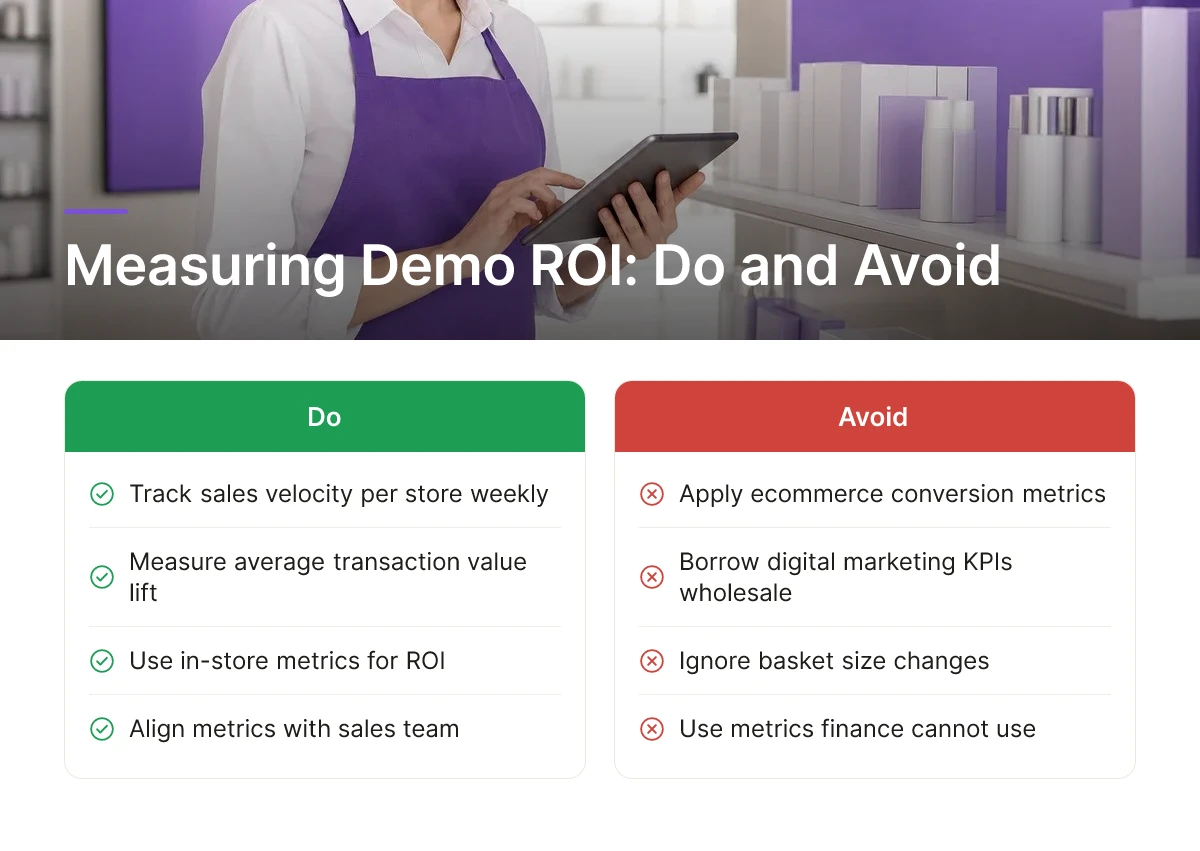
ROI for in-store demos comes from sales velocity lift and average transaction value, not ecommerce conversion rates, which don't translate to a physical aisle. Any brand activation strategy that borrows digital marketing metrics wholesale will produce numbers nobody on the sales or finance side can actually use.
Sales velocity, units sold per store per week during and immediately after the demo, is the single clearest signal of whether a demonstration moved product. Basket size, or average transaction value, matters almost as much: a demo that gets shoppers to add a second item or trade up to a larger pack size is working harder than one that only drives a single unit sale.
Below the top-line numbers, three signals tell you whether the demo itself is doing its job. Trial-to-purchase behavior at the shelf, did the person who tasted or tried the product actually put it in their cart, separates genuine conversion from polite sampling. Ambassador-reported consumer feedback, collected as structured notes rather than anecdotes, surfaces objections and praise brands can act on. And units moved per shift lets you compare one ambassador's four-hour block against another's, which matters once a brand is running dozens of demos a week across different markets.
None of these metrics are useful in isolation. A single Saturday afternoon demo at one store tells you almost nothing about whether a wider rollout is worth the spend.
Post-campaign analysis starts with comparing performance across store formats and regions, not treating every location as interchangeable. A natural foods store in a dense urban market and a big-box location in a suburban strip mall will produce very different velocity numbers for the same product, and that comparison is what tells a brand which store types justify repeat activations versus a one-time trial.
Sales data alone can mislead if it's not paired with execution data. A weak sales number might mean the product didn't resonate, or it might mean the ambassador showed up late, the display was out of stock by noon, or photo compliance shows the table was never set up correctly. Rolling up photo compliance, stock-out incidents, and staffing reliability alongside the sales figures is what separates an execution problem from a product-market fit problem. Attack! Marketing's research on in-store demos notes that sampled products often sell meaningfully better than non-sampled items [2], but that lift only shows up when the activation is actually executed as planned.
The comparison only holds if the KPI definitions stay consistent. A brand running some demos through an in-house ambassador team and others through a third-party agency needs both sides reporting against the same metrics, same definition of a "unit moved," same feedback format, same compliance checklist. Demo Wizard's analytics dashboard was built around this problem: it standardizes reporting across mixed execution models so a coordinator can pull performance data by store and time period regardless of who staffed the event, and see which locations earned a second visit and which didn't.
A scalable brand activation strategy balances two competing instincts: go wide for immediate visibility, or go deep in fewer stores to protect execution quality. Most mid-market CPG brands eventually run both, but the sequencing matters more than either choice alone.
Activating broadly across dozens or hundreds of doors at once maximizes short-term visibility and category velocity, every shelf gets attention in the same week, and the brand shows up everywhere a retailer buyer might be watching. The tradeoff is coordination complexity. Staffing forty simultaneous demos means forty chances for a no-show, a signage mix-up, or an ambassador who never got the updated talking points. Inconsistent execution across doors is the most common failure mode of a wide launch, and it is hard to catch until the reporting comes back uneven.
A phased, store-by-store rollout trades some of that immediate reach for control. Running a brand activation strategy through a controlled set of ten or fifteen locations first lets a team test messaging, staffing models, and inventory forecasting before committing budget to a hundred more. If a sampling format underperforms or a store runs out of product by noon on a Saturday, that's a contained problem in a pilot phase, it's a budget-wide problem at full scale. Attack! Marketing's guide to in-store demos frames this scaling path explicitly as moving from local proof points to national programs once the format is validated [2].
Most brands don't choose purely in-house or purely outsourced, they run a mixed model, with internal teams covering flagship or strategic accounts and demo companies covering broader regional footprint. That split only works with a shared calendar that every party can see. Without one, a club store and a regional grocery chain in the same market can end up double-booked for the same weekend, or a smaller independent gets skipped three months running because no one owned that territory.
Field sales and retail execution are frequently cited as the operational backbone connecting distribution to actual sell-through [1], and demo coordination sits squarely inside that function. Demo Wizard addresses the mixed-model problem directly: it centralizes scheduling across in-house ambassadors and third-party agency staff in one calendar, so a coordinator can see every planned activation, regardless of who is running it, without reconciling spreadsheets from two different teams.
Setup requirements, signage placement, staffing credentials, and check-in verification need to be identical whether the person at the table is a full-time employee or a contracted agency ambassador. A shopper doesn't know or care who signs the paycheck, they just experience the demo. If one crew sets up a full branded display and another shows up with a card table and no signage, the brand looks inconsistent in the exact moment it's trying to build trust.
Retailer-specific rules complicate the uniformity goal further. Club stores typically mandate a single exclusive vendor and tightly scripted execution; regional grocery chains allow brand-managed staff but charge slotting fees for the calendar slot; independent grocers often set almost no formal rules at all. A realistic rollout plan accounts for these differences rather than forcing one execution template onto every store format.
Automation fixes the reporting gap that opens whenever a brand splits execution between internal staff and outside demo companies, by forcing every shift into one tracking format. That gap is where most brand activation strategy decisions quietly fail, not in the field, but in the follow-up.
Spreadsheet-based reporting works fine when one team runs every demo the same way. It breaks down fast once a brand adds a second or third demo company into the mix. In-house ambassadors might log units sold and photos in a shared drive. One agency emails a PDF recap. Another submits a form with different fields entirely. A brand activation manager trying to compare performance across 40 stores in a given month ends up reconciling four different formats before any analysis can start.
Look for a platform that centralizes three things regardless of who staffs the shift: scheduling, ambassador confirmation, and recap submission. If a tool only handles scheduling and leaves reporting to whatever format each execution partner prefers, it solves half the problem.
Demo Wizard coordinates scheduling, ambassador assignment, and post-demo recap collection in one system, whether the shift is staffed by an internal team member or a contracted agency. Brands input campaign details and store locations once; the platform manages the calendar and payroll on the in-house side while still accepting standardized recap data from outsourced partners. That means a brand running demos through a mix of internal ambassadors and two or three outside demo companies gets one dataset, not three or four disconnected ones.
Standardized recap fields matter more than they sound. Photos, units sold, consumer feedback, and stock status need to be captured the same way every time, whether a company-trained ambassador or an agency contractor ran the shift. Without that consistency, comparing an in-house market against an outsourced one is a comparison of apples and spreadsheets, not performance.
Centralized visibility closes the loop between what a brand planned and what actually happened on the sales floor. A brand activation manager should be able to open one calendar and see every demo that was scheduled, completed, or missed, across every store, every market, and every execution model, without calling five different coordinators for status updates.
That visibility also supports the renewal and reallocation decisions that drive long-term brand activation strategy. If an outsourced agency consistently outperforms the in-house team in one region, standardized reporting makes that visible and defensible to finance. If a particular demo company has a pattern of missed shifts or incomplete recaps, the data shows it instead of relying on anecdote.
One limitation worth naming: Demo Wizard tracks ROI and performance data by ingesting sales figures that retailers or third-party data providers supply, it does not connect directly to point-of-sale systems. For brands, that means sales data arrives on whatever cadence the retailer or data provider delivers it, not in real time from the register. Even with that constraint, pairing consistent recap data with available sales figures gives brand managers a far clearer read on which stores and execution partners are actually earning their place in next quarter's plan.
Yes, and most mid-market brands running 20+ store campaigns do exactly this. In-house ambassadors often cover flagship or nearby stores where brand knowledge matters most, while a demo company fills in distant regions or high-volume periods. The split only works if both sides report into one tracking system, so results are comparable store to store.
Most brands pilot in 10 to 25 stores across two or three formats before committing to a national rollout. This gives enough variation in traffic, demographics, and store layout to spot patterns in sales velocity. Expanding before the pilot data shows a clear winner risks scaling a demo approach that only works in one type of store.
A solid recap includes units sold per hour, foot traffic estimates, store and time-slot breakdowns, ambassador notes on shopper objections, and photo compliance. It should also flag stock-outs or display issues that affected results. Brands managing a mixed in-house and agency model need this format standardized across every execution partner, or comparisons across stores become unreliable.
Not if the demo company is trained and audited properly. Consistency risk comes from skipping ambassador training and compliance checks, not from the outsourcing decision itself. Brands that require photo check-ins and standardized scripts from every partner, in-house or agency, keep the experience uniform regardless of who staffs the table.

The in-house versus demo company decision isn't permanent, it's a choice to revisit every time a campaign's scale or geography shifts. Start with a focused pilot, track sales velocity and basket size by store, and let that data decide whether to broaden the footprint or concentrate spend further. Whichever execution model you choose, standardize the recap report before you scale, not after.
Next step: pull your last three months of demo data and check whether you can currently compare results across stores and vendors in one view. If you can't, that's the gap to close before adding another market.
Explore more from our content library:
About the Author
Written by the SaaS / Retail Marketing Technology experts at Demo Wizard. Our team brings years of hands-on experience helping businesses with SaaS / Retail Marketing Technology, delivering practical guidance grounded in real-world results.
Demo Wizard is the Ultimate Store Sampling & Demonstration management software for Brick and Mortar Retailers and CPG Vendors.
Chat with usPhone