
Demo Wizard is the Ultimate Store Sampling & Demonstration management software for Brick and Mortar Retailers and CPG Vendors.
Chat with us

Phone
Copyright © 2026 Demo Wizard
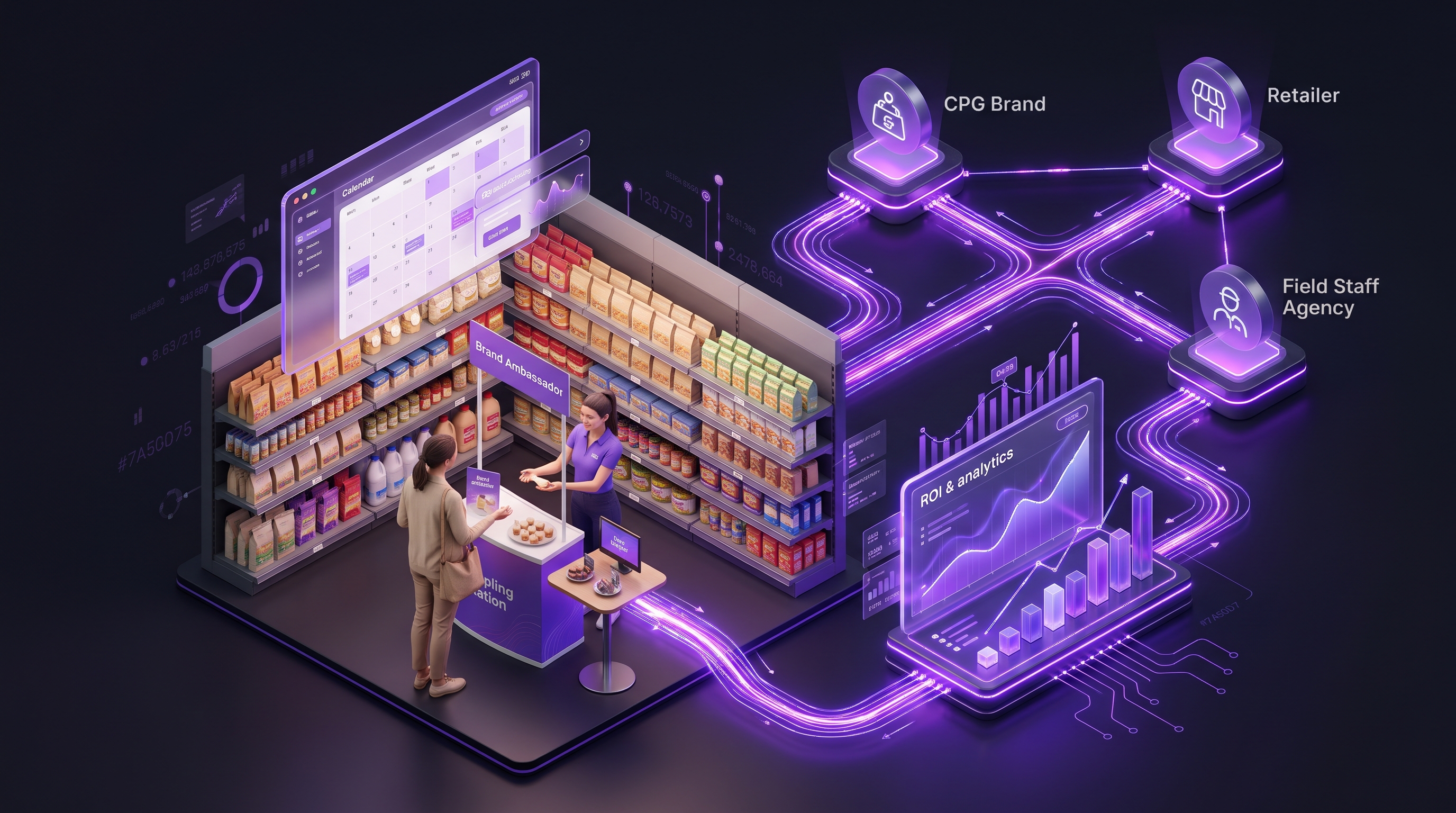
Customer engagement marketing for CPG in-store demos is the operational coordination between brands, retailers, and staffing agencies to automate demo scheduling, track compliance, and tie live product activations directly to retail sales lift.
Customer engagement marketing for CPG brands and retailers means coordinating, automating, and measuring in-store product demonstrations and brand activations so they consistently convert shoppers while reducing the operational burden on store staff. In practice, this requires a shared calendar visible to brands, retailers, and demo agencies, automated scheduling and confirmation workflows to prevent no-shows, and standardized reporting that ties demo activity to units sold and sales velocity, replacing manual phone calls, spreadsheets, and disconnected reporting with a coordinated system all parties can trust.
In this article, customer engagement marketing refers to how a CPG brand, a retailer, and demo staff coordinate and measure physical in-store events, not how a brand messages individual shoppers.
That distinction matters because most searches for this phrase land on a different topic entirely: building emotional connections with consumers through loyalty programs, personalized email, or social media interactions. That version of customer engagement marketing is about the relationship between a brand and the end consumer across digital and physical touchpoints [3], a concept covered in more depth by resources like Amazon Ads' guide to customer engagement [3]. This article focuses on a narrower, operational problem that sits one layer back, the coordination work brands and retailers must get right before a shopper ever tastes a sample or talks to an ambassador. Without that coordination, the consumer-facing moment never happens, or happens badly.
A roadshow illustrates the operational version concretely. Rather than a single ambassador working a sampling table for an afternoon, a roadshow claims a dedicated footprint inside the store, a center aisle, an end-cap, a front lobby, for a limited run, often three to ten days. It's staffed by trained ambassadors who demonstrate the product, handle objections, and close sales on bundled or exclusive offers not normally found on the shelf. The urgency is deliberate: a temporary installation creates the kind of scarcity that drives weekend foot traffic and larger basket sizes. None of that happens through messaging or loyalty mechanics. It happens because a brand secured the space, a retailer approved the footprint and schedule, and an agency or in-house team showed up with trained staff and enough inventory to last the run.
Three actors have to stay aligned for any of this to work: the CPG brand running the campaign, the retailer's store team hosting it, and the demo staff or agency executing it on the floor. When coordination between these three breaks down, a schedule conflict, a missed confirmation, a store team caught off guard by an unannounced setup, the activation either underperforms or creates friction that damages the brand-retailer relationship. Demo Wizard's scheduling and ambassador management tools exist specifically to keep these three parties working from the same calendar, which is the operational core of customer engagement marketing as this article uses the term.
A coordinated demo campaign moves through five distinct stages, and conversion depends on a brand ambassador sampling product within arm's reach of the shelf, not a few aisles away. This is customer engagement marketing in its most literal retail form: a planned sequence of logistics and human interaction designed to turn a taste or touch into a purchase before the shopper leaves the aisle.
Every successful activation follows the same backbone, regardless of category or retailer size:
Coordinating this manually across more than a handful of stores creates the scheduling chaos most brand activation managers already know firsthand, spreadsheets, phone tag, and missed slots. Platforms like Demo Wizard exist specifically to automate this sequence: scheduling across locations, assigning ambassadors, and tracking the handoff from setup to teardown so one coordinator can run hundreds of monthly events without the process collapsing under its own logistics.
Frictionless taste-to-purchase is the mechanism behind most of a demo's conversion power. When a shopper samples a product and can grab it immediately from the display pallet right in front of them, there's no gap for hesitation or forgetting, they don't have to remember a flavor name three aisles later. Requiring that extra mental step, even briefly, measurably reduces the odds a sample turns into a sale.
That immediacy depends on tight coordination between the ambassador and store employees. Setup location, restocking timing, and compliance with store rules, fire code clearances, aisle width, checkout flow, all need sign-off from store staff so the activation doesn't disrupt normal operations or draw a complaint from a department manager.
Placement matters as much as execution. A table near the entrance, a high-traffic aisle, or the checkout queue captures far more shoppers than the same setup tucked in a back corner [1]. Retailers and brands that negotiate for prime real estate, even for a few hours, tend to see activation performance that back-aisle placements simply can't match.
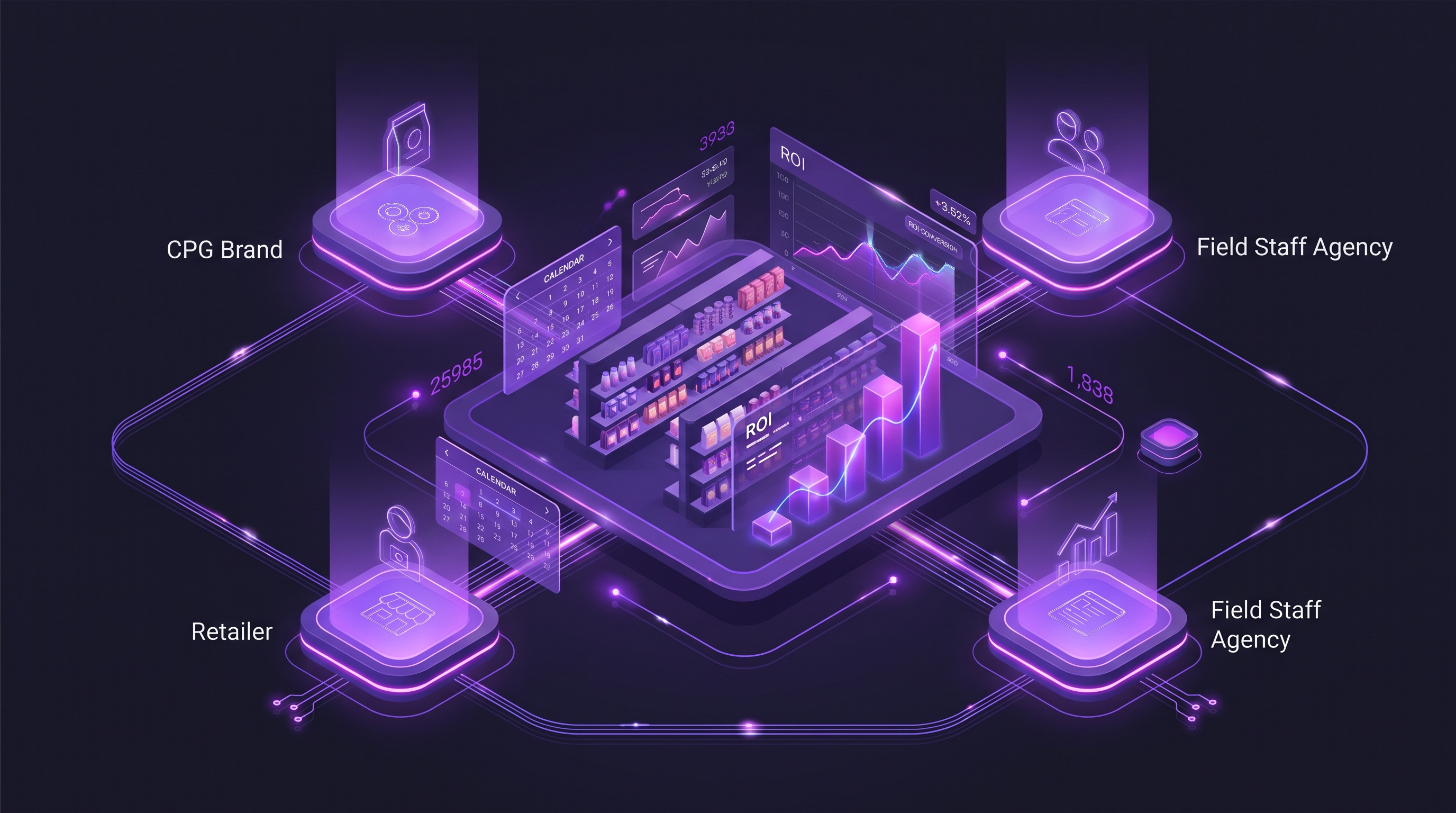
Manual demo coordination creates friction at every handoff point, and automated scheduling removes it by giving everyone one shared source of truth instead of scattered calls, emails, and paper logs. This is also where customer engagement marketing programs most often stall before they ever reach the shopper.
Ask any store manager who handles vendor relationships, and the complaints are consistent: too many phone calls, too little visibility. A regional grocery chain running demos across dozens of doors often relies on store staff to field vendor calls, confirm dates on a wall calendar, and hope two brands didn't book the same end-cap for the same Saturday.
Paper sign-in sheets get lost or filled out incorrectly. Ambassador confirmations arrive by text the night before, if at all, leaving store employees to guess whether anyone is showing up. None of this is a staffing failure, it is a process failure, built on tools that were never designed for the volume of activations modern CPG brands run. This is where customer engagement marketing breaks down operationally, long before a single shopper tastes a sample: the back-office coordination collapses under its own complexity, well-documented strategy guides for in-store demos emphasize timing and logistics as the first hurdle to scale [2]. For more information, see Dealership Marketing Playbook Smart Car Listing Optimization With Ai Images.
A centralized calendar visible to the brand, the retailer, and the staffing agency eliminates double-booking before it happens. Store staff see upcoming activations weeks in advance without a single back-and-forth email, and a brand's trade marketing team can check slot availability without calling the store directly.
Automated check-in and compliance tracking replaces the need for a manager to monitor setup in person. The system confirms an ambassador arrived, set up the display according to the retailer's layout rules, and followed store-specific requirements, all logged automatically rather than reported secondhand. Demo Wizard builds this kind of coordination directly into its scheduling platform, giving a single coordinator oversight across hundreds of monthly events without adding headcount.
Automated confirmation workflows also cut down on the day-of scramble. Ambassadors get reminders and confirm attendance through the system itself, which reduces the no-shows and last-minute cancellations that otherwise land on store employees to patch together, often by pulling a staffer off the register to cover a table nobody told them about.
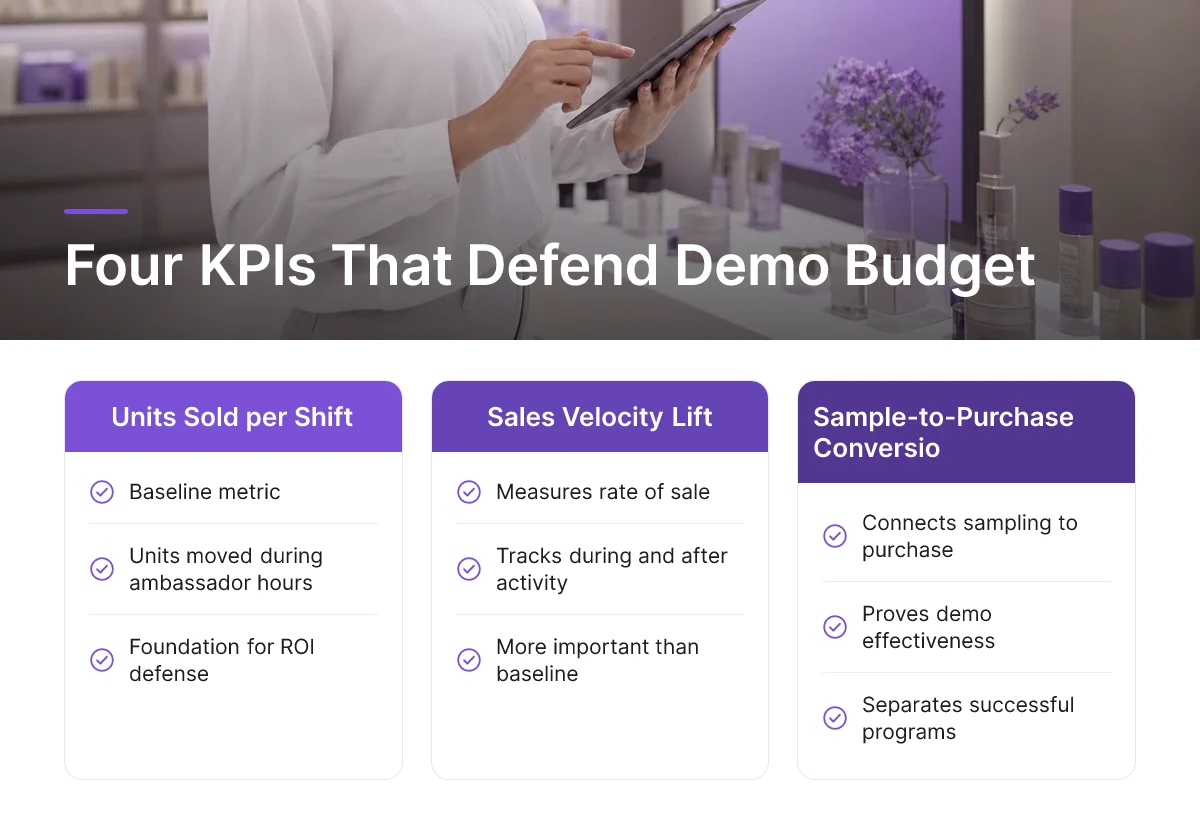
Four KPIs separate a demo program that keeps its retail shelf space from one that gets cut: units sold per shift, sales velocity lift, sample-to-purchase conversion, and ambassador compliance. Brand managers who track all four can defend their budget to finance; those who track only "samples handed out" usually can't.
The core metrics worth tracking include:
A demo near checkout with strong conversion data can justify a bigger footprint next quarter; one with high foot traffic but weak conversion usually gets cut regardless of how many samples went out. These four categories echo the standard metrics used across the industry to judge in-store brand activation performance [1], and they're the same ones retailers increasingly require before renewing a brand's shelf placement.
Revenue impact comes from comparing store sales velocity during the demo window against a comparable baseline period, same stores, same day-of-week pattern, no demo running, not from looking at raw units moved in isolation. A Saturday that moves 200 units sounds strong until you check whether that store normally moves 180 units on an average Saturday without any activation at all. This baseline comparison is what turns a demo report into a customer engagement marketing argument that finance teams actually accept, because it isolates the activation's effect from normal store traffic.
Photo compliance and consumer feedback loops have replaced "samples handed out" as the proof point brands demand from agencies and retailers, because a headcount of samples says nothing about whether the display was built correctly, staffed on time, or stocked when a Saturday rush hit. Brands now want evidence the activation ran as planned, alongside direct shopper reaction, not just a tally of product given away. Resources on customer retention strategy make a similar point: engagement data only matters when it's tied back to measurable outcomes [4].
The sales data itself typically comes from the retailer or a third-party data provider, point-of-sale feeds the brand has access to by agreement, not something a scheduling tool generates on its own. Demo Wizard's role sits on the other side of that equation: it supplies the execution and compliance data, check-ins, photo confirmation, ambassador timing, that brand managers then match against the retailer's sales numbers to calculate the actual lift.
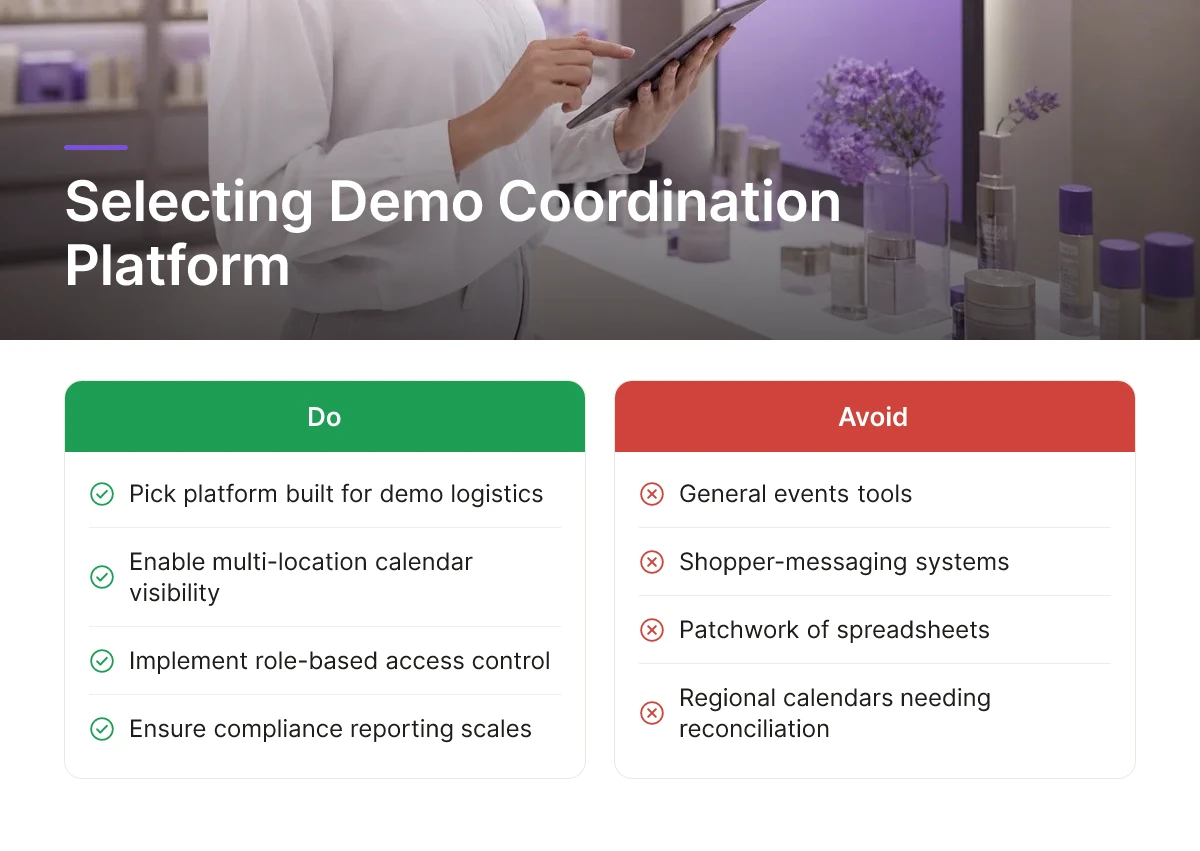
Pick a platform built for in-store demo logistics, not a general events tool or a shopper-messaging system, and weigh it against three criteria: visibility, access control, and compliance reporting that scales.
Start with multi-location calendar visibility. A coordinator running demos across 20 states needs one screen showing every scheduled event, every ambassador assignment, and every open slot, not a patchwork of spreadsheets and regional calendars that have to be reconciled by hand.
Role-based access matters just as much once a program involves more than one type of actor. A CPG brand's trade marketing lead, a retailer's store manager, and an agency's field staff all need different views into the same calendar: the brand wants ROI by store, the retailer wants to confirm no two vendors are booked in the same aisle on the same Saturday, and the agency needs ambassador assignments and payroll status. A platform that can't segment permissions by role forces someone to manually filter or redact data, which defeats the purpose of automating in the first place.
Compliance reporting is the third test. As programs grow from a handful of stores to hundreds, proof that each demo happened on schedule, in the right location, with the right setup becomes the difference between renewing a retail partnership and losing shelf space. The tool should generate that proof automatically, not require a coordinator to chase down photos and sign-offs after the fact.
Centralized scheduling and automated compliance tracking are what let headcount stay flat while store count climbs. Demo Wizard, for example, is built specifically for this problem: it coordinates scheduling, ambassador management, payroll, and post-demo analytics in one system, so a single coordinator can manage hundreds of monthly events instead of hiring a regional coordinator for every new market. That's a different job than a broad retail suite or a consumer engagement marketing platform designed to message individual shoppers, those tools solve for shopper communication or general retail operations, not the specific choreography of ambassadors, store calendars, and demo-day compliance. Paddle's overview of customer engagement strategy frames this same distinction between relationship-building tools and operational execution tools [4].
On pricing, expect three rough tiers rather than a single number: budget-friendly tools that cover basic scheduling, mid-range platforms that add ROI analytics and role-based permissions, and enterprise tiers built for national footprints with heavier compliance and reporting needs. The jump in tier is usually justified by deeper analytics, broader store-level segmentation, or support for larger ambassador networks, not just a longer feature list. Demo Wizard's per-demo pricing model, with no per-user or per-location restrictions, is one way vendors structure costs to avoid penalizing brands for growth rather than rewarding it.
In-store demonstrations give shoppers a physical, sensory interaction with a product that digital channels cannot replicate, making them one of the strongest conversion moments in the entire funnel [3]. For CPG brands, demos work alongside digital advertising and loyalty programs by closing the gap between awareness and purchase at the shelf itself [1]. They should be planned and measured as a distinct activation channel, not an afterthought.
Engagement marketing focuses on the interactions that build a relationship with a buyer, while retention and experience management focus on keeping that buyer after the sale [4]. In retail CPG terms, an in-store demo drives trial and first purchase, the engagement moment, but repeat purchase depends on product quality, shelf availability, and pricing, which sit outside what a single activation can control.
It depends on the retailer's model: club and mass retailers often charge a turnkey fee through an exclusive agency, regional grocery chains typically charge a smaller slotting or scheduling fee, and many independent or natural grocers waive fees entirely because the sampling event drives foot traffic and basket size. Brands should budget separately for the retailer's gatekeeper fee and their own ambassador labor and product costs, since these are two distinct line items.
With scheduling automation, a single coordinator can realistically manage hundreds of monthly demo events across dozens of store locations. Demo Wizard, for example, is built so one person can coordinate multi-location campaigns and ambassador assignments without adding headcount, replacing the spreadsheet-and-email juggling that caps most manual coordination around a few dozen events a month.
No. Smaller and regional brands use customer engagement marketing just as often, sometimes with more flexibility since they can negotiate directly with independent or regional grocers rather than going through an exclusive agency. The core requirements, a shared schedule, trained ambassadors, and basic ROI tracking, scale down to a handful of stores just as well as they scale up to a national footprint.

Scaling in-store demonstrations without losing visibility into ROI comes down to three things: centralized scheduling that removes spreadsheet chaos, ambassador management that keeps staffing reliable across stores, and post-demo analytics that connect specific events to sales lift. Brands that treat these as separate manual tasks burn coordinator hours and still can't answer the question retail buyers ask most, which activations actually moved product. Platforms like Demo Wizard bundle scheduling, ambassador payroll, and conversion tracking into one system, so a coordinator managing 20 stores today can manage 200 next quarter without hiring. Start by auditing your current demo calendar: if you can't tell which stores and time slots drove your last quarter's best conversion rates, that's the first gap to close, and it's the clearest sign your customer engagement marketing program needs a shared system rather than another spreadsheet.
Explore more from our content library:
Demo Wizard is the Ultimate Store Sampling & Demonstration management software for Brick and Mortar Retailers and CPG Vendors.
Chat with usPhone