
Demo Wizard is the Ultimate Store Sampling & Demonstration management software for Brick and Mortar Retailers and CPG Vendors.
Chat with us

Phone
Copyright © 2026 Demo Wizard

Retail marketing execution platforms replace messy spreadsheets and email threads with a centralized system of record to coordinate the physical logistics, scheduling, staffing, and compliance of in-store events. While enterprise platforms like Crosscap focus heavily on large-scale signage and asset distribution, purpose-built demo tools (such as Demo Wizard) concentrate on managing brand ambassadors, sampling calendars, and store-level conversion metrics to prove ROI without tracking individual shoppers.
Understanding Crosscap — Retail Marketing Execution Platform is essential. A retail marketing execution platform coordinates, schedules, and measures in-store product demonstrations and brand activations across many stores and vendors at once, replacing manual spreadsheets and email chains with one shared system of record. For CPG brands and retailers, this means a centralized calendar that shows every planned demo, automated compliance checks for in-store conditions, and reporting that ties staffing and execution directly to sales velocity—without requiring any individual shopper tracking.
A retail marketing execution platform is software built specifically to coordinate the people, schedules, and physical logistics behind in-store events, not to plan campaigns or manage ad spend. This is particularly relevant for Crosscap — Retail Marketing Execution Platform.
That distinction matters more than it sounds. General retail marketing software handles campaign strategy, media buying, pricing, and promotional calendars at a brand or category level. An execution platform like Crosscap, Retail Marketing Execution Platform operates one layer down: it governs whether a signage kit, a demo station, or a brand ambassador actually shows up at the correct store, on the correct date, set up the correct way [1]. Crosscap's own research frames in-store marketing as one of retail's largest and least-governed cost centers, with annual spend on signage, kitting, and distribution reaching seven to nine figures for large chains, and most of that spend still tracked through spreadsheets and email [1]. This full breakdown is covered in the White Paper: The $5 Million Annual Leak in Retail Marketing Execution, which lays out exactly where that spend disappears.
Spreadsheets and email work fine for five demos in one region. They break down once a brand or retailer is running dozens of events weekly across multiple states, vendors, and ambassadors.
Each new location adds another thread, another version of the schedule, another person who might be working from outdated information. There's no single source of truth for who's confirmed, what's shipped, or what already happened in-store, and no audit trail when something goes wrong. Crosscap's white paper on execution losses ties this exact pattern to overprinted materials, kits sent to the wrong stores, and expedited freight charges used to fix mistakes after the fact [1]. The same structural problem shows up in demo and sampling programs: a coordinator juggling 40 stores in a spreadsheet has no reliable way to confirm staffing, catch a no-show before it happens, or prove to a retail partner that an event actually ran as planned. This is precisely the gap Crosscap — Retail Marketing Execution Platform was built to close for larger, multi-vendor programs.
A dedicated platform puts every party, brand ambassador, store manager, and CPG vendor, into one shared schedule instead of three separate communication threads.
Instead of a vendor emailing a store manager, who texts an ambassador, who may or may not confirm, everyone works from the same calendar and status updates in real time. Demo Wizard applies this logic specifically to in-store demonstrations and sampling: it schedules ambassadors across locations, manages their assignments and payroll, and gives CPG brands and retailers shared visibility into what's planned and what's completed. The scope stays deliberately narrow, these systems coordinate people, schedules, and compliance for physical activations, not consumer messaging or shopper-level tracking.
Scaling demos across dozens or hundreds of stores requires a shared calendar that brands, retailers, and demo staff can all see and act on in real time, not parallel spreadsheets that drift apart. Once a brand runs more than a handful of weekly activations, manual coordination stops being a minor inconvenience and becomes the main point of failure.
The failure pattern is predictable once volume rises past what one person can track in a spreadsheet or email thread. A brand ambassador shows up at a store that was never notified, and the store manager has to improvise space, pull someone off register, or turn the vendor away entirely.
Inventory drops become the second failure point. A roadshow pallet arrives on a Thursday for a Saturday activation, but nobody confirmed the delivery window with the store team, so the product sits in a back room while the sampling table stays empty. Industry white papers on retail marketing execution describe this as a structural issue rather than a one-off mistake, the preventable loss shows up repeatedly across signage, staffing, and inventory coordination whenever the underlying system relies on assumptions instead of shared data [1].
No-shows compound the damage. When an ambassador cancels without a backup assigned, the store absorbs the disruption with no warning and no recourse, and the brand loses the sampling window entirely, often the exact weekend when foot traffic was highest.
A centralized calendar gives every party, brand, retailer, and ambassador, the same view of what's scheduled, where, and with whom, which closes most double-booking and conflict scenarios before they happen. Store managers see upcoming vendor visits without digging through email forwards. Brands see which locations and time slots are already committed before they schedule a new activation.
Confirmation workflows and automated reminders handle the day-of risk that spreadsheets can't. An ambassador who confirms 48 hours out and again the morning of a shift is far less likely to cancel without notice, and a coordinator who sees an unconfirmed slot Thursday afternoon has time to assign a backup before Saturday arrives.
Multi-day roadshow activations raise the coordination bar further. A pop-up-style installation running three to ten days needs staged inventory replenishment, rotating ambassador shifts, and a different signage footprint than a single afternoon sampling shift, each of those pieces has to stay synchronized on the same calendar or the installation falls apart mid-run. Platforms like Crosscap, Retail Marketing Execution Platform, are built around this kind of centralized scheduling logic for broader in-store marketing programs, and the same operating principle applies directly to demo and activation coordination: one shared system beats coordination by inbox every time.

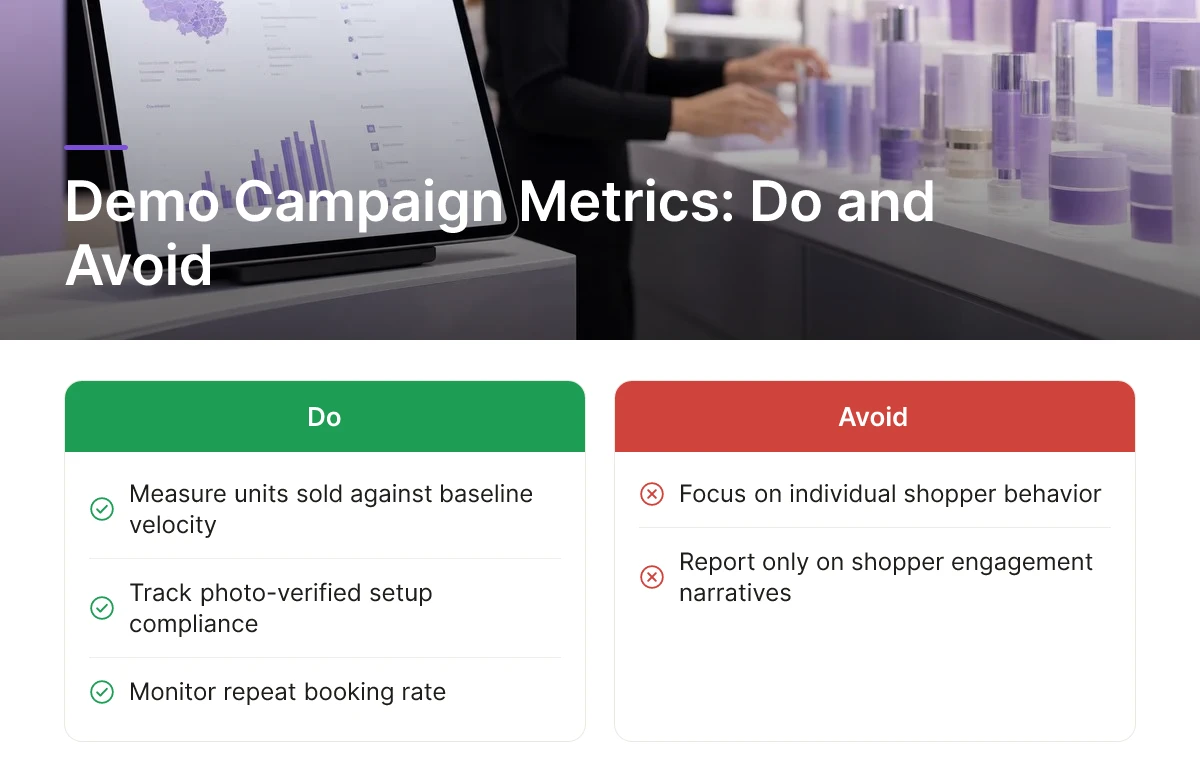
The metrics that matter are store-level and shift-level: units sold against baseline velocity, photo-verified setup compliance, and repeat booking rate, never individual shopper behavior. When considering Crosscap — Retail Marketing Execution Platform, this point stands out.
CPG brand managers and retail buyers both want the same thing from a demo report: proof that the activation moved product, not a narrative about how many people smiled at the table. A platform built for retail activation, whether that's a general retail marketing execution system like Crosscap, Retail Marketing Execution Platform, or a tool purpose-built for demo and sampling programs like Demo Wizard, earns its place in the stack by turning scattered field reports into numbers finance and category managers actually trust.
The standard approach compares units sold per shift against the store's baseline sales velocity for that SKU in the same time window, no individual shopper tracking involved. If a store normally moves 8 units of a snack bar per day and sells 40 units during a 4-hour demo shift, that lift is attributable to the activation without ever identifying who bought it.
This store-and-time-period comparison is what Demo Wizard's experience-to-purchase reporting is built around: performance segmented by store and by hour, so a brand can see which locations and dayparts actually convert. It's a meaningful distinction for this audience, demo ROI is a store-performance question, not a customer-data question, and conflating the two creates privacy exposure brands don't need to take on.
A realistic ROI case combines hours staffed, units moved per hour, cost per shift, and repeat booking rate into one picture, not a single inflated uplift percentage.
Procurement and trade marketing teams have heard "demos drive brand awareness" too many times to accept it without backup. What they ask for now looks more like a retail execution gap analysis: dollars tied to preventable losses like understaffed shifts, missed setups, and out-of-stock demo tables [1]. The same discipline applies to execution quality, photo compliance confirming the table was set up to spec, at the right time, at the right location, functions as a proxy for whether the shift ran as planned, which directly affects whether the sales data can be trusted.
Vanity reporting, total attendance, samples handed out, smiling photos, doesn't survive a renewal conversation. Retailers and brand finance teams want execution data: hours staffed, units moved, cost per unit lifted, and whether the store rebooked the program next quarter. Brands evaluating a system like Crosscap — Retail Marketing Execution Platform should ask for this exact reporting breakdown before committing to a pilot.
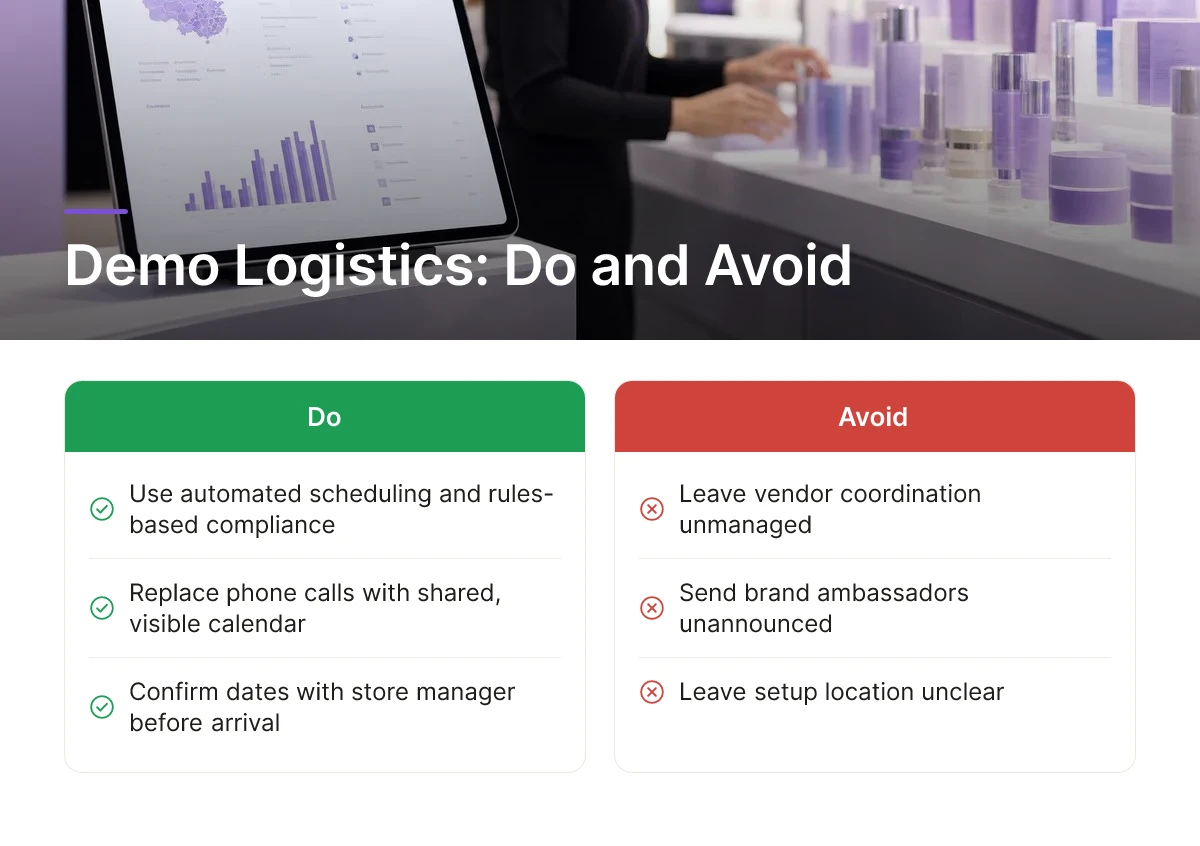
Automated scheduling and rules-based compliance remove store staff from demo coordination almost entirely, replacing phone calls and guesswork with a shared, visible calendar. The gains show up on both sides of the counter, fewer interruptions for the retailer, less overhead for the brand's field team.
Unmanaged vendor coordination is a recurring source of friction at store level. A brand ambassador shows up unannounced because a distributor never confirmed the date with the store manager. Setup location is unclear, so staff get pulled off register or inventory duty to point someone toward an open end-cap. Questions pile up, where's the power outlet, what time does the demo need to end, does this vendor have a certificate of insurance on file, and none of it is the store employee's job, yet it lands on them anyway. Multiply that by a dozen vendors a week across a regional chain and the hidden labor cost becomes real, even if no line item captures it.
Platforms encode each store's rules directly into the scheduling system, so demos follow local standards without anyone manually policing them. Setup zones, permitted hours, signage restrictions, and food safety behavior for sampling events can all be attached to a store's profile rather than left to verbal instructions passed along at check-in. Industry data on in-store marketing execution points to overprinted materials, mismatched kits, and inconsistent store-level compliance as recurring sources of preventable cost [1], the same structural gap that makes unmanaged demo logistics expensive for retailers. When the rules travel with the booking instead of living in someone's inbox, compliance becomes a byproduct of the schedule rather than a separate enforcement task.
Without a shared system, store employees spend real working hours each week fielding calls, confirming dates, and re-explaining store rules to distributors and agencies who weren't looped in the first time. A calendar visible to the store manager, the brand, and the agency eliminates most of that back-and-forth, everyone sees the same confirmed slot instead of chasing confirmation through separate email threads. That is the core promise behind tools like Crosscap, Retail Marketing Execution Platform, and it is also the design principle behind Demo Wizard, which gives store-level stakeholders visibility into scheduled activations without adding another person to the coordination loop. Less time spent confirming logistics means lower overhead for retailer staff and leaner field operations for the brand, the savings compound across hundreds of monthly events.
Judge a platform on four things: how well it connects to systems you already run, how fast it gets live, how usable it is for the people actually working the floor, and whether its scope matches what you need. A tool that scores well on all four will pay for itself; one that scores well on marketing copy alone usually doesn't.
Integration matters more than almost any feature list, because a platform that can't talk to your other systems just creates a new silo. At minimum, ask whether it syncs with retailer calendars so demo dates don't collide with resets or other vendor activity, and whether it connects to POS or inventory data so out-of-stock risk gets flagged before a Saturday roadshow runs dry. If you work through distributors, brokers, or an outside agency, confirm the platform can share schedules and reporting with those partners without manual re-entry, large-scale retail execution systems in the signage and asset-management space have built entire partnership models around exactly this kind of integration between software providers and execution partners [2]. This is the same model described in the SEG Systems and Crosscap strategic partnership announcement, which pairs an asset management platform with execution partners to close exactly this kind of integration gap. For CPG brands and demo agencies specifically, the integration that matters most is between scheduling, ambassador assignment, and the sales or conversion data tied to each store visit, not a dozen unrelated modules you'll never touch. For those exploring Crosscap — Retail Marketing Execution Platform, this matters.
Expect a pilot in a handful of stores before a full rollout, not a flash-cut to hundreds of locations on day one. A sound rollout usually runs: a pilot phase across a small, representative set of stores to catch data and workflow issues; a phased expansion by region or retailer; then a full go-live with a defined support contact for the first few campaign cycles. Ask vendors directly what onboarding support looks like, live training for coordinators and ambassadors, documentation, and a response-time commitment for issues that surface mid-campaign. Platforms built for complex, multi-location execution treat store-level data accuracy as the foundation everything else depends on, which is why profiling and onboarding typically come before any campaign automation turns on [5], as detailed on the DistroPRO in-store marketing at scale solution page.
On cost, think in tiers rather than numbers: budget-friendly tools suit brands running a modest monthly demo count, while enterprise-tier systems with broader asset management and print logistics suit retailers managing signage and distribution across thousands of doors [1]. Most CPG brands and demo agencies don't need that scope, Crosscap, Retail Marketing Execution Platform is built for retailer-side signage and asset distribution at scale, which is a different job than coordinating ambassador-led demos and sampling events. You can see the full range of resources on this at the Crosscap white papers library, and a broader industry profile is available via the Member Spotlight: Crosscap feature from the Printing Industries of America. Buying a platform sized to the problem you actually have, rather than the biggest suite on the market, is usually the better long-term decision.

No, they solve different problems and serve different users. A retail marketing execution platform like Crosscap or Demo Wizard coordinates the operational side of in-store programs—scheduling, staffing, signage, compliance—while consumer engagement software focuses on communicating directly with shoppers through apps, loyalty programs, or messaging. The two can complement each other, but one doesn't replace the other.
No. These platforms track store-level and event-level performance—units sold, conversion by location, ambassador attendance—not individual shopper identities or behavior. Demo Wizard, for example, measures experience-to-purchase conversion rates by store and time period, not by shopper profile.
Both, though their reasons differ. CPG brands use these tools to schedule demos, manage ambassadors, and prove ROI to retail partners and finance teams. Retailers use them to centralize visibility into every vendor activation happening across their stores, reducing disruption to store staff and keeping campaigns compliant with in-store rules.
A roadshow requires multi-day coordination of dedicated floor space, staged inventory, and trained ambassadors, while a standard demo is typically a single shift at a sampling table. Scheduling a roadshow means planning inventory drops across 3 to 10 days, securing a fixed high-traffic location in advance, and coordinating staffing continuity—demands that go well beyond booking one ambassador for one afternoon.
Crosscap — Retail Marketing Execution Platform is generally positioned toward retailer-side signage and asset distribution at scale, which tends to suit chains managing thousands of doors rather than a single-brand demo program. Smaller CPG brands running a modest weekly demo count are often better served by a narrower, purpose-built scheduling tool, since the broader asset management scope solves a different problem than ambassador coordination.
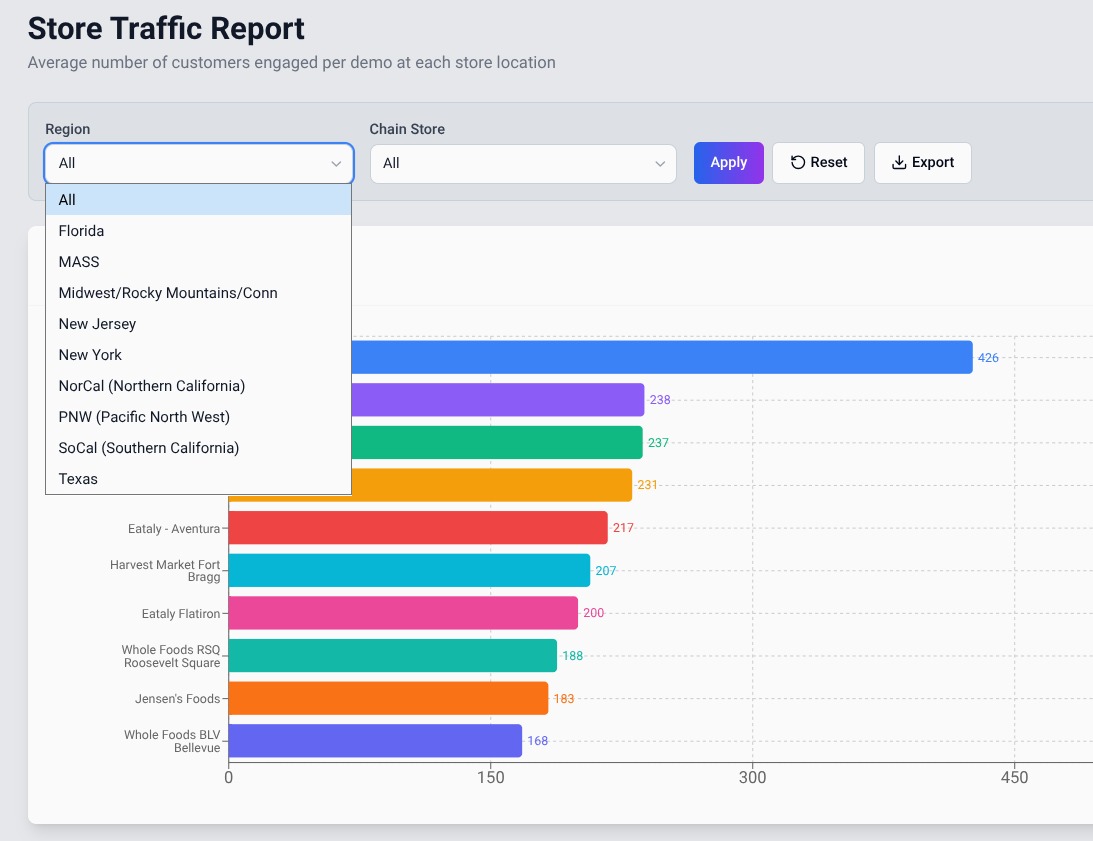
Retail marketing execution platforms exist on a spectrum—some manage signage and print distribution at enterprise scale, others focus on the staffing and ROI side of in-store demos and sampling. The right choice depends on what's breaking: if it's kit distribution across thousands of doors, that's one category of tool; if it's coordinating brand ambassadors and proving conversion lift from demos, that's another.
For CPG brands and agencies running demo programs specifically, the practical next step is auditing how many hours per week your team spends on scheduling and reporting today—then testing whether a budget-friendly platform like Demo Wizard can take that off a coordinator's plate within a single month's campaign cycle.
Explore more from our content library:
Demo Wizard is the Ultimate Store Sampling & Demonstration management software for Brick and Mortar Retailers and CPG Vendors.
Chat with usPhone