
Demo Wizard is the Ultimate Store Sampling & Demonstration management software for Brick and Mortar Retailers and CPG Vendors.
Chat with us

Phone
Copyright © 2026 Demo Wizard


Understanding the top retail campaign management platforms for coordinating demo staff scheduling and shopper engagement tracking is essential. Specialized demo campaign platforms coordinate in-store demo staff scheduling and track demonstration execution in one system, replacing phone calls, spreadsheets, and texts between brands, agencies, and store staff. These platforms let coordinators assign ambassadors to stores, confirm shifts, log check-ins and photo compliance, and connect that activity to sales-per-shift data. For CPG brands and retailers running frequent activations, this turns scattered coordination into a single, auditable calendar of demo activity and its measurable retail impact.
These platforms manage two things: who is staffing a demo table at which store and when, and what happened at that table once the ambassador showed up. This is particularly relevant for top retail campaign management platforms for coordinating demo staff scheduling and shopper engagement tracking.
That second piece, "shopper engagement tracking" in this context, does not mean messaging shoppers or building consumer profiles. It means logging demo activity, attendance, and photo or compliance proof tied to a specific store visit, a timestamped check-in, a photo of the table setup, a sales-per-shift figure pulled from the register. The subject being tracked is the demo event, not the individual shopper walking past it. Brands and retailers who confuse this with broad consumer engagement software end up evaluating the wrong tools entirely, because these platforms are built around field operations, not customer data profiles.
Most teams still run this by phone and spreadsheet. A brand activation manager calls or texts a roster of ambassadors to confirm availability, emails a store manager to lock in a table location, then updates a shared spreadsheet that may or may not reflect the latest change. Demo agencies juggling multiple CPG clients repeat this cycle dozens of times a week, often across different regional contacts with no shared calendar. Retail execution research describes a similar gap between what headquarters plans and what actually happens on the sales floor, promotional displays get distributed, but execution at the store level varies widely without a system to confirm it [3].
Phone trees and email chains break down in predictable ways. Two ambassadors get assigned to the same table on the same Saturday. A no-show at a Phoenix location surfaces only when the regional manager calls asking why the demo never happened. Nobody has one place to check who is working which store, so confirming a schedule means re-asking the same question across three communication channels.
Add more stores and the problem does not scale linearly, it compounds. A coordinator managing five locations can track details from memory and a sticky note. A coordinator managing two hundred monthly events across twenty states cannot, because every added location adds its own store manager, time zone, and point of contact. This is precisely the operational strain that distinguishes demo coordination from generic retail marketing or employee scheduling software, which assumes a fixed workforce at fixed locations rather than a rotating cast of ambassadors covering activations that change weekly. A broader comparison of retail management tools shows how general-purpose scheduling platforms are built around different assumptions entirely [5].
Specialized scheduling software replaces phone calls and spreadsheets with a shared calendar where shifts, acceptances, and fill rates update in real time for everyone involved.
Coordinators managing dozens of weekly demos across multiple states cannot afford to call each brand ambassador individually to confirm availability. A centralized calendar flips that workflow: the coordinator posts an open shift with store, date, and product details, and available ambassadors claim it directly from their phone. If someone cannot make it, they can trigger a swap request instead of leaving the coordinator to discover a gap the night before. The manager's screen shows fill status across every location at a glance, which shifts are staffed, which are still open, and which need backup.
Ambassadors and coordinators need different views of the same data, and the best tools build separate interfaces for each.
On the ambassador side, the mobile experience stays deliberately simple: accept a shift, check in on arrival, upload a photo of the table setup, and check out when the demo wraps. That check-in/check-out sequence, paired with photo evidence, replaces the old self-reported recap email, a coordinator no longer has to take someone's word that a demo happened as scheduled. Automated confirmation requests and day-before reminders also cut down on no-shows, since the system nudges ambassadors without requiring a coordinator to manually dial every person on the roster.
Campaign managers need the opposite kind of view: aggregate visibility across every store, every ambassador, and every shift in a single dashboard, rather than a list of individual actions. This is the layer where these platforms earn their keep, turning hundreds of individual check-ins into a single operational picture a coordinator can review in minutes rather than hours. Demo Wizard, for instance, builds its scheduling layer around this split: ambassadors get a short list of mobile actions, while coordinators get store-by-store fill rates and payroll tied to completed shifts, not just booked ones.
Demo schedules that live separately from a store's own event calendar create real risk: two vendors showing up for the same table, or a demo landing on a day the store has blocked for inventory resets. Platforms that sync with store-level event calendars flag these conflicts before they happen, rather than leaving a store manager to sort out a double-booking on the sales floor. For retailers hosting activations from multiple CPG brands in the same week, that shared visibility is what keeps one brand's roadshow from colliding with another's standard sampling shift.

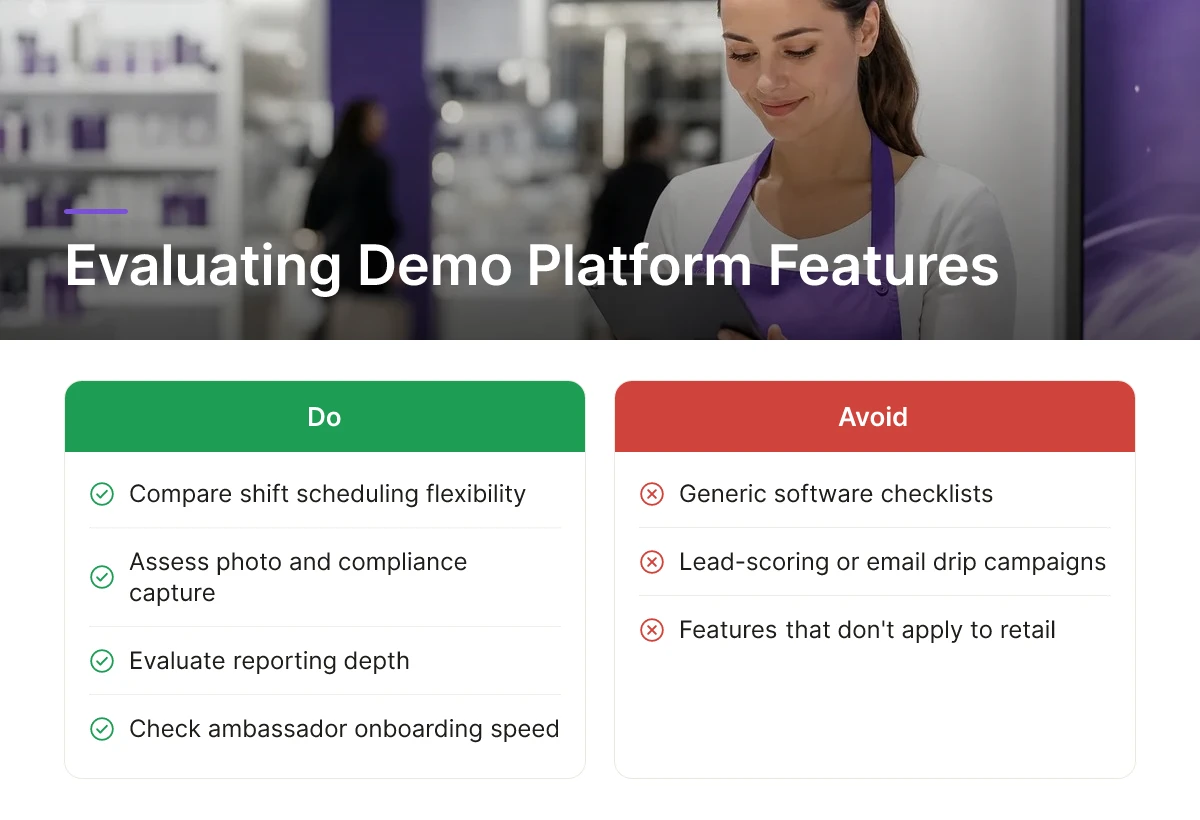
Compare platforms on five concrete criteria: shift scheduling flexibility, confirmation workflows, photo and compliance capture, reporting depth, and how fast ambassadors can get onboarded. For more information, see Book A Threatlocker Demo.
Generic software checklists lead buyers to features that sound relevant but don't apply to retail activations. A demo coordinator does not need lead-scoring or email drip campaigns. They need a system built around the actual unit of work in this business: a scheduled event, at a specific store, staffed by a specific ambassador, with a specific outcome to measure. A side-by-side look at store management suite software illustrates how differently these priorities are weighted outside the demo-specific category [6]. When considering top retail campaign management platforms for coordinating demo staff scheduling and shopper engagement tracking, this point stands out.
General workforce management tools schedule shifts and track hours; they have no concept of per-event sales uplift or activation-specific compliance. Tools built for retail staffing and employee scheduling, the kind evaluated in broader retail management comparisons, are designed around recurring store shifts and payroll accuracy [4]. That's a different problem than coordinating a three-day roadshow across forty stores with a rotating bench of brand ambassadors.
Demo-specific platforms track a different data model: events tied to products, stores, and conversion outcomes, not just hours worked. This is the core distinction buyers should apply when comparing these tools against adjacent categories like retail execution software, which focuses on planogram compliance and stock checks rather than staffing live demo events [3].
Demo platforms collect operational data: ambassador check-ins, store conditions, setup photos, and units sold. They do not collect individual shopper data, no names, no purchase history tied to a person, no consumer-level tracking. Demo Wizard, for example, measures experience-to-purchase conversion rates and sales impact at the store and time-period level, not by tracking individual shoppers. That distinction matters when retail partners ask what data a vendor's app is gathering inside their stores.
On pricing, expect three rough tiers: budget-friendly tools for single-market or small sampling programs, mid-range platforms built for growing multi-store operations, and premium or enterprise options for multi-brand portfolios running activations nationally. Ask vendors directly whether adding users or locations triggers additional cost, per-seat pricing models can quietly inflate costs as a program scales from ten stores to two hundred.
They pair logged demo shifts against store sales data for the same window, then compare that period to non-demo days to estimate uplift. This is the core mechanism behind every credible ROI read in retail activation, and it depends entirely on how clean the underlying shift data is.
The basic method is straightforward: a platform records when a demo happened, date, store, start and end time, and lines that up against sales figures from the same store during that window. Compare the demo-day sales to a baseline from a comparable non-demo period, and you get a directional read on lift. Products featured in retail and in-store demos often sell over 40% better than non-sampled items [1], which is the kind of result brands want to isolate store by store rather than assume applies evenly everywhere.
These platforms replace the old reporting cycle, waiting two or three weeks for an agency or coordinator to compile a spreadsheet, with dashboards that update as shifts close out. A brand activation manager can check Tuesday's demo results on Wednesday morning instead of at the end of the quarter, which matters when a campaign is running across dozens of stores and early signals should inform where to add or pull shifts.
Photo compliance and check-in timestamps serve as the proof layer underneath the sales numbers. A geotagged check-in confirms the ambassador showed up at the right store at the right time; a photo of the table setup confirms it looked the way the brand specified. Retail buyers increasingly expect this kind of documentation before renewing shelf space or demo privileges, and it's the evidence that turns a sales claim into something a retail partner can audit. Demo Wizard builds this into its performance insights by segmenting results at the store and time-period level, so a coordinator can see not just that a campaign worked, but where and when it worked best.
Rolling this out takes a realistic runway. Expect initial setup and ambassador onboarding, then a pilot across a handful of stores to confirm the scheduling and reporting workflows hold up, before scaling to the full store list. Skipping the pilot is the most common reason brands end up with messy, inconsistent data six months in.
None of this replaces a controlled experiment. Demo-driven uplift estimates are directional, they account for seasonality and promotions imperfectly, and are strongest when paired with retailer point-of-sale data where a brand can access it [3].
A centralized demo calendar gives store managers visibility into every vendor activation before it happens, cutting the scheduling conflicts and surprise setups that disrupt daily store operations.
Grocery retailers don't request demos, they host them. Every CPG brand, broker, and demo agency wants a table near the entrance on a Saturday, and without a shared system, store staff end up as the default traffic controllers. A single calendar visible to store management, the brand, and the demo company closes that gap. When a vendor books a slot, the store sees it immediately, along with who's coming, what they're bringing, and where they plan to set up. That visibility alone prevents the scenario every store manager knows too well: two brand ambassadors arriving for the same end-cap at the same hour, or a vendor showing up with a folding table and no record of ever being approved. For those exploring top retail campaign management platforms for coordinating demo staff scheduling and shopper engagement tracking, this matters.
Automated check-in and compliance tracking extends that same logic to execution. Instead of a manager walking the floor to confirm an ambassador set up in the right spot, arrived on time, and followed the store's footprint rules, the platform logs it. Geo-tagged check-ins and photo or timestamp confirmation do the policing that used to fall on store personnel [1]. That matters because compliance failures, wrong location, oversized displays, extended hours, are usually what turn a welcome activation into a liability for the store.
Retailers don't need a full retail execution suite to solve a vendor-coordination problem, they need a tool built specifically for it. Broad platforms that bundle planogram compliance, inventory checks, and workforce management across every in-store function [3] ask a retailer to adopt an entire operating layer just to fix demo scheduling conflicts. A purpose-built coordination tool like Demo Wizard addresses that one workflow directly: it gives every party a shared schedule and tracks execution against the store's own rules, without requiring the retailer to overhaul how it manages inventory or staff. Among demo-specific platforms, the ones retailers adopt fastest tend to be the narrowest in scope, not the broadest.
The payoff shows up in two places: less staff time spent fielding vendor phone calls and approving last-minute schedule changes, and more consistent execution of the activations retailers actually want. Demos that run on time, in the right spot, without disrupting aisle traffic are the ones that reliably lift basket size and foot traffic, which is the entire reason a retailer agreed to host them in the first place.

No, these platforms do not track or identify individual shoppers. Demo Wizard and similar systems measure aggregate outcomes, units sold, conversion rates by store and time, and ambassador performance, not personal shopper data. The analytics tie demo events to sales lift, not to the people who stopped by the table.
No, they reduce the administrative load on a coordinator rather than eliminate the role. A platform like Demo Wizard automates booking, availability matching, and payroll so one coordinator can run hundreds of monthly events instead of dozens, but someone still sets strategy, handles exceptions, and manages retailer relationships.
Most teams can launch a pilot across a handful of stores within days, then expand store-by-store over a few weeks. Timelines depend on how many retail banners are involved and whether ambassador rosters and payroll data need to be imported first. Brands running simpler single-banner programs often move faster than agencies juggling multiple retailer compliance rules.
General scheduling software manages shifts and attendance; demo coordination platforms connect staffing to sales outcomes. Tools built for retail activations, like Demo Wizard, pair ambassador scheduling with store-level ROI tracking and payroll tied to completed events, a layer that generic workforce scheduling tools, built for fixed retail staff rather than traveling demo teams, don't offer.
It depends on volume. A brand running a handful of demos a month may manage fine with spreadsheets and phone calls. Once a program grows past a few dozen monthly events or spans multiple states, the administrative overhead and risk of no-shows usually justify a dedicated platform, since manual coordination rarely scales cleanly beyond that point.

Coordinating demo staff and proving sales impact requires more than a shared calendar or a generic scheduling app. The brands and agencies scaling past 50 or 100 monthly events rely on platforms that combine ambassador scheduling, payroll, and store-level conversion data in one system, because spreadsheets and disconnected tools break down well before that volume. Retailers benefit too, gaining a single calendar of activity instead of fragmented vendor requests. If you're currently managing demos across spreadsheets and texts, start by auditing how many hours per week go to scheduling alone, that number usually makes the case for automation on its own.
Explore more from our content library:
About the Author
Written by the SaaS / Retail Marketing Technology experts at Demo Wizard. Our team brings years of hands-on experience helping businesses with SaaS / Retail Marketing Technology, delivering practical guidance grounded in real-world results.
Demo Wizard is the Ultimate Store Sampling & Demonstration management software for Brick and Mortar Retailers and CPG Vendors.
Chat with usPhone