
Demo Wizard is the Ultimate Store Sampling & Demonstration management software for Brick and Mortar Retailers and CPG Vendors.
Chat with us

Phone
Copyright © 2026 Demo Wizard
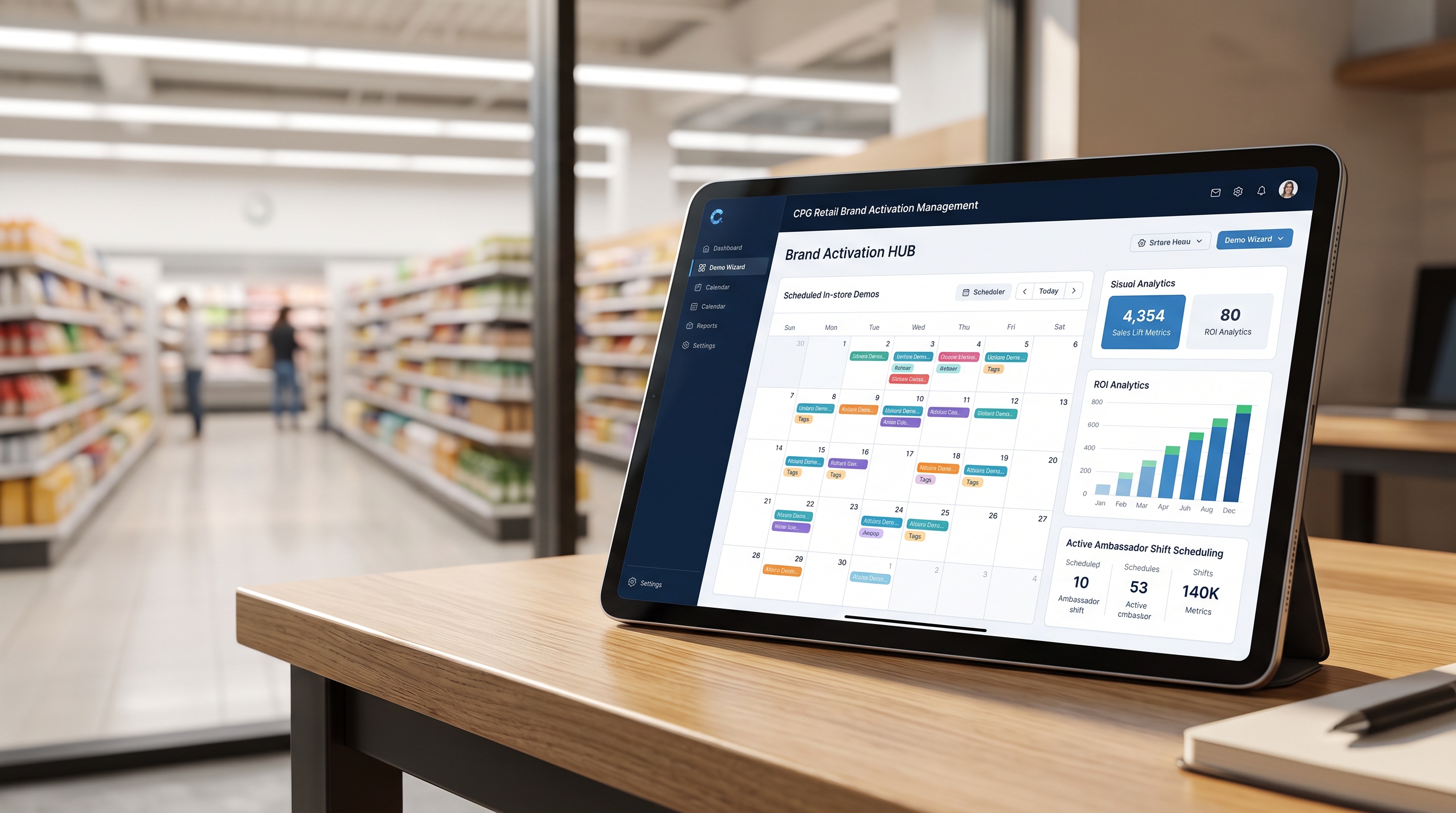
The best software for brand activations coordinates, schedules, tracks the ROI of in-store product demonstrations, and generates actionable analytics to help CPG brands, retailers, and demo agencies stop relying on email chains and spreadsheets and optimize their operations. These platforms centralize scheduling, automate compliance with in-store conditions, and connect demo activity to sales lift and performance data. The right choice depends on whether you need a focused in-store demo coordination tool or a broader activation management system and whether your priority is CPG brand oversight or retailer-side store operations.
Demo Wizard bundles in-store demo scheduling, brand ambassador management, and post-demo ROI analytics into one platform built specifically for CPG retail activations. This is particularly relevant for Best Software for Brand Activations.
Unlike generic event tools, Demo Wizard's core job is coordination at scale: a brand or agency inputs store locations, campaign details, and ambassador availability, and the platform automates scheduling across every location, handles ambassador payroll, and generates performance data tied to experience-to-purchase conversion. The result is a single coordinator can run hundreds of monthly demo events across dozens of states without hiring additional staff.
It fits CPG brands running national sampling programs, demo agencies and distributors juggling multiple client calendars, and retailers who need one centralized view of vendor demo activity instead of chasing updates store by store. Searches for the best software for brand activations usually surface broad experiential marketing suites built for pop-ups and events, Demo Wizard stays focused on the mechanics of in-store sampling specifically.
What sets it apart from the top competitors in this category: Demo Wizard applies automatic compliance to in-store conditions and behavior, which cuts down how much store staff have to get involved in coordinating with vendors, brokers, and ambassadors in the first place.
These tools manage shift assignments, availability windows, and the geographic spread of brand ambassador talent across many retail doors at once.
Agencies and CPG brands with large rosters of part-time or gig-based demo staff use these platforms to fill shifts dynamically, often with incentive-based pay models that reduce day-of call-outs, one of the most common reasons a scheduled demo never actually happens. Dynamic scheduling also helps managers reassign a no-show ambassador quickly instead of losing the entire event window.
This category serves agencies and brands managing dozens or hundreds of ambassadors across regions, where manual scheduling in spreadsheets breaks down past a certain headcount. The differentiator worth evaluating: does the scheduling data feed a calendar that stores and distributors can see, or does it stay locked inside the agency's own system? Pairing ambassador scheduling with a shared demo calendar gives retailers visibility into all vendor activity, not just confirmation that an agency filled its shifts.
These tools use geo-fenced check-ins and photo verification to confirm ambassadors arrived, set up correctly, and ran the demo as planned.
The key benefit is proof without on-site supervision, a retailer or brand manager can confirm a vendor followed setup rules and store conditions without a manager standing at the table. For multi-location retailers juggling several simultaneous vendor demos on a busy Saturday, that proof matters more than a timestamp; it is evidence the activation didn't create a compliance problem or safety issue on the floor.
This software fits grocery and big-box retailers managing many vendor demos per week across departments, where one disruptive or out-of-compliance activation can create friction with store management. The real differentiator is automatic enforcement of behavior and condition rules, flagging a missing permit, an unapproved location, or an ambassador working outside assigned hours, rather than simply logging that someone checked in on time.
A centralized demo calendar gives store managers, brand coordinators, and demo staff one shared view of every scheduled in-store activation.
The benefit is straightforward: no more double-booking two CPG vendors into the same end-cap, and no more surprise demo tables blocking an aisle during a scheduled reset. Grocery retailers fielding dozens of vendor requests weekly across produce, deli, frozen, and center-store departments need this kind of shared visibility to avoid scheduling conflicts that frustrate both shoppers and store teams. When considering Best Software for Brand Activations, this point stands out.
This category is best suited to grocery and specialty retailers coordinating activity from many brands and brokers at once, rather than a single CPG brand managing its own calendar. The differentiator that matters here: does visibility stay internal to store staff, or does it extend outward to distributors, brokers, and agencies submitting requests? A calendar that only store employees can see still requires someone to manually relay schedules to outside vendors, the more useful systems give everyone involved, inside and outside the store, access to the same live schedule.
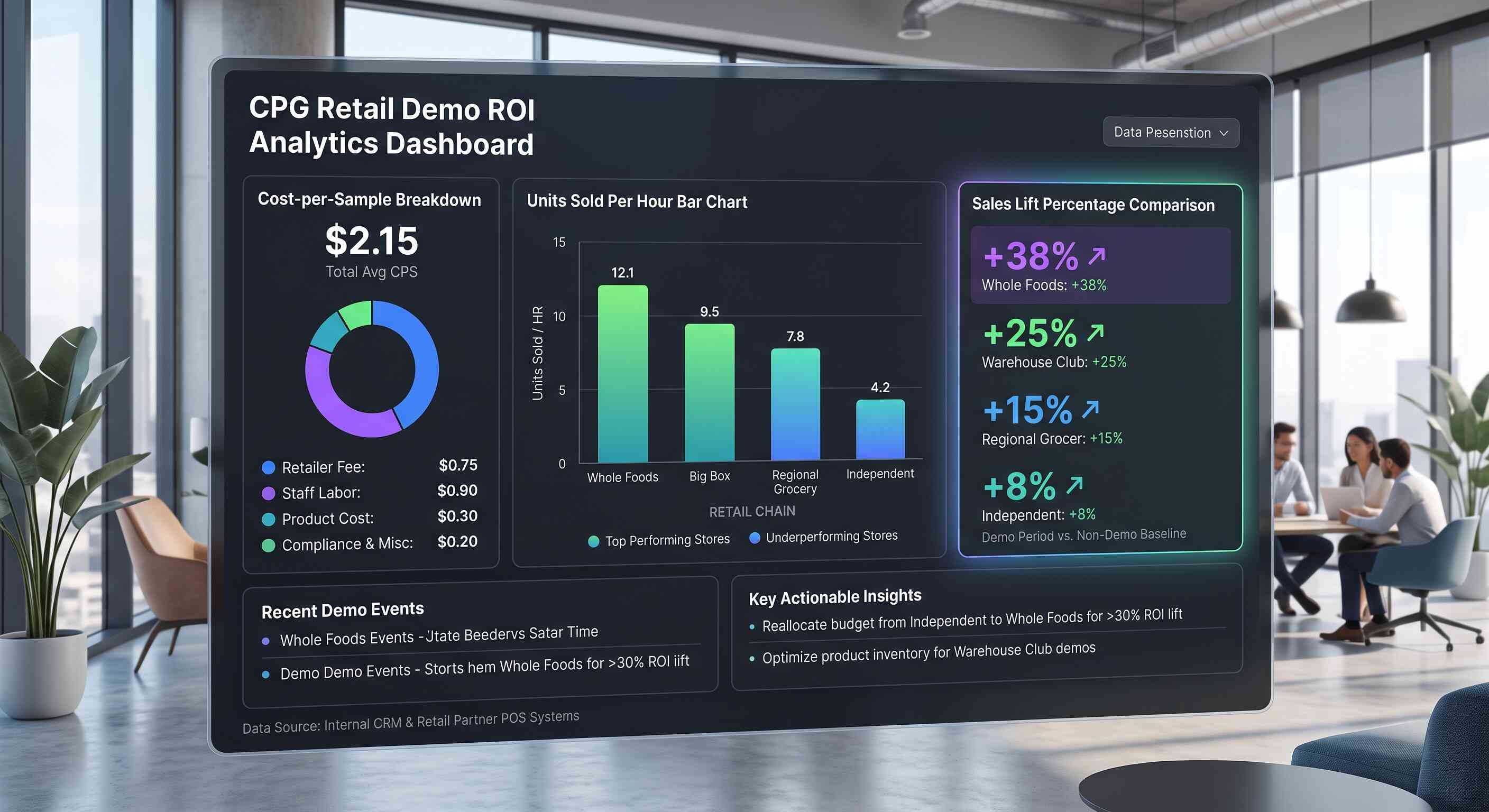
These dashboards connect demo event data to point-of-sale or inventory movement, showing what a specific activation actually sold.
The benefit for brand managers and agencies is replacing manual spreadsheet reporting with performance data they can hand to finance or a retail partner on demand, instead of compiling it after the fact from ambassador notes. When evaluating the best software for brand activations, this is the category that separates tools that just schedule events from tools that prove those events were worth running.
It serves brand managers who need to justify demo spend internally, and agencies that need hard numbers to retain CPG accounts at renewal time. The differentiator is mechanism, not just output: the strongest tools isolate lift by matching the exact sales window against the scheduled demo window, store by store and hour by hour, rather than relying on an ambassador's self-reported sense of how busy the table was. That store-and-time-level matching is what turns a conversion claim into something a retail buyer or a finance team will actually trust.
Mobile reporting apps let brand ambassadors log photos, notes, and inventory flags from the store floor during the shift itself, not after.
The benefit is proof-of-performance captured at the moment it happens. An ambassador who notices a shelf gap or a surge in samples taken can flag it in seconds rather than trying to reconstruct the detail from memory during an end-of-day recap. That immediacy matters to CPG brand managers who need photo compliance and attendance records they can trust, not a summary written on a drive home.
These apps fit field teams covering many stores in a single day or week, where carrying a laptop between aisles isn't realistic. A phone in a pocket is the only hardware that scales with a roadshow schedule spanning a dozen locations.
The differentiator worth checking before you buy: does the reporting feed the same record used for scheduling and compliance, or does it live in a separate app? Tools built as one of the Best Software for Brand Activations tie field reports directly to the shift record, so a coordinator never has to reconcile two data entry systems to confirm a demo actually happened as planned.
These portals let store and category managers approve, schedule, and track incoming vendor demo requests from one screen instead of an inbox.
The key benefit is time back for store staff. A category manager fielding a dozen emails a week from different brands, brokers, and agencies about table space and dates loses hours that should go to running the department. A portal consolidates those requests into one queue with approval status visible to everyone involved.
This category serves regional and national grocery chains handling high volumes of vendor demo requests across many doors. A single-store independent grocer rarely needs this layer; a chain approving hundreds of requests a month does.
These add-ons give visibility into product stock levels ahead of a scheduled demo date, flagging shortages before the event, not during it.
The benefit is avoiding the single most damaging failure in an in-store activation: running out of product mid-shift. A roadshow or sampling event depends on frictionless taste-to-purchase, where a shopper samples the product and grabs it from the display immediately. An empty pallet at 2 p.m. on a Saturday kills that momentum and the sales data along with it.
CPG brands running multi-store or multi-week activation schedules get the most value here, since manually checking stock at twenty locations before every weekend isn't sustainable for one coordinator. Demo Wizard's performance insights, which identify high-performing stores and optimal demo times, pair naturally with this kind of stock visibility since both depend on knowing what's happening at the shelf, not just on the calendar.
The differentiator is the link to the demo calendar itself. Inventory tools that sit apart from scheduling require someone to manually cross-check two systems; the ones worth adopting tie forecasting to the actual event date, so a low-stock flag shows up next to the shift it threatens.
Pick based on how much fragmentation your current process can tolerate: manual spreadsheets, single-purpose point tools, and unified platforms each trade off differently between flexibility and one source of truth.
Manual coordination, a shared spreadsheet and group texts, is cheap to start but breaks down past a handful of weekly events because no one has a single view of what's scheduled, who showed up, and what sold. Point solutions, a scheduling app here, an ROI dashboard there, solve one problem each but create reconciliation work when data has to move between them by hand. A unified platform trades some customization for a single record that scheduling, payroll, and analytics all reference, which is the trade-off most coordinators managing 50 or more monthly demos eventually choose [3].
Prioritize compatibility with the retail systems you already run: POS or sales data feeds, distributor communication channels, and clean reporting exports finance and retail partners can open without reformatting. A tool that can't export a simple store-by-store performance file creates as much manual work as the spreadsheet it replaced.
Start with a limited set of stores, ten to twenty, before committing to a full-chain rollout. A phased approach surfaces scheduling conflicts and store-specific compliance quirks while the stakes are still low, and it gives store employees time to adjust without disrupting an entire region's demo calendar at once.
Weigh cost against scale honestly. Budget-friendly tools often cap functionality at basic scheduling; mid-range options add ROI tracking and ambassador management; premium platforms bundle payroll, analytics, and trade promotion tools in one system. Demo Wizard's per-demo pricing model, starting at $3 per demo with no per-user or per-location restrictions, fits brands scaling past a few dozen monthly events who don't want cost to climb just because they add stores or staff.
Finally, be honest about scope. A CPG brand or demo agency coordinating in-store sampling needs a focused tool built around scheduling, ambassadors, and conversion data, not a broader experiential marketing suite designed for pop-ups, loyalty programs, or digital engagement campaigns that have nothing to do with the retail floor. This directly impacts Best Software for Brand Activations outcomes.
Prioritize compatibility with the retail systems you already run: POS or sales data feeds, distributor communication channels, and clean reporting exports finance and retail partners can open without reformatting. A tool that can't export a simple store-by-store performance file creates as much manual work as the spreadsheet it replaced.
Start with a limited set of stores, ten to twenty, before committing to a full-chain rollout. A phased approach surfaces scheduling conflicts and store-specific compliance quirks while the stakes are still low, and it gives store employees time to adjust without disrupting an entire region's demo calendar at once.
Weigh cost against scale honestly. Budget-friendly tools often cap functionality at basic scheduling; mid-range options add ROI tracking and ambassador management; premium platforms bundle payroll, analytics, and trade promotion tools in one system. Demo Wizard's per-demo pricing model, starting at $3 per demo with no per-user or per-location restrictions, fits brands scaling past a few dozen monthly events who don't want cost to climb just because they add stores or staff.
Finally, be honest about scope. A CPG brand or demo agency coordinating in-store sampling needs a focused tool built around scheduling, ambassadors, and conversion data, not a broader experiential marketing suite designed for pop-ups, loyalty programs, or digital engagement campaigns that have nothing to do with the retail floor. This directly impacts Best Software for Brand Activations outcomes.
In-store demos focus on one retail location, one transaction window, and a direct path from sample to sale. Experiential campaigns often span pop-ups, events, and digital touchpoints aimed at brand awareness rather than immediate purchase. A demo's success is measured by units moved during a shift; an experiential campaign's success is measured by reach, engagement, or sentiment.
Most brands can't match ambassador attendance records to store-level POS data in the same system, leaving a gap between "the demo happened" and "sales moved." Spreadsheets track hours worked, not conversion. Without a platform that pairs scheduling data with sales-by-store-and-time reporting, brands are left guessing which activations actually drove purchases.
Store staff often field vendor emails, calendar conflicts, and last-minute reschedules manually, pulling them away from core store operations. The exact hours vary by store size and vendor volume, but any time spent on logistics instead of customers reduces the operational value a demo program is supposed to add. Centralized scheduling removes most of that burden.
Quality drops because conflicts, no-shows, and double-bookings go unnoticed until the ambassador fails to show up. Spreadsheets don't flag when two brands book the same end-cap or when a store's compliance window closes. The result is inconsistent execution and gaps in the sales data brands need to justify shelf space.
Demo coordination tools manage ambassadors, store schedules, and conversion data tied to physical retail locations rather than individual shopper profiles. Consumer engagement platforms focus on messaging, loyalty, and personalization aimed at shoppers directly. Demo Wizard, for example, tracks experience-to-purchase conversion by store and time period without collecting or messaging individual consumer data, keeping its scope limited to coordinating ambassadors and measuring in-store sales impact.
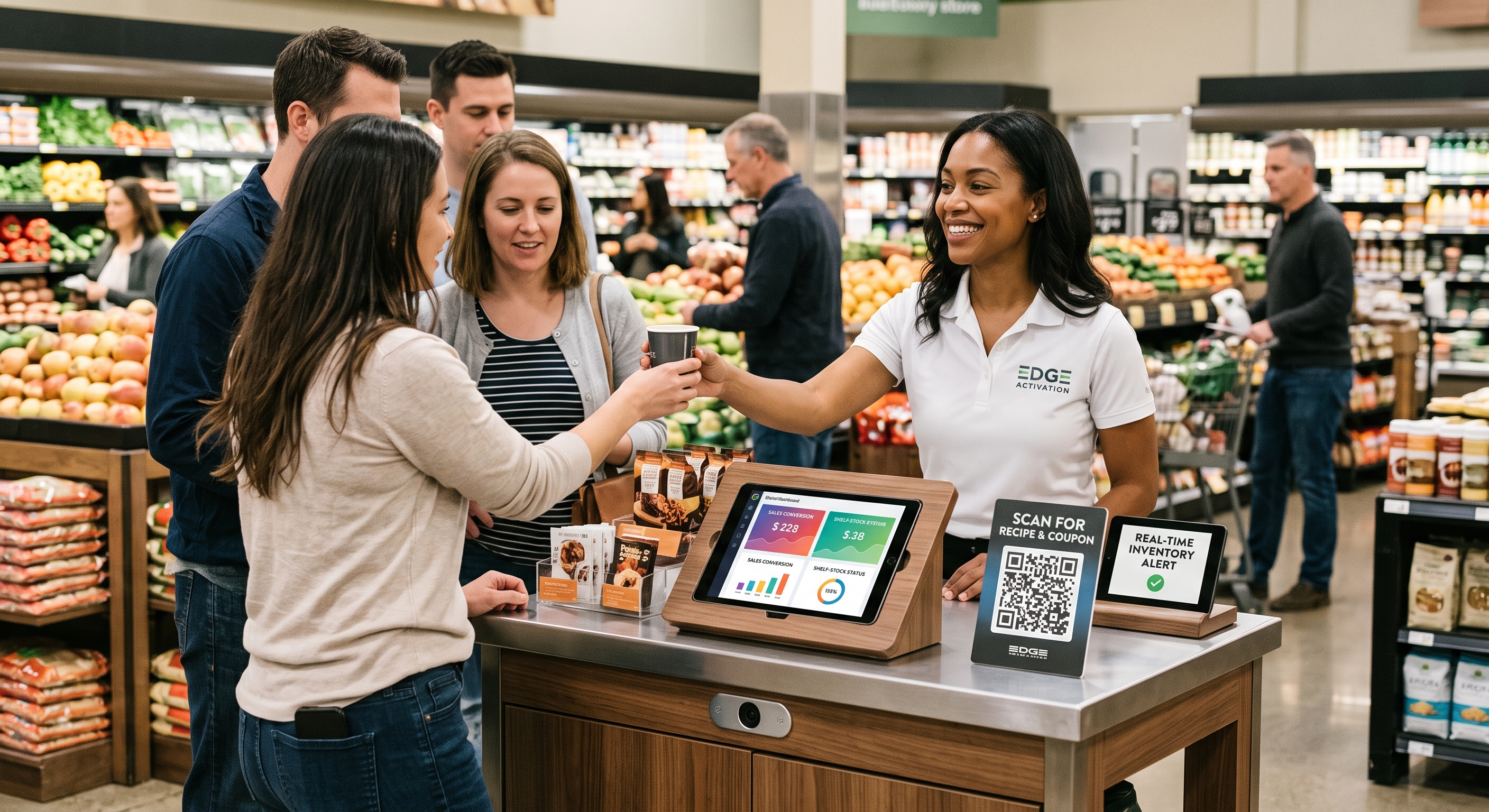
Picking software for brand activations comes down to three questions: can it schedule across every store on your calendar, can it manage ambassadors and payroll without manual follow-up, and can it tie each demo back to sales data by store and time period. Tools built for digital engagement or broad event ticketing rarely answer all three, because they weren't built for retail floors. Demo Wizard addresses all three directly, letting one coordinator run hundreds of monthly in-store demos at a flat per-demo cost while tracking which stores and time slots convert best. Start by auditing how many hours your team currently spends on scheduling logistics each week, then test whether a dedicated platform can cut that number before your next multi-store campaign.
Explore more from our content library:
About the Author
Written by the SaaS / Retail Marketing Technology experts at Demo Wizard. Our team brings years of hands-on experience helping businesses with SaaS / Retail Marketing Technology, delivering practical guidance grounded in real-world results.
Demo Wizard is the Ultimate Store Sampling & Demonstration management software for Brick and Mortar Retailers and CPG Vendors.
Chat with usPhone