
Demo Wizard is the Ultimate Store Sampling & Demonstration management software for Brick and Mortar Retailers and CPG Vendors.
Chat with us

Phone
Copyright © 2026 Demo Wizard

Promomash CPGenius Demos and Events integrates in-store demo scheduling with robust ROI tracking for CPG brands. It replaces manual spreadsheets with automated workflows, ensuring proper execution, compliance, and clear visibility into sales lift.
Promomash CPGenius Demos and Events couples in-store demo scheduling with ROI tracking so CPG brands and retailers can see which activations actually move product. Instead of coordinators juggling spreadsheets and phone calls, a shared calendar assigns brand ambassadors, confirms store-level compliance, and logs sales-lift data in one place. The result: fewer missed shifts, less manual reporting, and a clear line between a demo event and the units it sold.
Running 50 or 200 monthly demos across multiple states requires one shared schedule that every party can see and trust, not separate calendars for each stakeholder.
A CPG brand running demos in 40 stores across three states typically deals with four separate groups: internal marketing staff, the retailer's store managers, a distributor or broker, and the brand ambassadors actually working the table. When each group keeps its own records, something drops. A store manager double-books the entrance table for a competing vendor. An ambassador shows up to a closed sampling area. A distributor ships product a day after the event already happened. None of this is a staffing failure; it's a visibility failure.
A centralized calendar works because every stakeholder reads from the same source instead of reconciling separate spreadsheets after the fact. The brand's coordinator sees which stores are booked and which ambassadors are assigned. The retailer sees what's happening in its own aisles without calling the brand to ask. The distributor sees delivery windows tied to actual event dates, not estimates. Platforms built for this, including Promomash CPGenius Demos and Events, treat the calendar as the single system of record rather than a reporting layer bolted on afterward.
The time savings come from removing steps, not from software magic. A manual process usually involves a phone call to confirm the slot, an email to confirm the ambassador, a follow-up call to confirm the store received product, and a text the morning of the event to confirm someone showed up. Automated scheduling collapses those four touchpoints into one system that confirms availability, assigns staff, and sends reminders without a human re-keying the same information four times.
A scheduling platform has to enforce the operational details that make a demo count as actually executed, not just scheduled. That means check-in and check-out timestamps so coordinators know an ambassador was on-site for the full shift, photo proof of the table setup for brands that need to verify compliance remotely, store-specific setup rules (end-cap only, no open flame, dedicated power outlet), and staffing confirmation that flags a gap early enough to find a backup.
Centralizing this across locations also protects the retailer's own staff. When schedules live in spreadsheets and inboxes, store employees end up fielding vendor phone calls and resolving scheduling conflicts that have nothing to do with running the store. A shared system removes that burden by handling confirmations automatically.
Sales lift comes from a shopper tasting, touching, or testing a product on the spot, a direct trial experience that display advertising and shelf signage cannot replicate.
A banner ad asks a shopper to imagine the product. A demo table lets them taste it, decide they like it, and put it in the cart within seconds. That gap between imagining and experiencing is where most of the conversion lift happens, and it's why CPG brands still budget for in-person sampling even as digital ad spend grows.
Retail marketing in 2025 is fragmented across email, social, retail media networks, and in-store tactics, and demos still fill a gap none of the others can close: physical proof at the moment of decision. A shopper scrolling a retail media ad on their phone in the parking lot has not tasted anything yet. A shopper standing at an end-cap sampling table has.
That doesn't make digital tactics obsolete, it means demos work alongside them, not instead of them. A brand running paid social to build awareness and a coupon app to drive repeat purchase still needs the in-store trial moment to convert a first-time shopper standing in the aisle. Brands that treat demos as one coordinated channel among several, rather than a standalone event, tend to see more consistent lift across a campaign.
Execution quality determines whether a scheduled demo produces any sales lift at all. A well-trained ambassador working a fully stocked table, positioned at the right time of day for store traffic, converts browsers into buyers. A no-show ambassador or an empty table produces exactly zero lift, the brand still paid for the shift, but got no trial, no conversion, and no data.
This is the operational reality that makes scheduling and staffing tools matter as much as the sampling strategy itself. Platforms built to coordinate Promomash CPGenius Demos and Events exist precisely because the gap between a planned demo and an executed one is where most lost revenue hides. Demo Wizard addresses this by tracking ambassador assignments and store-level performance side by side, so a coordinator can see not just that a demo happened, but whether it converted.
Frictionless taste-to-purchase, grabbing the product from the display pallet right after sampling, converts at a higher rate than tactics requiring a shopper to remember a brand later. The shorter the distance between trial and purchase, the more of that lift a brand actually captures.
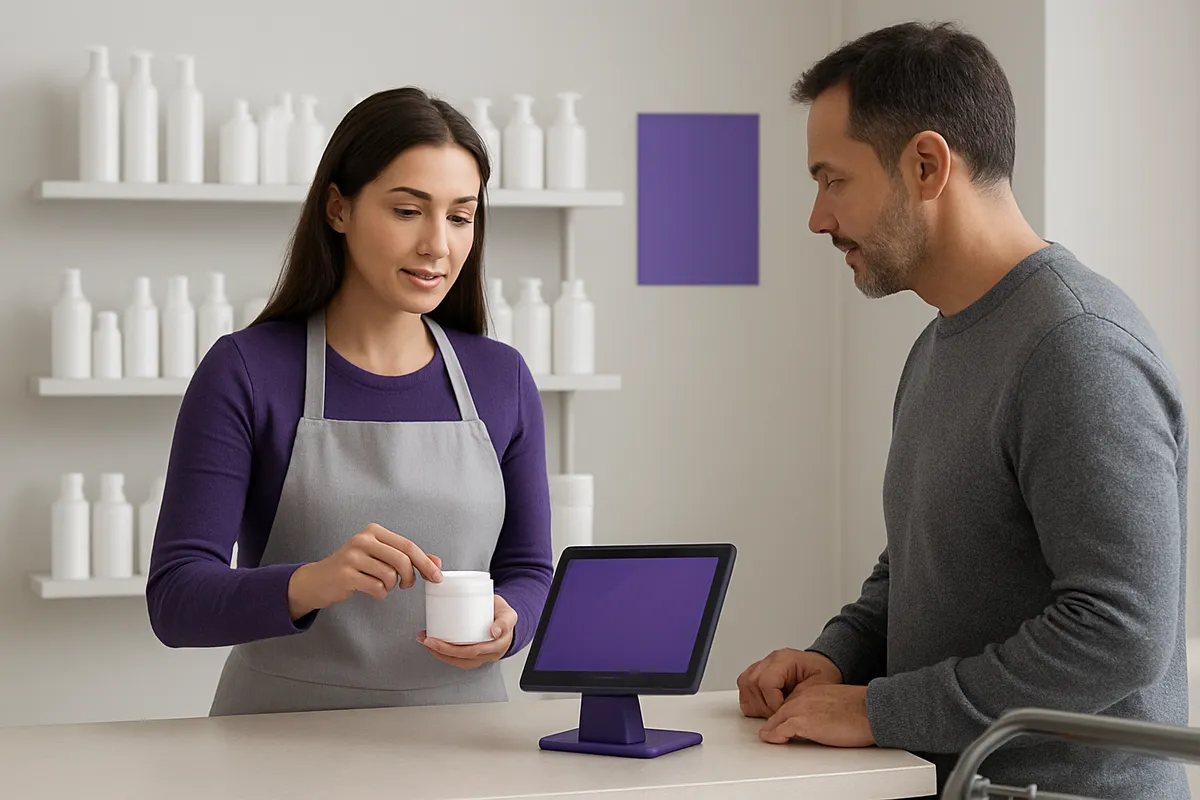
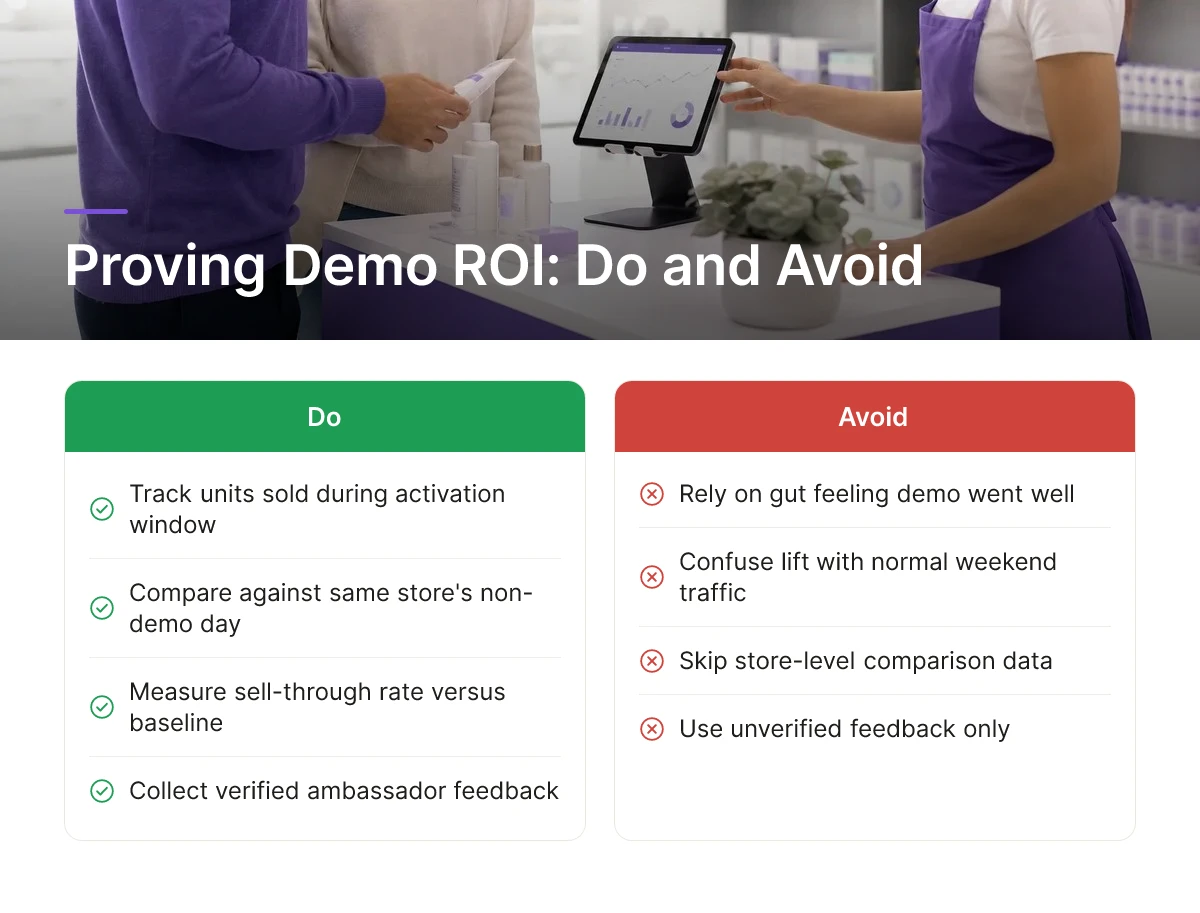
Proving ROI requires four concrete data points: units sold during the demo, sell-through rate versus baseline, store-level comparison against non-demo periods, and verified ambassador feedback, not a gut feeling that "the demo went well."
A credible demo report starts with units sold during the activation window, then compares that number against the same store's sales on a typical non-demo day. That comparison is what separates a real lift from normal weekend traffic.
Sell-through rate matters as much as raw units, a table that moved 40 units but left half the sampled inventory unsold tells a different story than one that cleared stock and triggered a reorder. Ambassador-submitted photos and compliance notes round out the picture: did the table get prime placement near the entrance, was signage visible, did the brand ambassador follow the script and product story. Without that documentation, a brand manager reporting to finance or a retail buyer is guessing.
A single demo report is a data point. A season of them, aggregated by store and time slot, is a playbook. Teams running Promomash CPGenius Demos and Events can filter completed activations by store performance and immediately see which locations, dayparts, and ambassadors consistently outperform the rest, intelligence that used to live in someone's memory or a buried spreadsheet tab.
That same pattern-spotting applies to staff. If one ambassador's stores show higher sell-through across multiple campaigns, that's a signal to deploy them to flagship locations or new store launches. Demo Wizard's performance insights work the same way, surfacing high-converting store and time combinations so a coordinator can rebook the winners instead of re-running the full rotation blind.
The bigger shift is speed. Manual spreadsheet collection means a brand manager waits a week or more for a field team to compile receipts, photos, and notes into something presentable. Automated reporting dashboards, the core of what Promomash CPGenius Demos and Events and comparable platforms deliver, give same-day visibility instead, which matters when a retailer buyer asks for proof before the next planning cycle closes.
Documented ROI also protects the relationship that keeps shelf space and event slots available. A retailer granting demo real estate wants evidence of sales velocity and foot-traffic lift, not anecdotes. Brands that show up with store-level data, not a verbal recap, are the ones that get invited back for the next roadshow or seasonal activation window.
A platform cuts administrative load when it centralizes communication, gives field staff a mobile-first workflow, and automates the confirmation steps coordinators used to chase by hand.
Brands evaluating Promomash CPGenius Demos and Events against other coordination tools tend to focus on three things: how fast a coordinator can schedule 50 stores instead of 5, how reliably ambassadors show up, and how much store staff still get pulled into logistics that have nothing to do with running their aisles.
A shared communication layer replaces the scattered phone calls and email chains that otherwise connect four separate parties to one event.
Without it, a single demo date change means the coordinator calls the ambassador, emails the distributor about inventory timing, and the store manager fields a separate call confirming the table is still reserved. Each party keeps its own version of the schedule, and conflicting updates are common.
A platform that puts brand, retailer, distributor, and ambassador on one system of record removes the duplicated threads entirely. Everyone sees the same schedule, the same status updates, and the same confirmation history, so no one has to relay information between parties who should already have it.
Ambassadors need a simple way to confirm their shift, check in from the store, upload photos, and log sales counts without juggling separate apps for each task.
Field staff turn over frequently and often work for multiple brands or agencies in the same week. A mobile experience that requires a new login or a new app for every client adds friction exactly where speed matters most, on the floor, mid-shift, with a line of shoppers waiting to sample a product.
Automated confirmation workflows address a related problem: the day-of no-show. A system that prompts ambassadors 24 to 48 hours before a shift, and again the morning of, catches scheduling conflicts before they become empty tables and wasted inventory. This single feature often does more to protect a campaign's conversion data than any reporting dashboard downstream.
Cost tiers vary with how much of this a brand automates. Manual coordination through spreadsheets and phone calls is budget-friendly on paper but expensive in coordinator hours. Point solutions that handle only scheduling or only payroll sit in the mid-range and still require manual work to stitch data together. Premium all-in-one platforms cost more upfront but reduce the store employee hours spent managing vendor and ambassador communications, which is often the real goal retailers and brands share when they choose a coordination system over spreadsheets.
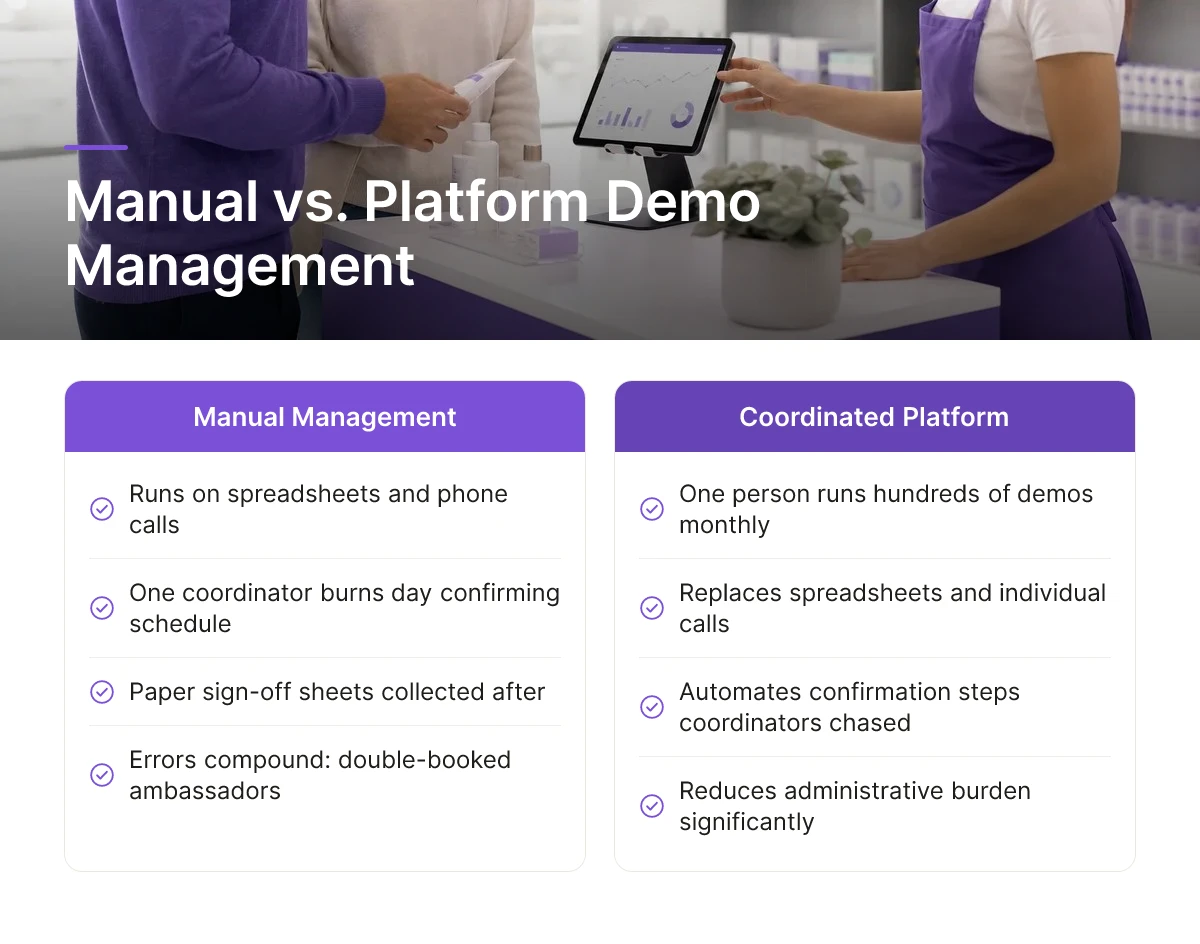
Leading brands replace spreadsheets and phone calls with a coordinated platform, letting one person run hundreds of demos a month instead of dozens.
Manual demo management runs on spreadsheets, individual phone calls to ambassadors, and paper sign-off sheets collected after the fact. A coordinator checking ambassador availability for 40 stores by phone or email can burn an entire day confirming a single weekend's schedule, and errors compound: double-booked ambassadors, missed confirmations, stores with no record of who's showing up or when.
A coordinated platform compresses that same work into templated scheduling. Searches comparing CPG demo management tools to spreadsheets surface this exact question, brands want to know how to scale sampling campaigns without manual coordination, which is precisely where a platform built for retail activations, like Demo Wizard, changes the math. Instead of rebuilding a schedule from scratch for every campaign, a coordinator sets a template once, store list, shift times, product details, and reuses it across regions. Confirmations go out automatically. Reporting rolls up in bulk rather than arriving as a pile of individual paper sign-offs that someone has to key into a spreadsheet.
The gap shows up most clearly in visibility. Spreadsheets tell you what was scheduled; they rarely tell you, in real time, whether an ambassador actually confirmed, showed up, or sold through inventory. A platform approach surfaces that status as the campaign runs, not weeks later during reconciliation.
Store teams are the weak link in most manual rollouts, they end up fielding vendor calls, approving ambassadors they've never vetted, and chasing paperwork that has nothing to do with running the store. Searches for Promomash CPGenius Demos and Events reflect brands looking for exactly this fix: a way to route all of that coordination through software instead of the sales floor.
When vendor confirmations, ambassador check-ins, and schedule changes flow through a platform instead of a store manager's inbox, staff see one clean calendar entry instead of a stream of interruptions. That structure is what makes roadshow-style activations, multi-day pop-up displays across dozens of doors, repeatable without adding headcount every time a brand adds another region.
It depends on the retailer's format and gatekeeper model. Club stores and mass merchants using exclusive demo agencies often charge turnkey fees per shift, regional supermarkets typically charge smaller slotting or scheduling fees to reserve table space, and many independent or natural grocers waive fees entirely in exchange for the foot traffic and basket-size lift a good demo brings.
A standard demo is a brand ambassador handing out samples from a table or cart for a few hours. A brand activation—like a multi-day roadshow—builds a dedicated footprint with branded signage, staged inventory, and bundled offers, creating a pop-up-within-the-store designed to drive volume and urgency rather than occasional trial.
A centralized scheduling system gives store staff one calendar showing every vendor, ambassador, and activation, instead of fielding separate phone calls and emails from each brand or agency. This cuts the time employees spend managing vendor communications and reduces scheduling conflicts, no-shows, and confusion at the point of execution—without requiring store teams to own the coordination themselves.
Ambassadors are the direct link between sampling and sales, turning product trial into purchase through storytelling and objection handling. Their consistency and training affect conversion more than almost any other variable, which is why platforms that manage ambassador assignments and track performance by store and shift matter for measuring true ROI.
Look for centralized scheduling visible to every stakeholder, mobile check-in and photo verification for ambassadors, automated reminders that reduce no-shows, and reporting that ties each activation to sales data rather than attendance alone. A platform that handles all four reduces the administrative load on coordinators and store staff alike, which is usually the real cost savings over spreadsheets and phone calls.

Scaling in-store demos without spreadsheets comes down to three things: centralized scheduling that gives every stakeholder visibility, ambassador management that keeps execution consistent across hundreds of locations, and analytics that tie each activation back to sales. Brands that skip any of these pieces end up guessing which stores and times actually move product.
Demo Wizard builds all three into one system, priced per demo with no per-user or per-location restrictions, so a single coordinator can run activations nationwide. Start by auditing one month of your current demo calendar and flagging how many hours went to scheduling logistics instead of ROI analysis—that number usually makes the case for automation on its own.
Explore more from our content library:
Demo Wizard is the Ultimate Store Sampling & Demonstration management software for Brick and Mortar Retailers and CPG Vendors.
Chat with usPhone