
Demo Wizard is the Ultimate Store Sampling & Demonstration management software for Brick and Mortar Retailers and CPG Vendors.
Chat with us

Phone
Copyright © 2026 Demo Wizard

Manual in-store product demo coordination using spreadsheets, phone calls, and emails creates major friction, missed activations, and administrative drag as programs scale beyond 15–30 locations per month. Product demo logistics management resolves these operational breakdowns by establishing a centralized calendar and single source of truth connecting CPG brands, retailers, agencies, and field staff. By automating confirmation workflows, ambassador check-ins, store compliance checks, and post-event ROI reporting (focusing on sales velocity, units per shift, and basket-size lift), brands and retailers eliminate double-booking, lower administrative costs, and prove campaign sales impact without requiring dedicated headcount or complex POS integrations.
Product demo logistics management means coordinating the scheduling, staffing, compliance, and performance tracking of multiple in-store demonstrations across a retail network from one system, instead of handling each location by phone, email, and spreadsheets. For CPG brands and retailers running demos across dozens or hundreds of stores, this coordination directly determines whether demos happen on time, whether staff show up, and whether anyone can prove the sales lift afterward. A shared calendar, automated confirmations, and centralized reporting replace the manual back-and-forth that normally eats staff time and causes missed or non-compliant demos.
Four parties have to stay in sync before a single demo table gets set up: the CPG brand, the retailer, the distributor or broker agency, and the brand ambassador working the floor. Product demo logistics management exists because none of these parties naturally sees what the others are doing, and a gap between any two of them can sink a demo day. This same alignment problem shows up across CPG and retail operations more broadly, not just in demo scheduling [Retail and CPG: Why Alignment Keeps Breaking Down].
Each party needs a different slice of the same information:
Coordinating this by phone, email, and spreadsheet works for a handful of stores. Past that, it breaks down fast. One coordinator managing 30 locations in spreadsheets typically ends up juggling multiple versions of the same file, missed confirmation emails, and store managers who never got the memo about a crew showing up Saturday morning. Retail execution research points to the same root problem across CPG operations: fragmented systems and inconsistent data create friction that shows up as missed visits, delayed updates, and manual rework [2]. Demo scheduling has the same failure pattern, just compressed into a single weekend.
A centralized calendar fixes the visibility problem by giving every party, including the store manager, the same view of what's scheduled, confirmed, and completed. Nobody is coordinating blind, because updates in one place reflect everywhere at once. Demo Wizard builds its scheduling system around this idea: brands, agencies, and store-level contacts all see the same event data instead of reconciling separate records after the fact.
CPG brands need this calendar to manage campaign timelines across many retailers at once, a rollout spanning three regional chains has different compliance rules and different calendars to track. Retailers need the same calendar for a different reason: shift visibility and disruption control, so staff know who's coming into the store and when, without vendors calling the front desk to confirm. This is a people-and-schedule problem, not a freight problem, product demo logistics management covers staffing, timing, and compliance, which puts it in a different category from supply-chain software that routes inventory and trucks [5].
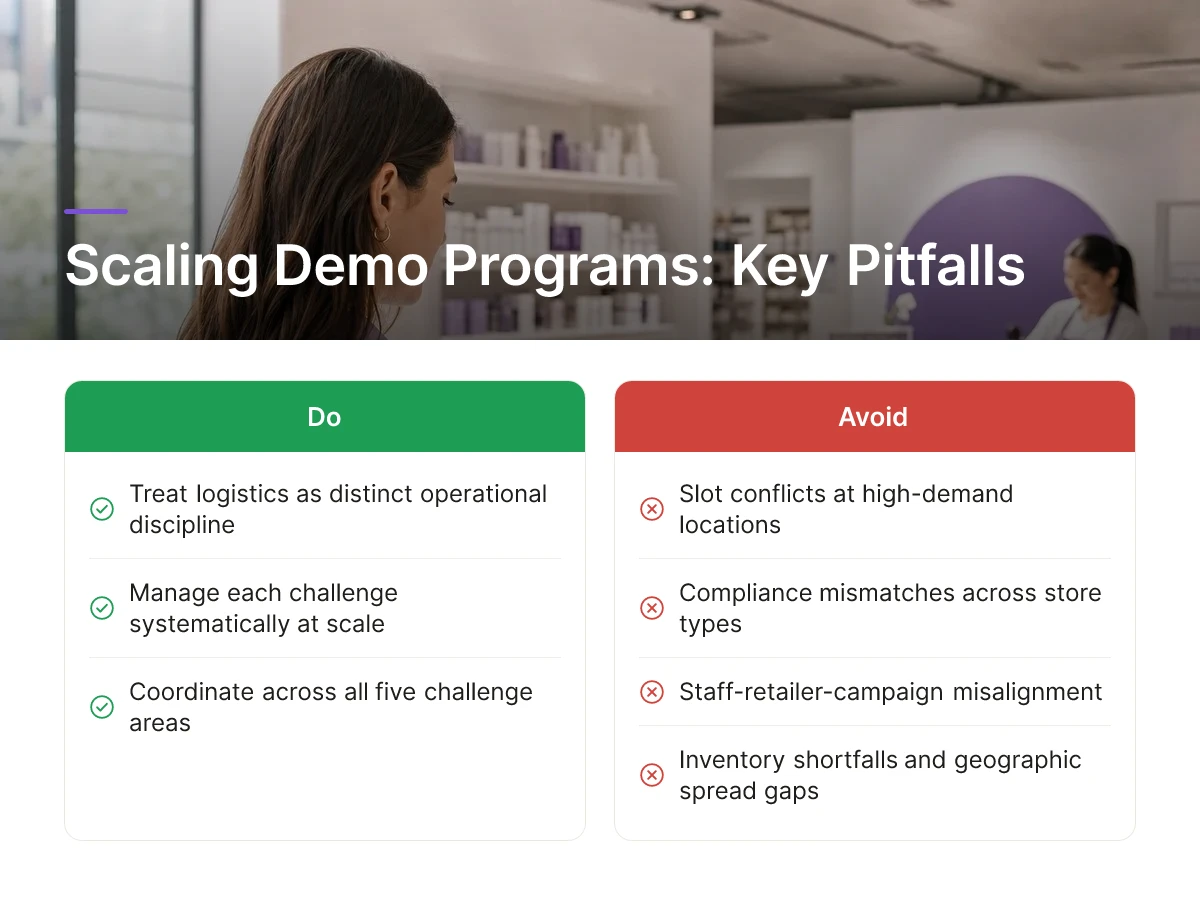
Five challenges break down most multi-location demo programs: slot conflicts, compliance mismatches, staff-retailer-campaign misalignment, inventory shortfalls, and geographic spread of ambassadors. Each one is manageable at ten demos a month. At a hundred demos across twenty states, they compound into missed events and wasted budget, which is why product demo logistics management becomes a distinct operational discipline rather than a side task for a single coordinator.
Scheduling conflicts happen because every brand wants the same thing: the end-cap near the entrance on a Saturday afternoon. When two CPG brands or two brokers both request the same high-traffic slot in one store, someone loses the date or gets bumped to a worse time, often after staff and product are already committed.
Compliance mismatches cause a different kind of failure. A demo plan built without knowing a store's fire code limits, aisle width, or manager approval process can get cancelled on arrival, the ambassador shows up, the table doesn't fit, or the store never signed off on propane use for a hot-sampling cart. A centralized calendar that shows every planned activation alongside each store's layout and approval rules catches these problems before a van ever leaves the warehouse, instead of after.
Even with a clear calendar, three variables rarely line up on their own: which ambassadors are free, how many events a store can host that week, and when the brand's campaign needs to run. A brand wanting 40 demos finished by month-end may find its available ambassadors clustered in the wrong region, or a retailer only willing to host two activations per week per location. Automated matching rules, assigning ambassadors by location, availability, and certification rather than by manual lookup, close this gap and are part of why a single coordinator can run hundreds of monthly events without adding headcount.
Inventory forecasting is the dependency that's easy to overlook until it fails. A fully staffed, perfectly scheduled demo still collapses if the product runs out by noon on a Saturday, and running out mid-event undermines everything else, as pallet forecasting practice in CPG distribution already recognizes [5]. Logistics coordination has to account for expected foot traffic and sample rates, not just dates and staff names. Broader fulfillment and distribution planning across CPG supply chains touches the same forecasting discipline, just applied upstream of the store shelf [CPG Fulfillment & Distribution Strategies].
Geographic dispersion adds a constraint separate from compliance rules: an ambassador pool spread across a region means travel time, not just availability, determines who can realistically staff a given store on a given day.
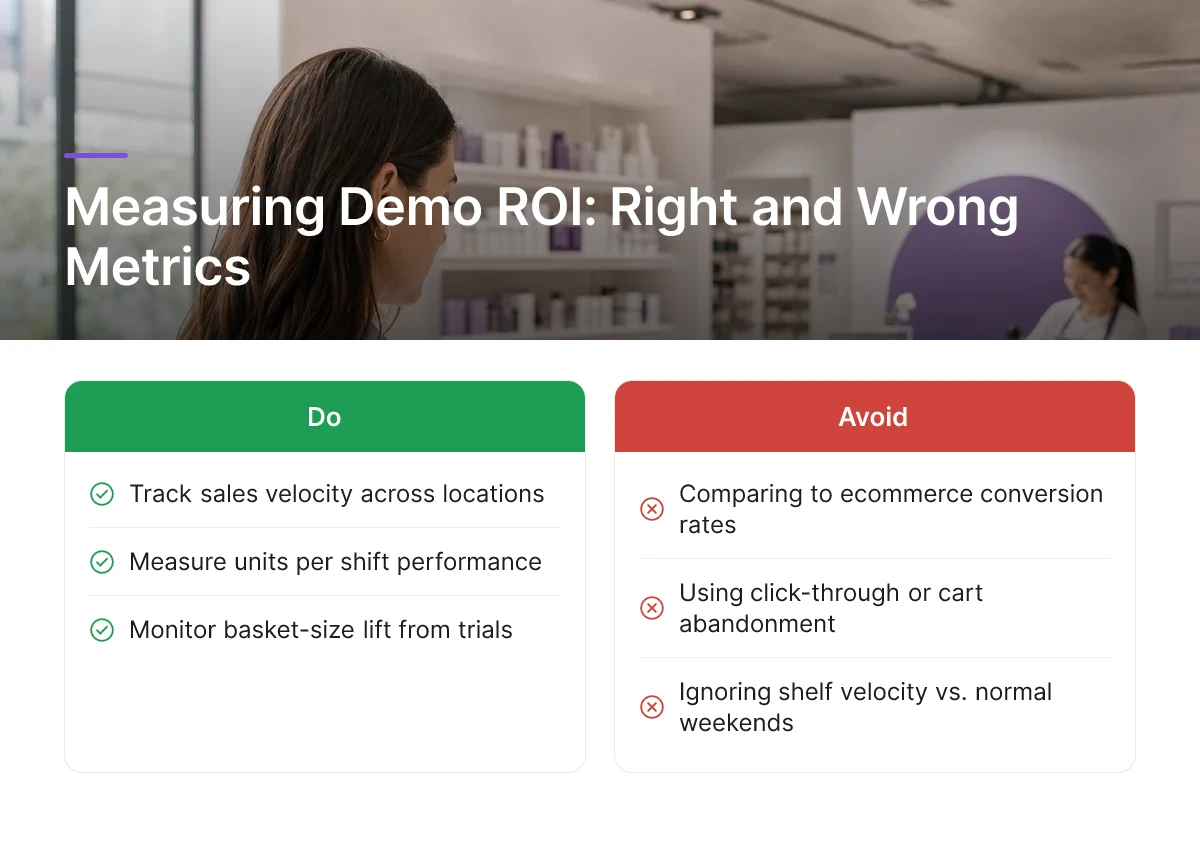
ROI from in-store demos comes from sales velocity, units per shift, and basket-size lift, not from ecommerce conversion rates, which don't apply to a physical aisle.
Brick-and-mortar brands need their own vocabulary for performance. A brand manager comparing demo results across 40 stores isn't tracking click-through or cart abandonment, they're tracking whether a Saturday sampling event moved product off the shelf faster than a normal weekend, and whether shoppers who tried the product bought more than they otherwise would have. Scenario planning frameworks used elsewhere in CPG and retail finance apply the same logic of testing assumptions against outcomes before committing budget [Scenario Planning for CPG & Retail].
The core metrics are sales velocity during and immediately after the demo window, units sold per shift, and average transaction value (basket size) lift for baskets that include the sampled product:
Connecting execution to sales results starts with confirming the execution actually happened as planned. Photo verification and compliance check-ins, was the ambassador on site, on time, with the correct signage and product display, give brands proof-of-performance before any sales number gets trusted. Retail execution platforms increasingly build this kind of compliance tracking into the pitch and reporting workflow because unverified execution data undermines every sales claim layered on top of it [2]. That sequencing matters for product demo logistics management broadly: a brand can't credibly attribute a sales spike to a demo if it can't first confirm the demo was staffed and run to spec. Sales uplift data itself typically comes from the retailer's point-of-sale reports or a third-party data provider, not from the coordination platform. Demo Wizard ingests that sales data once it's available and pairs it with its own execution and scheduling records, rather than trying to replace the retailer's or data provider's role in supplying it.
Structured, consistent reporting format across every store is what makes the comparison useful. When ambassador assignments, shift times, and compliance checks are logged the same way at every location, a coordinator can line up 50 stores side by side and see which ones, and which ambassadors, consistently drive the strongest velocity and basket lift, then shift budget and staffing toward what's working.
A coordination platform earns its keep by automating confirmations, reschedules, check-ins, and reminders so no one on the brand or store side has to chase these manually.
Without a shared system, store employees end up fielding vendor phone calls, approving ambassador schedules by email, and relaying last-minute changes to multiple brand contacts who all need the same update. A single demo might touch a store manager, a department lead, a brand's field marketing coordinator, and a staffing agency dispatcher, each working from a different version of the schedule. This is the retailer-side cost that rarely shows up in a CPG brand's budget spreadsheet but absorbs real hours from people whose job is running the store, not managing a brand's activation calendar.
Product demo logistics management breaks down exactly at this handoff point: the moment a schedule change has to travel through three or four people instead of updating once in a shared system. CPG brands feel this as administrative drag on their own trade marketing teams. Retailers feel it as an interruption to the people stocking shelves and running registers.
Four tasks deliver the most relief when automated:
Automatic compliance to in-store conditions removes a second layer of manual work. When a platform already knows a store's approved demo windows, assigned floor space, and blackout dates, it can reject or flag a conflicting booking before it's ever sent for approval, no email thread required between the brand's coordinator and the store manager to confirm something the system already knew. Demo Wizard builds this logic into its scheduling layer, which is part of how a single coordinator manages activations across hundreds of stores without a dedicated person per region. Generative AI tools now being piloted in retail operations point toward further automation of these matching and flagging tasks over time [Generative AI for Retail: Practical Use Cases for CPG Operations Teams].
The mechanism behind the time savings isn't a specific percentage, it's the number of touchpoints removed per event. Every manual handoff (a call, an email, a text confirming receipt) adds delay and a chance for miscommunication. Cutting touchpoints from five or six down to one or two shortens the coordination window for each demo and reduces the chance a change gets missed entirely.
For retailers specifically, the biggest win is distinct from anything the brand experiences: store staff are no longer the relay point between vendors, distributors, and brand ambassadors. That communication moves into a platform retailers can see without carrying any of it themselves.
The right software evaluation comes down to four criteria: calendar visibility across locations, confirmation workflows for staff, compliance tracking, and reporting depth tied to sales impact. Brands, agencies, and retailers each weigh these differently, but all three need the same underlying capability, clear visibility into what's happening at each store, on each date, with each ambassador.
Prioritize a multi-location calendar that shows every scheduled demo at a glance, automated confirmation workflows that reduce no-shows, compliance tracking that flags missed check-ins or setup issues, and reporting that connects events to sales lift rather than just attendance counts. These four categories cover most of what separates a tool built for product demo logistics management from a generic scheduling app repurposed for retail.
Integration expectations deserve a realistic framing. A coordination platform should ingest sales or performance data from retailers or third-party data providers after a campaign runs, it does not need a direct point-of-sale integration to be useful. Brands and agencies that wait for perfect POS connectivity before adopting a tracking tool often delay months of ROI visibility they could have had already, since sales velocity and basket-size data [5] typically arrives through retailer reporting or distributor channels rather than a live feed.
Test whether the tool matches how your team actually operates, not how a vendor's demo video operates. A broad all-in-one retail execution suite often bundles compliance auditing, planogram management, and trade promotion features that sound useful but add setup time and training overhead for a team that only needs to schedule, staff, and measure in-store demos [2]. A purpose-built coordination tool usually gets a single coordinator running hundreds of monthly events faster than a platform designed to do a dozen unrelated things at once.
Pricing tiers should scale with usage, not punish growth. Favor platforms priced per demo or per event over per-user or per-location licensing, budget-friendly tiers work for teams running a handful of monthly activations, mid-range tiers suit regional campaigns, and enterprise tiers fit brands or agencies coordinating hundreds of events across states. Demo Wizard's per-demo pricing model, with no per-user or per-location restrictions, matters for a brand activation manager scaling from a handful to hundreds of monthly events without renegotiating a contract.
Finally, recognize that CPG brand-side coordination and retailer-side oversight are different jobs on the same calendar. A brand needs to schedule ambassadors and prove conversion lift to finance; a retailer needs a centralized view of every vendor's activity inside its stores to avoid double-booked tables and disruptive conflicts. The strongest tools serve both sides from one shared calendar, so neither party is reconstructing the schedule from separate spreadsheets.

Demo logistics covers scheduling people and events in stores, not moving freight between warehouses. Supply chain logistics software tracks pallets, shipments, and inventory flow through distribution networks. Demo coordination tracks brand ambassadors, store calendars, and sampling outcomes at the shelf level, a separate operational problem that happens to share the word "logistics."
Responsibility usually splits three ways, which is exactly why coordination breaks down. The CPG brand sets campaign goals and budget, the retailer controls store access and in-aisle rules, and the agency or distributor supplies the ambassador. Without one shared calendar, each party works from a different version of the schedule.
Ambassador scheduling conflicts and last-minute availability gaps cause most cancellations, followed by store-level miscommunication about approved dates. A store manager unaware of a booked slot can turn away an ambassador on arrival. Inventory shortfalls also force cancellations, a demo can't run without product on hand, and forecasting that gap usually falls through the cracks between brand, distributor, and store.
Yes, scheduling, ambassador management, and post-demo reporting function independently of point-of-sale systems. Coordination platforms like Demo Wizard track experience-to-purchase conversion through its own event and performance data, and can ingest sales figures separately from retailers or third-party data providers when that data is available, rather than requiring a direct POS integration.
Most coordinators hit a wall somewhere between 15 and 30 active store locations per month. Below that, spreadsheets and phone calls are tedious but survivable. Beyond it, tracking ambassador assignments, confirmations, and payroll by hand consumes enough hours per week that scaling further requires either another hire or a scheduling platform.
Scaling in-store demos past a few dozen locations exposes the same three failure points every time: no shared calendar between brand, retailer, and agency; no system for catching ambassador no-shows before they cost a Saturday's sales; and no reliable way to tie a demo to the sales lift it produced. Fixing these doesn't require a bigger team, it requires a system that replaces spreadsheets with one schedule everyone can see. Demo Wizard builds that system around scheduling, ambassador payroll, and ROI tracking with per-demo pricing and no per-location fees. Start by auditing how many hours your team spends this month just confirming demo dates by phone or email, that number usually makes the case on its own.
Explore more from our content library:
About the Author
Written by the SaaS / Retail Marketing Technology experts at Demo Wizard. Our team brings years of hands-on experience helping businesses with SaaS / Retail Marketing Technology, delivering practical guidance grounded in real-world results.
Demo Wizard is the Ultimate Store Sampling & Demonstration management software for Brick and Mortar Retailers and CPG Vendors.
Chat with usPhone