
Demo Wizard is the Ultimate Store Sampling & Demonstration management software for Brick and Mortar Retailers and CPG Vendors.
Chat with us

Phone
Copyright © 2026 Demo Wizard
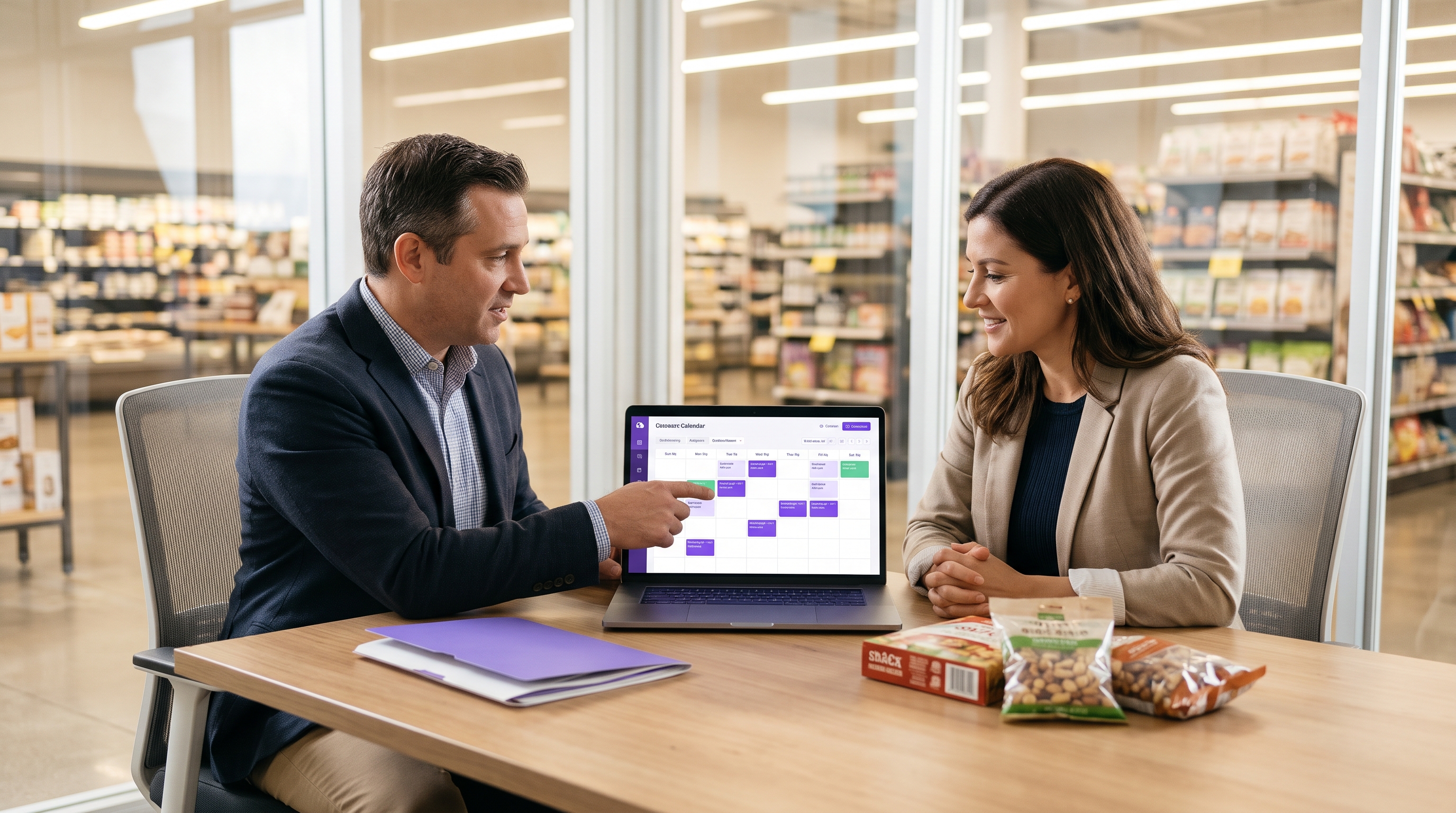
In-store product demos rarely fail during the actual sampling; instead, they break down at the communication handoffs between food brokers, retail store managers, and brand ambassadors. Replacing fragmented phone calls, texts, and spreadsheets with a centralized, automated scheduling and reporting calendar eliminates last-minute cancellations, enforces store compliance, and turns shopper feedback into measurable retail sales lift.
Food broker demo coordination breaks down most often at the handoff points between the broker, the retailer, and the brand ambassador, not during the demo itself. Brokers typically confirm the store slot, but if that confirmation isn't synced with the ambassador's schedule and the store manager's floor plan, demos get cancelled, moved, or staffed last-minute. The fix is a shared, real-time view of scheduling, confirmation status, and compliance, not more phone calls or email chains between the three parties.
Three parties have to act in sequence for a single demo to happen, and food broker demo coordination typically runs on phone calls, texts, and email between them with no shared record of who confirmed what.
A food broker represents several brands at once and works the phone to secure buyer relationships and shelf space, acting as an outside sales team rather than a logistics operator [2]. That sales-first skill set doesn't naturally extend to managing event logistics across dozens of stores. The typical sequence looks simple on paper: the broker confirms a demo slot with the retail buyer, the retailer approves the floor space and table placement, and the brand ambassador shows up to execute. In practice, each handoff depends on someone remembering to call, text, or forward an email, and any one dropped message stalls the whole chain.
Gaps open because confirmation at one link in the chain doesn't automatically reach the next link, so each party is often working from outdated information. A broker might lock in a Saturday slot with a regional buyer, but if that confirmation sits in an email thread the ambassador never sees, the ambassador shows up unprepared or doesn't show up at all. Store managers are frequently the last to know: it's common for a location to find out about a scheduled activation the same day it's set to happen, leaving no time to clear floor space or alert front-end staff. Traditional sampling programs are typically judged after the fact on cups poured rather than tracked and verified in real time as they happen [1], which is a symptom of this same coordination gap, nobody owns a live, shared view of status.
The most frequent breakdowns are predictable: double-booked demo tables when two brands' brokers both think they have the same Saturday slot, store remodels or inventory resets the broker never heard about, and ambassador cancellations called in the morning of the event with no backup lined up. None of these are rare edge cases, they're the default outcome of a process with no central record.
Each failure point compounds. A missed confirmation from the broker becomes a no-show ambassador, which becomes wasted product sitting in a cooler, which becomes a store manager who's now skeptical the next time that brand asks for table space. One broken handoff rarely stays contained to a single event.
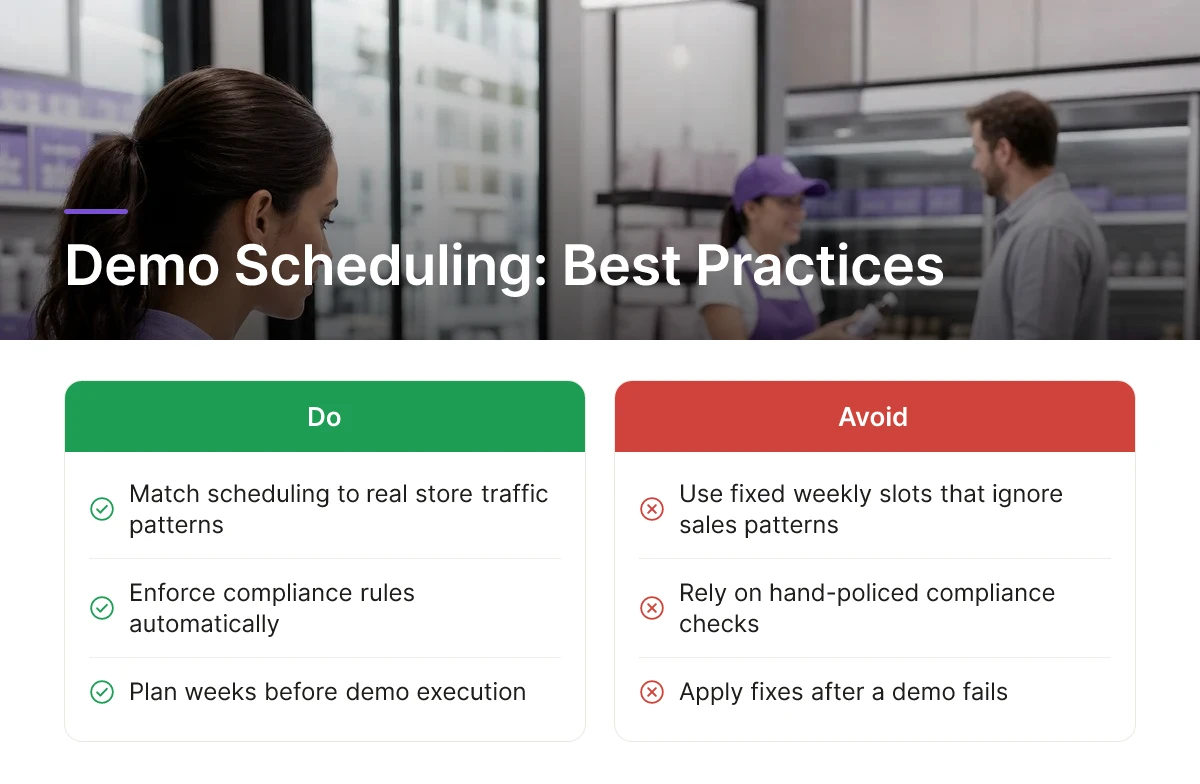
Breakdowns shrink when scheduling is matched to real store traffic patterns and compliance rules are enforced automatically rather than policed by hand. Good food broker demo coordination depends on decisions made weeks before an ambassador ever sets up a table, not fixes applied after a demo flops.
A fixed weekly slot, say, every Saturday at noon, is easy to plan around but rarely matches how a product category actually sells. A wine or snack brand may perform best during Thursday evening or Friday after-work shopping windows, while a breakfast item might convert better during Saturday morning family trips. Brokers and brand ambassadors coordinating demo calendars across multiple retail chains need to set timing by category behavior, not by what's convenient for the coordinator's calendar.
Store selection follows the same logic. Instead of rotating through every available location equally, prioritize stores where the shopper demographic already lines up with the product, a plant-based brand does better in a store with a health-focused customer base than in one where the top sellers are conventional staples. Past performance data, not guesswork, should drive this: if a store's demo conversion rate has trended below 10%, that's a signal the product may be mismatched to that shopper base rather than a reason to simply try again next month.
Retailers set the rules, table placement, signage limits, food safety and sampling handling procedures, and brokers are expected to follow them without a store employee standing over every visit. Clear standards posted and attached to each confirmed booking (where the table goes, what signage is approved, how open food samples must be handled) let ambassadors self-enforce compliance, because the expectations travel with the schedule rather than living in a manager's memory.
A confirmed, visible schedule also removes the single most common friction point: the vendor who shows up unannounced because a broker double-booked a date or never confirmed the slot. When store managers, brokers, and brand teams all see the same calendar, nobody discovers a demo mid-shift. Demo Wizard's in-store scheduling tool centralizes this calendar across every location a retailer manages, so compliance details and booking confirmations move together instead of getting lost between a broker's spreadsheet and a store manager's inbox.
Brands and brokers track demo conversion rate; retailers track sales velocity and basket size, and coordination breaks down when either side assumes access to the other's numbers.
Food broker demo coordination runs on a split data model. Brands and the demo companies executing on their behalf never see point-of-sale data, so they rely on demo conversion rate, samples given versus units bought at the table or end cap, as their primary KPI. It's the only hard number available to a coordinator standing in the aisle, and it's recorded directly in the post-demo report.
A healthy demo conversion rate sits well above 20%. When it drops below that line, the cause is usually one of three things: the store doesn't match the product's target shopper demographic, the brand ambassador isn't suited to the role, or the demo station sits too far from the shelf for shoppers to act on impulse. Shopper comments captured in the post-demo report typically point to which of the three is at fault, a repeated note about price or packaging signals a demographic mismatch, while silence and low engagement often point to ambassador performance.
Sales velocity, units sold per store per week, remains the primary lift metric for brick-and-mortar demo programs, because it reflects actual register activity rather than estimated interest. Store conversion rate works alongside it as a secondary signal: a high samples-to-sales ratio at a particular store indicates the shopper base there fits the product well, which helps brands decide where to repeat or expand activations.
The catch is ownership. Retailers hold the POS data behind sales velocity and basket size; brands and brokers only estimate these figures from register receipts, shopper self-reports, or rough observation during the shift. The two data sets are rarely combined across parties, so a broker coordinating dozens of monthly demos should treat sales velocity as directional, not verified, unless the retailer explicitly shares it.
Beyond conversion numbers, the most useful data a demo can produce is unscripted shopper reaction, comments on taste, price, packaging, or portion size collected by the ambassador in real time. Brands use this feedback to adjust product formulation and pricing strategy long before a reformulation cycle, and to decide which store types and regions deserve the next round of activation budget.
Platforms like Demo Wizard aggregate this feedback alongside demo conversion data across hundreds of monthly events, letting a single coordinator flag which stores and dayparts produce the highest conversion and route future bookings there instead of repeating underperforming slots.
Automation replaces the phone calls, texts, and spreadsheet updates that eat up a broker's week with one shared, always-current schedule that every party can check without asking anyone else first.
Food broker demo coordination breaks down when confirmation lives in six different places: a broker's spreadsheet, a brand manager's inbox, an ambassador's text thread, and a store manager's notebook by the register. Each party trusts their own version of the schedule, and none of them match. A platform that automates scheduling and ambassador deployment removes that fragmentation by making one version of the calendar the only version that counts.
The time savings come from eliminating repeated confirmation work, not from any single dramatic fix. A coordinator who used to call twenty stores to confirm next week's demos, then call again two days before to re-confirm, now sends one automated reminder sequence that does both jobs without a phone in hand. Demo Wizard is built around this exact gap: a single coordinator can manage hundreds of monthly events across locations because the platform handles scheduling, ambassador assignment, and reminder workflows that would otherwise require additional headcount.
Automated confirmation workflows also address the no-show problem directly. When an ambassador fails to confirm within a set window, the system can trigger a backup staffing alert instead of leaving a store with an empty table and no warning. Auto-reschedule logic catches conflicts, a store closure, a broker double-booking two brands in the same aisle, before they turn into a wasted trip.
A centralized calendar gives brands, brokers, ambassadors, and retailers the same real-time view of confirmed demos, so no one is working from outdated information. For retailers, this matters more than it might seem: store employees stop fielding separate calls from brokers, brand reps, and ambassadors about the same event, and instead glance at one calendar to see who's coming, when, and with what setup.
That shared visibility also resolves a recurring source of friction, disputes over who confirmed what and when. Without a timestamped, shared record, brokers and retailers end up relitigating whether a slot was ever booked. A centralized log settles that argument before it starts.
A platform built for food broker demo coordination needs five things working together: a unified scheduling calendar, automated confirmations and reminders, backup staffing alerts, compliance checklists, and post-demo reporting in one system.
Miss any one of these and the gaps reappear in a different form. A broker juggling 80 monthly demos across a dozen retail accounts cannot afford to rebuild visibility every time a store manager asks "who's showing up Saturday and what are they bringing?"
Scheduling, compliance, and reporting have to live in the same record for each event, not in three separate files that someone reconciles manually. When a demo slot is booked, the same entry should carry the ambassador assignment, the store's setup requirements, and the fields needed for the post-demo report.
This is where fragmented tool stacks fail brokers and agencies. A scheduling spreadsheet tracks dates, a group chat app handles day-of logistics, and a separate document captures results after the fact, three systems, three sources of truth, and no reliable link between them.
The problem compounds at scale. A food broker managing demos for several CPG brands across dozens of stores ends up re-entering the same information in each tool, and errors multiply with every handoff. Demo Wizard addresses this by keeping scheduling, ambassador management, and performance reporting inside one platform, so a coordinator can see which stores and time slots are converting without stitching together exports from unrelated tools.
Real-time coordination between the broker, the brand, and the ambassador means store staff no longer act as the go-between when something changes. If an ambassador is running late or a product shipment is delayed, that update should reach the people who need it directly, not route through a store employee relaying messages between a vendor and a broker.
Retailers benefit from this directly. Store teams spend less time fielding vendor phone calls and more time running the floor, because confirmation and backup-staffing workflows happen automatically rather than through ad hoc calls to the service desk.
Pricing for this kind of coordination typically scales with demo volume rather than headcount. Brands and agencies usually pay based on how many demos they run each month, not how many people log in, while retailer-side access is commonly offered at no cost since the vendors running demos cover the cost of the activation.
Scope matters here too. Demo Wizard coordinates brand ambassadors and in-store staff and reports performance back to brands and agencies, it does not message or track individual shoppers, and food broker demo coordination through the platform stays focused on the people executing the demo, not the consumers walking past it.
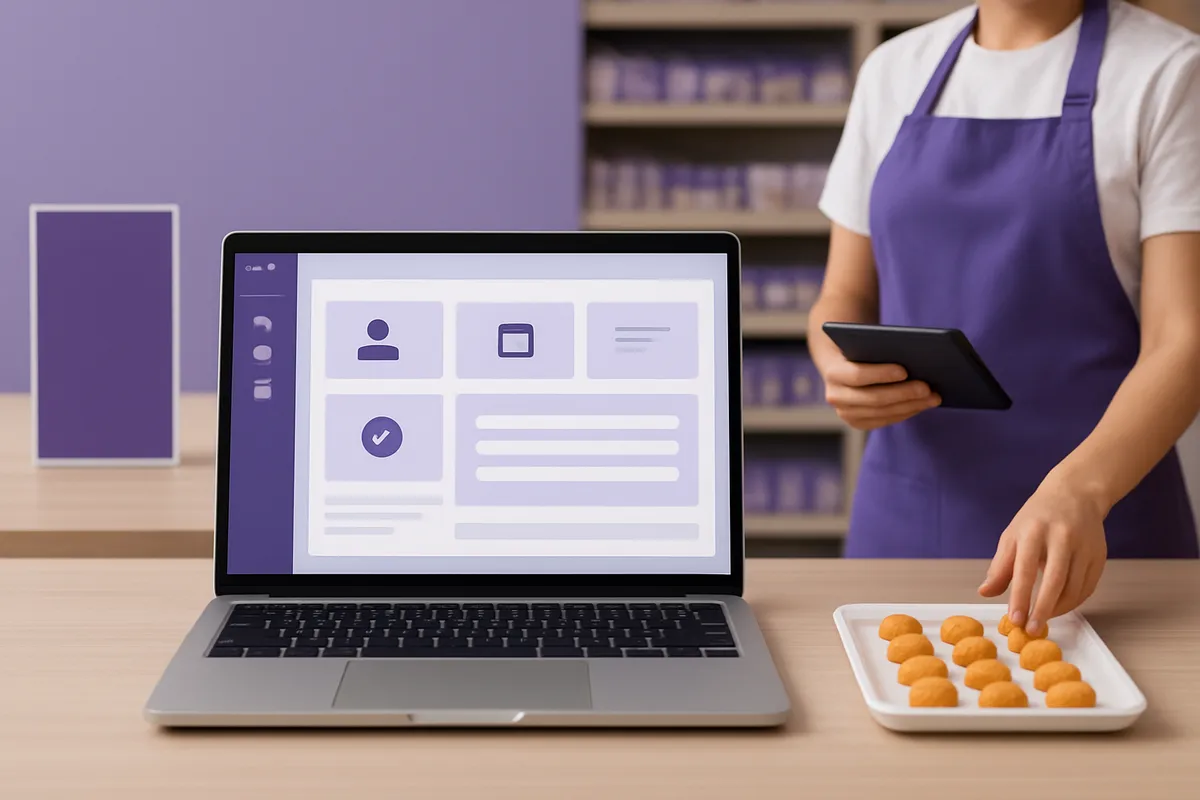
Responsibility usually sits with whoever staffed the shift, the brand, the food broker, or the agency managing ambassadors, not the retailer. Contracts should name a backup-staffing owner before the campaign starts. Without a documented chain, brands lose the shelf-space goodwill they fought to earn, and retailers are left with an empty table and no one to call.
Confirm store approval at least two to three weeks out, then lock the ambassador assignment 48 to 72 hours before the shift. Shorter windows raise no-show risk and leave no time to find a replacement if availability changes.
Yes, a weak conversion rate often points to a shopper-demographic mismatch, not ambassador performance. If samples-to-sales stays below roughly 20%, check the post-demo shopper comments first: wrong store for the product, poor station placement near the shelf, or an audience that simply doesn't buy that category are common causes alongside ambassador fit.
No separate purchase is required if the brand or agency uses a coordination platform retailers can view directly. A shared, centralized calendar lets store staff confirm what's happening, when, and who's arriving, without the retailer paying for or managing another system.
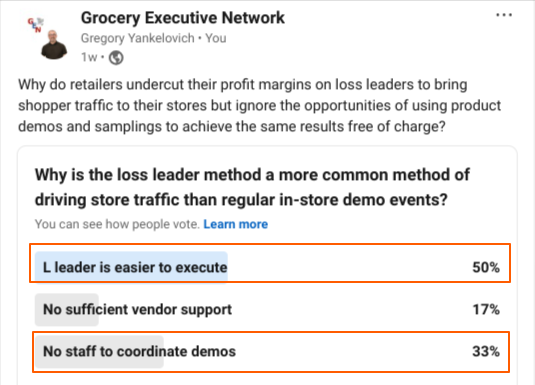
Smooth food broker demo coordination comes down to three things: a named owner for ambassador no-shows, confirmation timelines that leave room for backup staffing, and a shared calendar that keeps store staff, brokers, and ambassadors looking at the same schedule. Treat low conversion rates as a diagnostic signal rather than a verdict on ambassador performance, the post-demo shopper comments usually explain more than the number alone.
Next step: pull your last three months of demo reports and check whether any single store consistently underperforms regardless of which ambassador worked it. That pattern will tell you whether the fix is staffing or store selection.
Food brands rethink in-store sampling programs to better link tasting with sales performance
Difference Between Food Broker, Distributor, and 3PL, Zipline Logistics + SFA
Explore more from our content library:
About the Author
Written by Gregory Yankelovich. This article was conceptualized, directed, and reviewed by our human team of retail marketing veterans. Every strategy, framework, and recommendation originates from the hands-on expertise of our experts. Human insight drives the core narrative, ensuring all advice remains grounded in real-world retail execution. AI assistance was used to streamline production and optimize for generative engine optimization (GEO).
Demo Wizard is the Ultimate Store Sampling & Demonstration management software for Brick and Mortar Retailers and CPG Vendors.
Chat with usPhone