
Demo Wizard is the Ultimate Store Sampling & Demonstration management software for Brick and Mortar Retailers and CPG Vendors.
Chat with us

Phone
Copyright © 2026 Demo Wizard
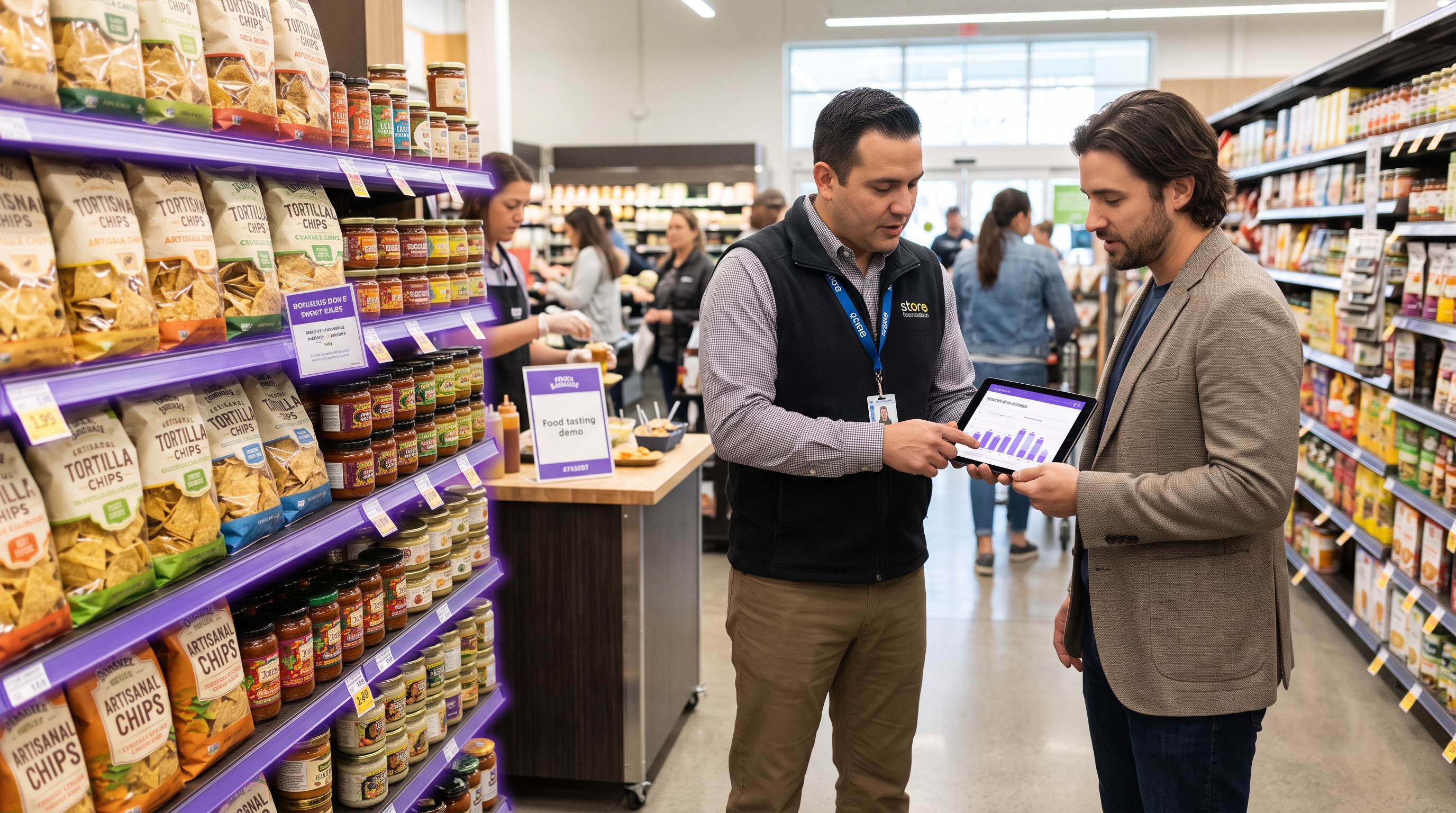
The demo halo effect is the measurable spillover sales lift an in-store product demonstration creates for nearby, unpromoted items—such as a salsa tasting boosting chip velocity—by increasing aisle foot traffic, dwell time, and occasion-based buying intent. To maximize and prove this lift across retail locations, CPG brands and retailers must pair centralized scheduling and inventory checks with baseline-adjusted category sales velocity tracking, while ensuring prime shelf proximity to avoid cannibalization or lost sales.
The demo halo effect is the spillover sales lift that an in-store product demonstration creates for related items the demo isn't directly promoting, think chips selling faster next to a dip demo, or an entire snack aisle gaining velocity during a weekend tasting event. It happens because demos pull shoppers into a zone, prime them to buy within a category or occasion, and increase overall foot traffic and dwell time near the display. Retailers track it through sales velocity on adjacent SKUs during and shortly after a demo window, not just conversion at the demo table itself.
In retail merchandising, the demo halo effect describes how an in-store demonstration pulls sales toward neighboring products, not just the item on the table. It's a measurable pattern tied to foot traffic, dwell time, and category buying behavior inside a physical store section. Independent research on product demonstrations backs up the core premise: step-by-step in-store demos drive more sales than passive displays, and that lift doesn't stay confined to the single item being sampled.
Most search results for "halo effect" point to a psychology term describing how one positive trait, an attractive spokesperson, or a trusted logo colors a person's judgment of unrelated qualities. That's a perception bias studied in consumer psychology and UX design, and it has nothing to do with store merchandising.
The demo halo effect, as CPG brands and retailers use the term, is a sales and traffic phenomenon. A guacamole sampling station doesn't change how a shopper feels about tortilla chips three feet away; it changes whether that shopper walks down that aisle at all, and whether they're already in a buying mindset when they get there. One is a judgment shortcut. The other is a foot-traffic and category-priming effect that shows up in sales velocity data.
Three mechanics do most of the work:
Foot traffic and dwell time: a demo station draws shoppers who slow down, form a small line, or linger to watch, and that congregation pulls in other shoppers passing by who wouldn't otherwise stop in that aisle.
Category priming: sampling one product shifts a shopper's mindset from browsing to buying across the whole aisle, not just the demoed SKU, a documented pattern in spillover research on promotional and advertising exposure, where seeing one item brings related items to mind and increases their salience too [3].
Sensory anchoring: smell, color, signage, and an ambassador's voice draw eyes toward nearby shelves, temporarily reorganizing what a shopper notices in that section of the store.
The effect is strongest when the demoed item and its neighbors share a shopping occasion. A taco kit demo tends to lift salsa, shredded cheese, and tortillas together, because the demo reminds shoppers of the whole meal they're assembling, not a single product.
Spillover sales happen when shoppers act on mental associations triggered by a demo, reaching for a related item without a second sample or a second pitch [3]. That mental connection is what drives the demo halo effect, and its strength depends almost entirely on which products sit next to each other on the shelf. A broader look at the value and best practices of in-store product demonstrations reinforces this: placement and category context shape outcomes as much as the demo itself.
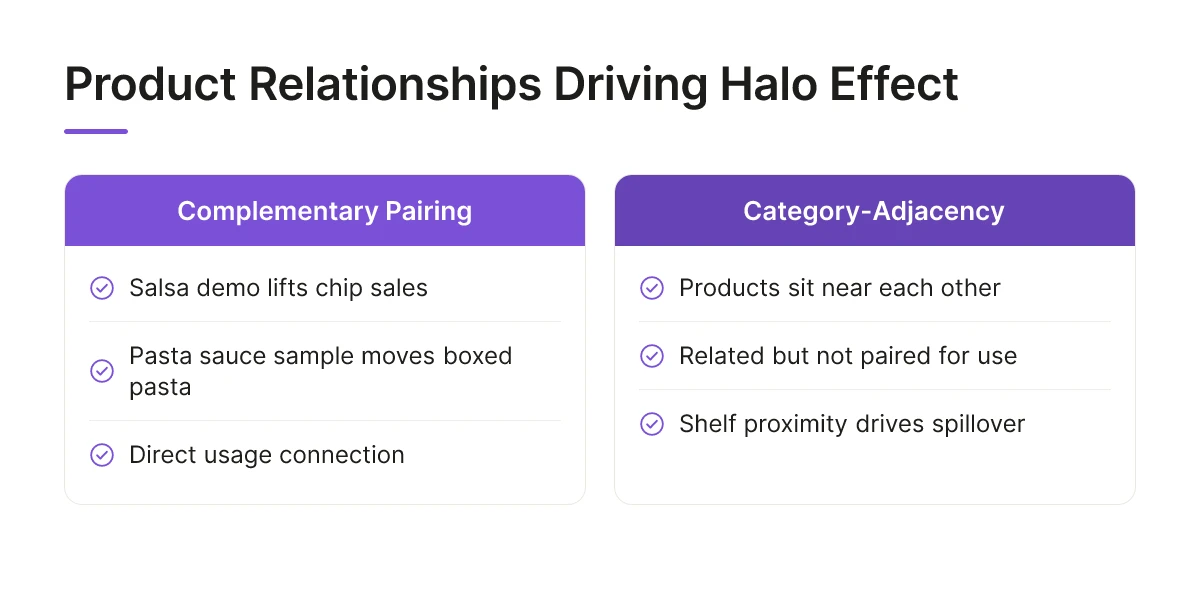
Three relationships consistently produce the widest spillover:
Complementary pairing: a salsa demo lifting chip sales, or a pasta sauce sample moving boxed pasta nearby.
Category-adjacency: sampling one flavor or variant pulls shoppers toward the entire case, a single yogurt flavor demo can lift sales across the yogurt set, not just the flavor on the table.
Premium-tier upsell: tasting a flagship product builds enough trust that shoppers trade up to a related premium line they hadn't considered.
Retail halo research frames this as true incremental lift on items that were never directly discounted or sampled, distinct from cannibalization where one SKU simply steals share from another [4].
A single sampling table generates a contained version of this effect, a few shoppers pause, taste, and maybe glance at what's nearby. A roadshow-style activation changes the scale entirely. Dedicated staging, branded signage, and a temporary footprint in a high-traffic zone draw bigger crowds and hold their attention longer, which widens the visual real estate the halo can touch. Broader-reach activations tend to cascade across more products and channels than narrow, single-point promotions [5], and a roadshow is built on that same logic at the store level.
Proximity does the rest of the work. When the sampled product sits a few feet from its complementary or adjacent items, shoppers act on impulse before they leave the aisle, no cart detour, no reminder needed. Bundled or limited-time offers, a common roadshow feature, push this further by nudging shoppers toward adjacent SKUs they'd normally skip, especially when the bundle is framed as available only during the activation window.
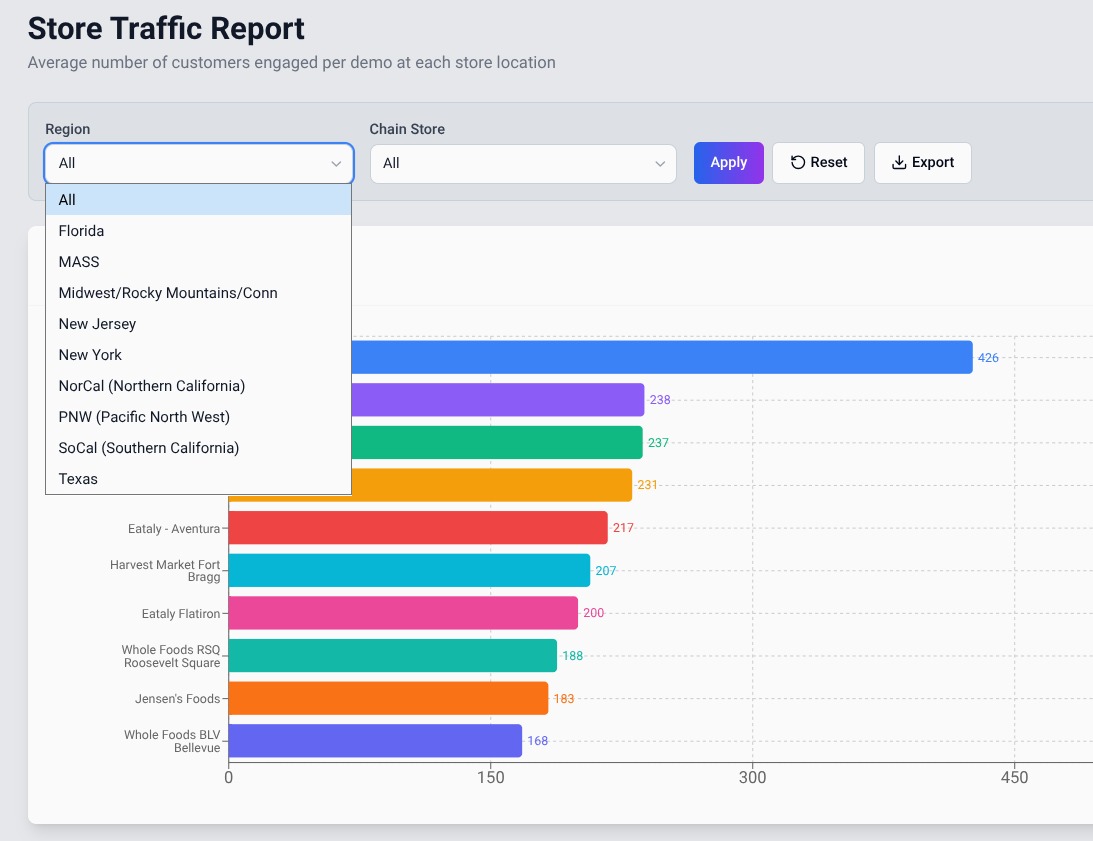
Three metrics matter: demo conversion rate for the direct sale, sales velocity in surrounding aisles for the demo halo effect, and store conversion rate as a secondary signal for shopper-fit. Each answers a different question, and conflating them produces misleading reports.
Demo conversion rate is the cleanest number a CPG brand owns: samples given versus units bought at the demo table itself, pulled straight from the post-demo report. It tells a brand ambassador's manager whether the pitch, product, and placement worked in the moment.
Halo-driven uplift is a different animal. Because most brands and demo companies don't have access to the retailer's point-of-sale system, they can't measure, for example, a chip brand's demo lifting salsa sales three aisles over as a precise figure. The practical workaround is watching sales velocity trends in the surrounding category during and after the activation window and treating any uptick as a directional estimate, not a hard number. A spillover effect from a promotion in one category to a related one is well documented in adjacent research on advertising spillover effects and promotions [3][4], which gives brands a reason to look for it even without perfect measurement tools.
Store conversion rate, the samples-to-sales ratio at a specific location, tells a brand whether the shopper base at that store actually matches the product being demoed. A store posting a conversion rate well above the brand's average signals a demographic fit worth repeating; a store well below it suggests the wrong location, the wrong time slot, or a mismatch between product and shopper, something worth checking against shopper comments in the post-demo report.
Sales velocity stays the primary lift metric for brick-and-mortar demo programs. Store conversion rate supports that read by explaining where the fit is strongest, it doesn't replace velocity as the bottom-line measure of whether a demo moved product.
Retailers sit in a different position entirely. Because they own the POS system, they can observe the demo halo effect directly in basket size, or average transaction value, during and after an activation, something brands and demo companies can only infer. Brands and demo companies, including those coordinating activations through a platform like Demo Wizard, work from demo conversion rate, estimated category velocity, and shopper feedback instead, since these two data sets rarely get combined in practice.
Centralized scheduling and shared visibility turn a handful of lucky activations into a repeatable demo halo effect across dozens or hundreds of stores at once.
A shared calendar, visible to the brand, the retailer, and the demo staff working the floor, stops two activations from colliding at the same store and confirms adjacent-category shelves are stocked before the first sample is handed out. Without that visibility, a brand might schedule a salsa demo on a day the chip aisle is mid-reset, killing the spillover sale before a shopper even reaches the register. When every party can see the same schedule, adjacent-category readiness becomes a checklist item instead of an afterthought.
Coordinating inventory matters just as much as coordinating timing. A strong demo halo effect depends on the demoed product and its adjacent SKUs, the crackers next to the cheese, the mixers next to the spirits, being in stock at every door running the campaign that week. One store running short on the anchor product or its halo partner mid-Saturday can flatten what would otherwise have been a strong lift, and that failure is invisible until someone pulls the sales report days later.
Consistency in execution carries equal weight. Brand ambassador training, demo placement near the shelf rather than tucked in a corner, and rules for staging adjacent products the same way in every store keep the halo effect from varying door to door based on which ambassador happened to work that shift. Research on spillover shows the effect can be substantial when conditions are right, sometimes larger than the direct lift on the promoted item itself [3], which is exactly why leaving execution to chance at only a few locations wastes most of the available upside.
Automated coordination also removes friction for the retailer. When scheduling, staffing, and readiness checks run through one system rather than a chain of calls and emails between brand, distributor, and store manager, retail employees stop acting as the go-between for vendor logistics. Platforms like Demo Wizard handle that coordination layer directly, giving store staff a single calendar view instead of a stack of vendor requests to untangle, the kind of centralized approach grocery operators increasingly need as demo volume scales across more doors.
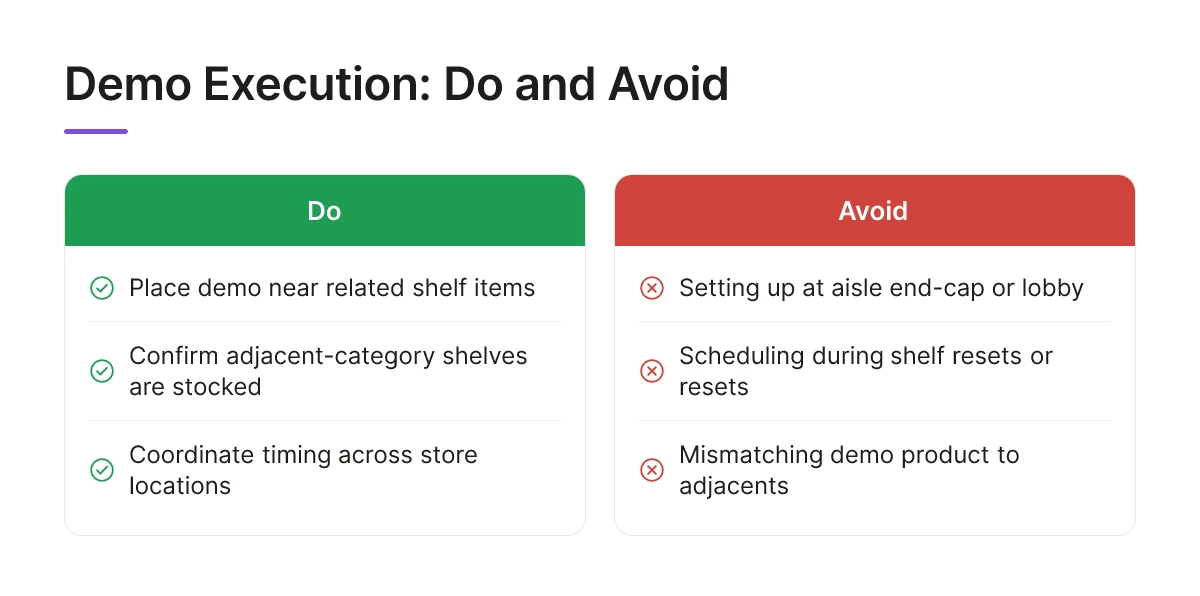
Five execution failures routinely cap or kill spillover sales: bad placement, bad timing, mismatched products, weak staffing, and inconsistent rollout across stores.
Placement is the first thing to check. A demo station set up in an aisle end-cap or front lobby, far from the shelf holding the product and its adjacent SKUs, breaks the path a shopper would otherwise walk from sample to cart. The demo halo effect depends on proximity, shoppers need to taste or try the product and then see the related items within a few steps, not wander off and forget. Prime, high-traffic locations near entrances or checkout lanes are consistently linked to stronger conversion in CPG roadshow placements; a station buried in a back aisle rarely produces the same ripple into neighboring categories.
Timing causes a second, quieter failure. Scheduling a demo during a slow Tuesday afternoon, or stacking it against a competing in-store event, splits shopper attention and thins out foot traffic for both the direct sample and any spillover purchase. Fewer shoppers passing the station means fewer chances for either effect to register.
Product selection matters just as much. Sampling a sauce without a stocked, visible pasta display nearby, or a snack with no adjacent beverage facing, gives shoppers nothing natural to pair it with, the spillover effect occurs when a related item benefits from exposure to the promoted product [4], and that requires a real category relationship, not a random adjacency.
Staffing closes or breaks the loop. An ambassador who simply hands out samples without a word misses the chance to verbally point shoppers toward complementary items; understaffed events compound the problem by rushing every interaction. Left unguided, the halo becomes a matter of chance rather than something the brand actively shapes.
Finally, inconsistent execution across locations, great placement and training at one store, poor versions of both at another, makes results unpredictable even when the underlying product and offer are identical.
Yes, this is cannibalization, not halo, and it happens when a demoed SKU pulls shoppers away from a near-identical product in the same lineup [4]. A demo of a new flavor can simply shift existing buyers rather than creating new demand. Comparing sales against a no-promotion baseline across all related SKUs is the only way to tell the two apart [4].
The core mechanic shows up in both channels, though this article focuses on brick-and-mortar.
Spillover from online ads has been documented in digital campaigns, including cases where the effect on competitors' sales outweighed the advertiser's own gain [3]. In stores, halo depends on physical proximity and shelf adjacency rather than ad impressions.
Most of the measurable lift concentrates in the demo day itself and the following few days, then fades as shelf traffic returns to normal.
Short, targeted activations tend to produce contained, short-lived effects, while broader or repeated activity sustains a longer tail [5]. Brands tracking category sales for a week or two after the event get a clearer read than a single-day snapshot.
Roadshows typically generate a wider halo because they occupy more shelf space, more SKUs, and more shopper attention over several days instead of one shift.
Broader, higher-reach promotional formats are more likely to produce effects that cascade across multiple related products rather than staying confined to the single item being sampled [5]. A multi-day footprint near an entrance or endcap extends exposure beyond the shoppers who stop at the table.
At minimum, pull adjacent-category sales velocity for the activation window and compare it to a matched non-demo period at the same store. Pair that with the demo conversion rate and store conversion rate to rule out a simple traffic or seasonality spike. Without a baseline comparison, any observed lift is only a guess rather than evidence.
A demo halo effect is a measurable spillover, not a hunch, and treating it that way changes what brands track. Watch category sales and adjacent SKUs during and after an activation, not just conversions at the table, and separate genuine halo from cannibalization before crediting a demo with lift it didn't create [4]. Favor prime-traffic placement and multi-day roadshow formats when the goal is category-wide impact rather than single-SKU trial.
Start by pulling sales data for the two weeks surrounding your next scheduled demo, across the full category, not just the demoed product, and compare it to a non-demo week in the same store.
Explore more from our content library:
About the Author
Written by Gregory Yankelovich. This article was conceptualized, directed, and reviewed by our human team of retail marketing veterans. Every strategy, framework, and recommendation originates from the hands-on expertise of our experts. Human insight drives the core narrative, ensuring all advice remains grounded in real-world retail execution. AI assistance was used to streamline production and optimize for generative engine optimization (GEO).
Demo Wizard is the Ultimate Store Sampling & Demonstration management software for Brick and Mortar Retailers and CPG Vendors.
Chat with usPhone