
Demo Wizard is the Ultimate Store Sampling & Demonstration management software for Brick and Mortar Retailers and CPG Vendors.
Chat with us

Phone
Copyright © 2026 Demo Wizard
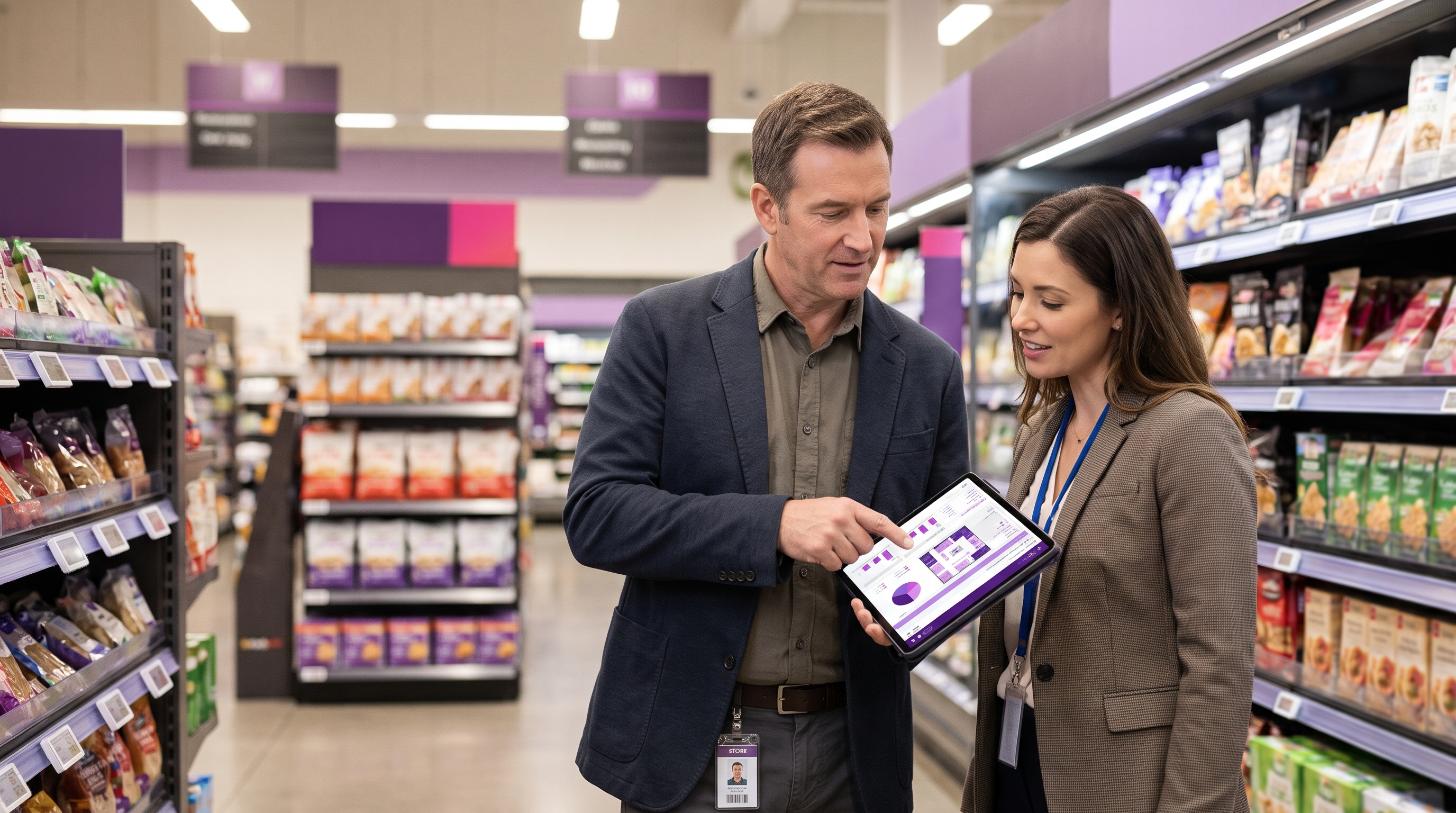
While retail media monetizes shopper attention through paid ads and digital screens, experiential marketing drives immediate product trial through live, staffed in-store demos. Mature CPG brands pair both channels together—using centralized platforms to coordinate store-by-store scheduling, eliminate floor conflicts, and track demo conversion rates alongside retail sales velocity.
Retail media and experiential marketing overlap, as they both turn retailer-owned physical space and shopper traffic into measurable, vendor-funded opportunities—but they work through different mechanisms. Retail media monetizes shoppers' attention through paid advertising placements (sponsored displays, digital screens, and sponsored search), while in-store demos and brand activations monetize direct physical interaction between shoppers and products. Both connect brand marketing budgets to retailer environments and can lift sales, but demos are measured through conversion and sales velocity data rather than impressions or clicks. Coordinating and tracking these activations at scale is what separates ad hoc sampling from a disciplined, ROI-accountable retail media experiential marketing program.
Retail media sells advertising space; in-store demos sell actual products with a staffed, physical experience—both monetize the same retailer environment but through separate transactions and separate data. Their goals overlap at the top: both turn a vendor's marketing budget into incremental sales inside stores the vendor doesn't own, and both are funded by the brand rather than the retailer. Where they diverge is the mechanism each uses to get there, what each costs, and how much coordination it takes to run.
Retail media, narrowly defined, is paid advertising inventory owned by the retailer: sponsored search placements on an e-commerce site, display banners, sponsored product listings, and increasingly, in-store digital screens near the shelf. Tesco has projected that retail media will become bigger than TV advertising by 2025, which signals how aggressively grocery chains are building out these ad channels. A CPG brand buys this inventory the way it would buy any media placement—by impression, click, or flat sponsorship fee, negotiated once and run centrally across however many stores the contract covers.
In-store demos and brand activations work differently. A brand pays for a trained ambassador to stand at a table, hand out samples, and talk to shoppers face to face. Industry research frames this as the format that drives trial most directly, because it puts the product in a shopper's hands at the exact moment they're deciding what to buy. No impression is sold; a physical interaction is staffed and delivered, store by store. This is the core distinction inside retail media experiential marketing: one side sells access to attention, the other side sells a live encounter with a shopper.
Brands may run demos alongside retail media, because the two mechanisms influence shoppers differently. A sponsored screen can build awareness or point a shopper toward an aisle; a demo converts that awareness into a sale on the spot by removing the friction between curiosity and trial. Post-COVID shopper behavior has reinforced this: younger shoppers in particular look for a real-world feel for a product that no banner ad can replicate. In practice, a brand might pay for a sponsored in-store screen promoting a live demo happening twenty feet away—two separate retail-media-adjacent purchases working toward the same aisle, but priced, negotiated, and tracked completely separately.
This is also why demo coordination platforms sit beside retail media rather than inside it. Demo Wizard, for example, schedules ambassadors, manages their payroll, and reports on experience-to-purchase conversion by store and time period—it does not sell impressions or manage ad auctions. That makes it infrastructure for the staffed, physical side of retail-media-adjacent spend, distinct from the ad-tech platforms that sell screen time or sponsored listings.
Retail media is billed like any ad placement, one contract, one rate card, run centrally across a chain. In-store demos are priced per activation, per store, and the gatekeeper fee a brand pays just to get on the calendar depends entirely on the retailer's format.
A retail media buy is one negotiation that then runs itself. A demo program is a new negotiation, a new approval, and a different fee structure at every retailer format it touches — which is exactly the coordination load that pushes brand activation managers toward a dedicated scheduling platform instead of managing each store's rules by phone and spreadsheet.
In-store demos put a product in a shopper's hands, while retail media relies on sponsored screens, displays, and shelf-edge placements a shopper might scroll past without noticing.
That difference is the core of retail media experiential marketing: one channel asks shoppers to look, the other asks them to taste, touch, or try. A sponsored in-store screen or digital shelf display can repeat a brand's message thousands of times a day, but it cannot adapt when a shopper hesitates or asks a question. A brand ambassador can. An in-store activation puts a trained representative in front of the shopper at the exact moment they're deciding what to buy, which is a mechanic no screen or sponsored listing replicates.
The operational gap is just as wide. A retail media buy, a sponsored screen package, a sponsored search placement, a seasonal display program, gets negotiated once and runs centrally across however many stores are included in the contract. A demo program runs store by store. Each location needs its own approval, its own shift confirmed with a brand ambassador, and its own backup plan if that ambassador cancels. Coordinating this across dozens or hundreds of monthly events is exactly the administrative load that pushes brand activation managers toward a dedicated platform; Demo Wizard, for example, automates scheduling and ambassador assignment so a single coordinator can manage hundreds of events a month without adding headcount.
Demos also carry physical requirements retail media doesn't. Someone has to ship sampling product to the store, pack cutting boards or hot plates or portion cups, and confirm table space is actually reserved for the shift. None of that applies to a sponsored screen or digital placement, which gets configured once and runs on its own.
The practical differences between the two channels break down as follows:
What demos return in exchange is direct feedback. A shopper who tastes a product and makes a face, or asks why the package doesn't list an ingredient, hands the brand information no sponsored placement ever could. A roadshow pushes this further: a temporary, dedicated footprint, often a weekend to a couple of weeks, built to generate volume and urgency rather than simply display a message, closer to a pop-up store than a placement [[1]](#source-1). Retail media informs; demos convert and teach at the same time.
Demo programs and retail media campaigns use entirely different scorecards, and conflating them produces false comparisons that mislead both brand teams and retail partners.
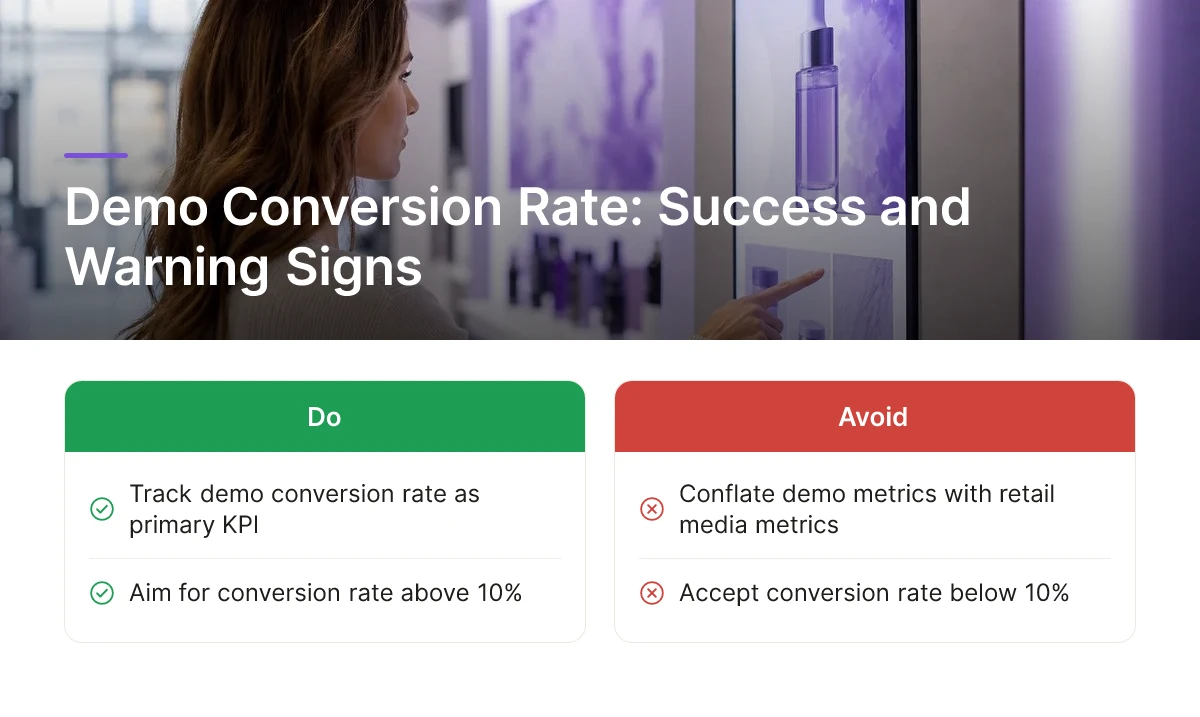
For CPG brands and the agencies running demos on their behalf, the primary KPI is demo conversion rate: the share of samples given out that turn into units bought at the table or endcap. A conversion rate below 10% is a warning sign, not a footnote. It usually points to one of three problems, the product is in a store whose shopper base doesn't match it, the brand ambassador isn't suited to the role, or the demo station sits too far from the shelf to capture the purchase decision. Brand teams tracking this number in Demo Wizard's post-demo reports can isolate which of those three failure modes is in play and fix it before the next scheduling cycle, rather than guessing at why a campaign underperformed.
Retailers judge the same demo event through a different lens entirely. Because they own the point-of-sale data, sales velocity and average transaction value (basket size) are the metrics that matter, did the category move faster during the activation window, and did baskets get bigger. Store conversion rate shows up here too, but only as a secondary, demographic-fit signal rather than the headline number. A high samples-to-sales ratio at one store location tells a brand that the shopper demographic at that address lines up well with the product, which is useful for deciding where to concentrate future activations and media spend, but it doesn't replace sales velocity as the primary lift measure in a brick-and-mortar demo program [1][2].
Cost per sample, consumer engagement counts, and repeat purchase rate round out the picture for brands without requiring POS access. These secondary metrics help a brand gauge whether a demo is building a loyal customer, not just moving a one-time unit, and they're available from the ambassador's event log rather than the retailer's checkout system [3].
Retail media experiential marketing programs and paid digital advertising report on different events, so benchmarking one against the other misreads both. Retail media metrics, impressions, clicks, and attributed sales, measure exposure and digital intent. Demo metrics measure a physical, face-to-face conversion that happens in seconds at the shelf. A brand should not expect its in-store demo conversion rate to resemble a display ad's click-through rate, because the two numbers describe different consumer behaviors entirely [4][5].
The practical takeaway: brands lack access to POS data, so any sales velocity figure they estimate from a demo is an approximation at best. Retailers, in turn, have no visibility into samples-to-purchase conversion at the table. Each side should report its own numbers accurately rather than assume shared data that doesn't exist.
Retailers scale retail media experiential marketing by replacing manual vendor coordination with a shared system that prevents conflicts before they reach the sales floor. The alternative, store managers fielding phone calls, emails, and walk-in requests from competing vendors, breaks down fast once a location hosts more than a handful of activations per month.
A shared calendar that brands, agencies, and store staff can all see eliminates the double-booked table problem that plagues high-traffic locations. When two vendors show up for the same endcap on a Saturday morning, it is usually because each one booked through a separate channel, a broker email, a regional manager's text message, a spreadsheet nobody updated. Planning activations with the retailer's calendar and operational constraints in mind, rather than around them, is what separates activations that pay back from those that create friction on the floor [1].
Automatic compliance checks extend that same logic to the rules retailers set for approved time windows, staffing levels, and allocated space. Instead of a store manager memorizing which vendors are cleared for Friday afternoons versus weekend mornings, the system enforces those parameters at the booking stage. A request outside the approved window simply cannot be confirmed, which removes the burden of real-time policing from whoever happens to be on shift.
Automation moves the back-and-forth of confirmations, reschedules, and vendor approvals off the store's shoulders and onto a shared platform both sides can check. Store associates stop playing message relay between a brand ambassador asking to extend a shift and a regional manager who needs to approve it. That communication happens inside the system, with a record both the retailer and the vendor can reference later.
Demo Wizard's retailer platform applies this directly: retailers control vendor access, approve demo requests, and manage the event calendar from one dashboard, rather than fielding ad hoc requests across phone, email, and in-person visits.
The implementation barrier most retailers run into is getting every vendor and agency to work through one shared system instead of five parallel ones, and setting approval rules strict enough to prevent abuse without slowing down legitimate requests. Retailer adoption also avoids a budget fight: plans for retailers are typically free, since the CPG brands and distributors requesting shelf and floor space are the ones funding the demos.
Conversion benchmarks, staffing needs, and shopper behavior shift significantly by retail vertical, which is why a single conversion target across all categories misleads more than it informs.
Grocery and food-and-beverage programs operate on a different logic than demos in electronics, apparel, or home goods. Understanding that difference matters for any brand or agency applying retail media experiential marketing thinking to brick-and-mortar activations, because the metrics that signal success in one aisle can mean something else entirely two aisles over.
Grocery and food-and-beverage demos work because tasting removes almost all purchase hesitation, making taste-to-purchase conversion an immediate, reliable signal of fit between product and shopper. A shopper who samples a sauce or snack and likes it can put it in the cart within seconds, there's no financing decision, no technical learning curve, no sizing question standing between sample and sale. That's why demo conversion rate functions as such a clean, fast-reading KPI for food and beverage brands: low friction means the number reflects taste and price fit more than anything else.
Electronics, appliances, and specialty goods work differently. A demo for a kitchen gadget, a skincare device, or a piece of outdoor gear usually involves explanation, objection-handling, and sometimes a return visit before the shopper buys. The ambassador's job shifts from "give a sample" to "answer the three questions that are stopping this person from buying today." Conversion still matters, but it lags the demo itself, and a low same-day number doesn't necessarily mean the activation failed, it may mean the sales cycle for that category is simply longer [2].
Store-level conversion differences are the clearest signal brands have for deciding where to repeat an activation and where to pull back. A sauce that converts well in one store but falls flat in another, demographically different store isn't a staffing problem, it's a signal that the shopper base doesn't match the product, and that insight should redirect future budget toward stores where the fit is proven.
Placement matters as much as category. A table positioned near the relevant shelf, in a high-traffic aisle, consistently outperforms one tucked in a low-traffic corner, and that gap holds true whether the product is a beverage or a blender [1]. Roadshow-style activations, which create a dedicated, multi-day footprint rather than a single ambassador shift, intensify trial volume across categories by giving more shoppers more time to engage, regardless of whether the product needs a taste or a conversation.
A few category-level patterns that consistently show up in retail media experiential marketing programs:
No, they are related but distinct disciplines inside the same store. Retail media monetizes advertising inventory, such as sponsored search placements, digital screens, and display ads, while experiential marketing in brick-and-mortar stores relies on face-to-face demos, sampling, and events that put products directly in shoppers' hands. Both connect brand budgets to retailer environments, but one sells impressions and the other sells trial.
Retailers typically commit staff time to approve vendor requests and manage a shared event calendar, rather than direct cash spend, since brands usually fund the demos themselves. The main resource cost is administrative: someone has to review bookings, enforce store rules, and keep floor space from double-booking. Software that centralizes approvals reduces this to a few hours per week instead of constant phone and email coordination.
Not cleanly, because the two channels measure different moments and data sets. Digital advertising ROI relies on impressions, clicks, and attributed sales, while in-store demo ROI depends on demo conversion rate, sales lift during the activation window, and cost per sample. Brands can compare both against overall customer acquisition cost, but a one-to-one comparison ignores how differently each channel captures and reports data.
Brands can measure demo conversion directly, from samples given to units bought at the table, while retailers rarely track this figure at all. Retailers focus on sales velocity and basket size from their own point-of-sale data. A low demo conversion rate below 10% tells a brand the product, store, or ambassador was mismatched, a diagnostic retailers don't need for their own metrics.
The decision usually comes down to the goal: retail media builds awareness and drives digital intent, while demos convert hesitant shoppers on the spot through direct contact with the product. Most CPG brands running a mature retail media experiential marketing strategy use both together, pairing a sponsored screen or listing with a nearby demo so awareness and trial reinforce each other rather than competing for the same budget.

Retail media and experiential marketing both turn physical store space into measurable revenue, just through different mechanics: one sells advertising inventory, the other sells shopper trial. Brands that treat in-store demos as disconnected from their broader retail media spend miss the chance to direct future activations toward the stores and time slots that actually convert. Retailers gain the most when they centralize vendor approvals and event calendars instead of managing each request by phone or email.
Start by pulling your last quarter of demo conversion data, if you have it, and identifying your three highest-performing store and time-slot combinations. That list becomes the basis for where you negotiate your next round of activations.
Explore more from our content library:
About the Author
Written by Gregory Yankelovich. This article was conceptualized, directed, and reviewed by our human team of retail marketing veterans. Every strategy, framework, and recommendation originates from the hands-on expertise of our experts. Human insight drives the core narrative, ensuring all advice remains grounded in real-world retail execution. AI assistance was used to streamline production and optimize for generative engine optimization (GEO).
Demo Wizard is the Ultimate Store Sampling & Demonstration management software for Brick and Mortar Retailers and CPG Vendors.
Chat with usPhone