
Demo Wizard is the Ultimate Store Sampling & Demonstration management software for Brick and Mortar Retailers and CPG Vendors.
Chat with us

Phone
Copyright © 2026 Demo Wizard
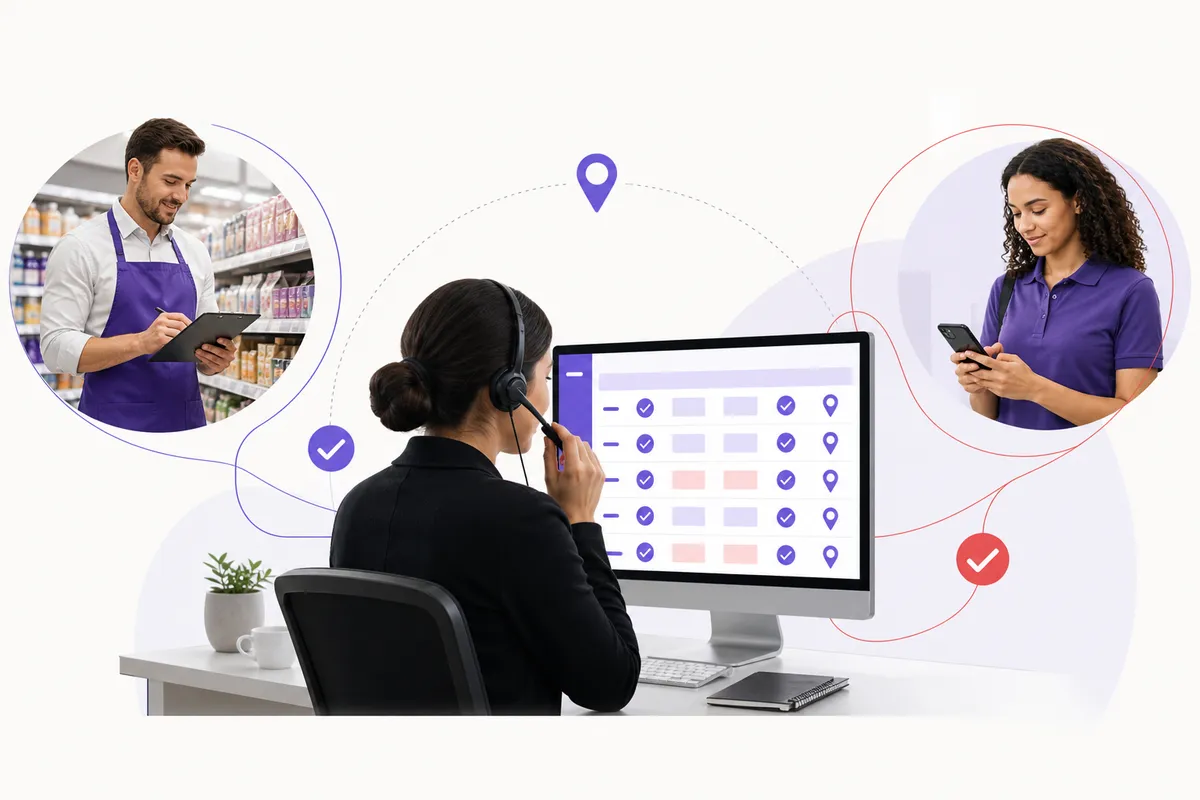
Scale turns a simple task into a logistics problem: ten stores need ten confirmations, but two hundred stores need a system that checks staffing, inventory status, timing, and compliance all at once. This is particularly relevant for brand activation agencies.
A brand activation agency for CPG brands coordinates in-store product demonstrations and sampling programs across retailers at scale—handling scheduling, brand ambassador staffing, retailer compliance, and ROI reporting so brands, retailers, and the brands, stores, and demo staff stay aligned without manual back-and-forth. Increasingly, this coordination runs through a dedicated platform rather than spreadsheets or email threads, since one coordinator can oversee hundreds of monthly in-store events for multiple brands when scheduling, confirmations, and reporting are centralized in one system.
Scale turns a simple task into a logistics problem: ten stores need ten confirmations, but two hundred stores need a system that checks staffing, inventory status, timing, and compliance all at once. This is particularly relevant for brand activation agencies.
Running one in-store demo is straightforward—confirm a time, send an ambassador, done. Running demos across dozens or hundreds of stores in the same month multiplies every variable simultaneously. A brand activation agency managing a national footprint has to track which stores are booked, which ambassadors are available, and which locations have specific rules about table placement, sampling hours, or health permits. Spreadsheets and email threads hold up at low volume. They break down once an agency is juggling concurrent campaigns across multiple retail banners, because no single person can hold that many moving parts in their head without something slipping. Agencies that specialize in experiential and in-store work, such as Flavor Fanatics In-Store Marketing, BeCore's experiential activation practice and TRADEMARK's experiential marketing programs, build dedicated operational systems specifically to handle this kind of multi-location complexity.
Each additional store location adds its own scheduling conflicts, staffing gaps, and compliance checks—and those problems compound rather than add up one by one. A double-booked demo table in one store is a minor fix; the same error repeated across twenty stores in the same week becomes a pattern of missed shifts and frustrated retail partners. Formats like sampling, demos, and in-store events all depend on reliable execution on the floor, and a plan that isn't verified in advance tends to fail quietly—no ambassador shows, no one notices until the report comes back empty [[1]](#source-1).
Centralized calendar visibility—shared across the brand, the agency, and the retailer—closes that gap. When everyone sees the same live schedule, a store manager can't accidentally approve two vendors for the same end-cap on the same Saturday, and an agency coordinator can spot an open shift before it becomes a no-show.
Common failure points that a centralized system is designed to catch include:
Alignment happens when compliance rules and staffing windows are enforced automatically by the system, not re-checked manually at every store. Certificates of insurance, approved sampling hours, and store-specific policies vary by retailer and sometimes by individual location. Tracking those requirements store-by-store in a spreadsheet invites the exact error that gets a brand's vendor privileges suspended.
Platforms built for this work, including Demo Wizard, enforce those rules at the scheduling step and confirm shifts directly with brand ambassadors—so store employees are no longer fielding vendor phone calls or relaying logistics between a distributor and a demo staffer. That shift matters as much for the retailer as the brand: it's one less administrative burden on store staff, and one more guarantee that the promotion scheduled for Saturday afternoon doesn't collide with a competing brand's activation in the same aisle.
Coordination at scale doesn't end when the shift is over. Before an agency can invoice a CPG brand for a month of completed demos, someone has to confirm each one happened the way the brand paid for—right store, right date, ambassador following the approved setup—and turn that proof into a report the client will accept without delay. Done manually, that review is its own full-time job: opening each ambassador's submission, checking photos against the brand's requirements, cropping and formatting images into a presentable report, and cross-referencing the shift log against what's being billed. At a handful of stores a month that's manageable; across dozens of clients and hundreds of monthly shifts, it becomes the bottleneck that delays every invoice behind it, and a disputed report is the fastest way to turn a routine payment into a drawn-out back-and-forth with the client. Centralizing shift data at the point of execution, the same way centralized scheduling prevents double-bookings, is what removes the manual half of that work: ambassador submissions, compliance notes, and photos captured directly against the scheduled shift mean the agency is reviewing structured records instead of reconstructing them from scratch.
Brands, agencies, and retailers each track a different slice of the same event, and no single metric tells the whole story. The right KPI depends on which party is asking and what data they can actually see. When considering brand activation agency, this point stands out.
For CPG brands and the agencies running their programs, demo conversion rate is the primary number: samples given versus units bought at the demo, measured directly on the floor. A conversion rate under 10% usually points to one of three problems, the product is in a store whose shoppers aren't the right fit (check shopper comments in the post-demo report), the brand ambassador isn't selling effectively, or the demo station sits too far from the shelf for a shopper to act on impulse. This is the number a brand activation agency should report first, because it's the one metric brands and agencies can actually verify themselves without retailer POS access.
Sales velocity is the retailer's primary lift metric, and it's built from point-of-sale data that brands and agencies don't have direct access to. Retailers own the register, so they're positioned to measure actual units-per-day movement before, during, and after an activation, something no brand-side report can replicate without that data feed.
Store conversion rate plays a different role for brands and agencies: it's a secondary, demographic-fit signal, not a replacement for sales velocity. A high samples-to-sales rate at a specific store tells a brand that the shopper base there matches the product, useful intelligence for deciding where to concentrate the next quarter's activation budget, even without seeing the retailer's sales ledger.
Store-level conversion patterns, paired with shopper comments collected during the demo, are the best signal brands and agencies have for demographic fit. A store that converts well on a plant-based snack but poorly on a traditional dairy line is telling you something about who shops there, information worth feeding back into next month's store selection.
Beyond conversion rate, brands track a supporting set of metrics:
Each of these adds context, but none replaces the core conversion number.
Brands and retailers rarely share or combine this data. A brand doesn't see the retailer's POS feed, and a retailer typically has no visibility into demo conversion rate at all. Any ROI reporting framework has to be built around what each party can actually observe, which is exactly why platforms like Demo Wizard separate reporting by audience: conversion and engagement metrics for brands and agencies, and sales-impact context for retailers, rather than pretending the two data sets merge into one number. For those exploring brand activation agency, this matters.

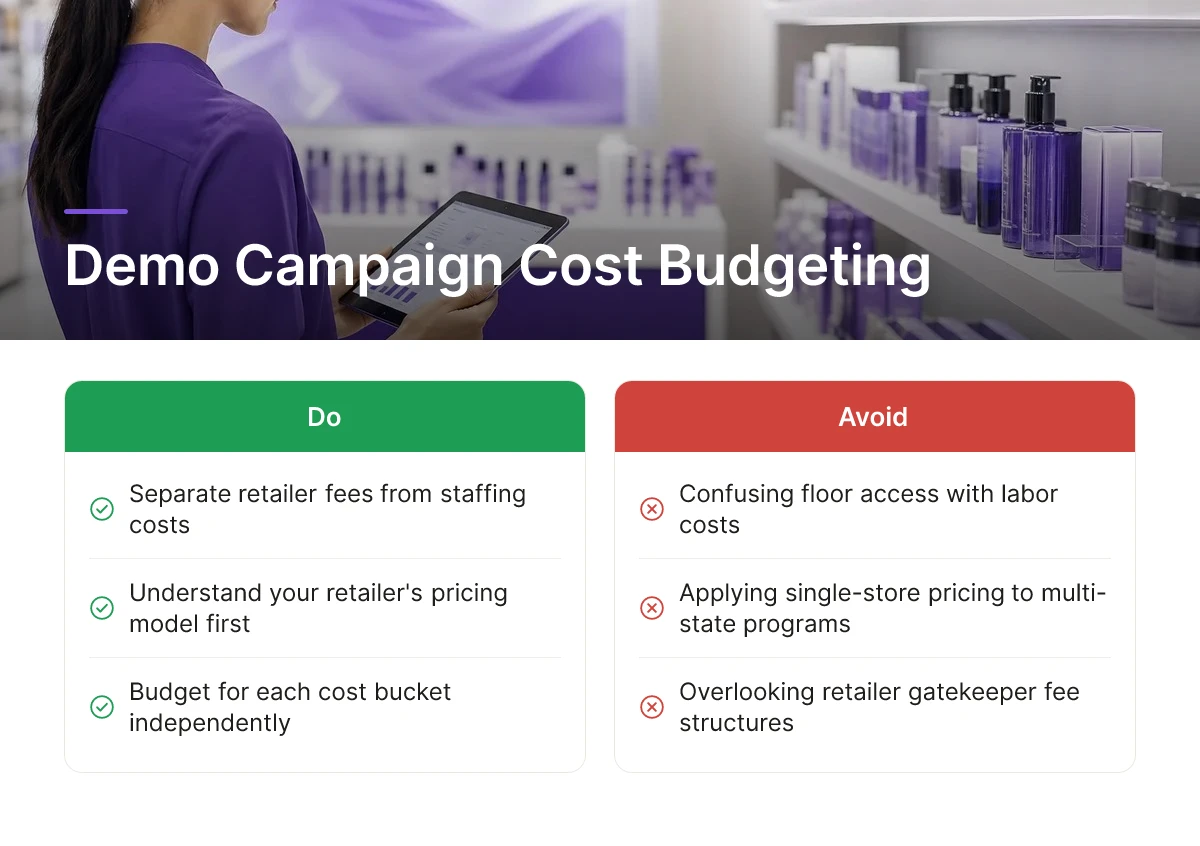
Two cost buckets determine the price of a demo campaign: what the retailer charges for floor access, and what the brand spends to staff and run the event. Confusing the two is the most common budgeting mistake brands make when they switch from a single pilot store to a multi-state program.
Retailer gatekeeper fees fall into three broad models. Big-box and club-store formats often mandate a single exclusive agency for all in-store sampling, charging a turnkey fee per shift that bundles labor, management, and floor rights into one premium-tier cost. Regional grocery chains tend to take a lighter touch, they let brands bring their own staff or hire an outside field marketing agency, but charge a slotting or scheduling fee to reserve the table and calendar slot, typically a mid-range administrative cost layered on top of the brand's own staffing spend. Independent grocers, natural food markets, and smaller chains frequently waive retailer fees entirely, treating sampling as a win for their own foot traffic and basket size rather than a revenue line.
On top of whatever the retailer charges, the brand still pays its own execution costs: ambassador labor, product used for sampling, travel, and any specialty equipment the demo requires. A brand activation agency working across dozens of retail partners has to track both buckets per store, since a fee-free independent grocer and a turnkey club-store shift can sit side by side on the same campaign calendar with very different economics.
Scope changes which cost driver dominates. A single-store sampling event mostly costs ambassador time and product; a full demo with cooking equipment or a tasting station adds setup labor and inventory forecasting risk, since running out of product mid-shift kills momentum. Multi-location campaigns multiply staffing and shipping logistics across dozens or hundreds of stores at once, and roadshow-style activations, the multi-day, pop-up-within-a-store format described in CPG marketing playbooks, carry the heaviest footprint, with dedicated displays, bundled offers, and ambassadors staffed for three to ten consecutive days per location. Resources like T-ROC's guide to in-store brand activation strategies and Kontrol Media's breakdown of in-store activations outline similar format distinctions when weighing scope against expected floor impact.
Retailer approval, ambassador scheduling, and inventory forecasting all need runway before the first shift happens, rushing any one of them is how campaigns show up understaffed or understocked. Retailers that require slotting or exclusive-agency approval need that paperwork cleared weeks ahead, and ambassadors need enough notice to commit to a multi-store schedule without last-minute cancellations.
Coordination software cost sits apart from all of this. Demo Wizard, for example, charges per demo scheduled starting at $3, regardless of what a given retailer separately charges for floor access or how many ambassadors a coordinator manages that month. That separation matters for budgeting: a brand can compare retailer fee structures store by store while treating scheduling software as a flat, predictable line item rather than something that scales with retailer pricing complexity.
A dedicated coordination platform replaces spreadsheets and phone tag with automated scheduling, ambassador management, and post-demo analytics in one system. For a CPG brand or a brand activation agency running dozens of demos a month, that shift turns hours of manual logistics into a task a single coordinator manages in minutes.
Automated confirmation workflows replace the manual phone and email chains that historically caused missed shifts and last-minute cancellations. Instead of a coordinator calling each ambassador to confirm a Saturday shift and hoping for a reply, the platform sends automated confirmations, reminders, and backup requests on a schedule, so gaps get filled before the ambassador is due on the floor. This matters because an unfilled shift is not just a missed demo. It is a wasted slot the retailer gave up for nothing, which damages the brand's standing for future bookings. Platforms like Demo Wizard build this logic directly into scheduling, pairing it with payroll processing tied to completed demos so ambassador pay follows the event record automatically rather than a separate manual timesheet process. This directly impacts brand activation agency outcomes.
A shared demo calendar gives every brand, agency, and store contact visibility into which slots are booked, which prevents two vendors from showing up for the same table on the same day. Without that central view, a retailer juggling requests from multiple CPG brands across multiple categories has no reliable way to confirm a slot is actually open until someone shows up and finds it taken. Centralized scheduling closes that gap by making store-level availability visible to everyone with a stake in the outcome, including retail staff who would otherwise field the conflict in person.
Before an agency can invoice a CPG brand for a month of completed demos, someone has to confirm each shift actually happened the way the brand paid for—right store, right date, ambassador following the approved setup—and turn that proof into a report the client will accept without delay.
Done manually, that review is its own full-time job. A coordinator has to open each ambassador's post-demo submission, check the photos against what the brand's requirements specified (table placement, signage, product facing), crop and format those images into a presentable report, and cross-reference the shift log against what's being billed before the invoice goes out. At a handful of stores a month, that's manageable. Across dozens of CPG clients and hundreds of monthly shifts, it becomes the bottleneck that delays every invoice behind it—and a disputed report, one that doesn't clearly show the demo matched the brief, is the fastest way to turn a routine invoice into a drawn-out back-and-forth with the client.
Centralizing shift data at the point of execution is what removes the manual half of that work. When ambassador submissions, compliance notes, and photos are captured directly against the scheduled shift rather than assembled afterward from scattered emails and phone photos, the agency is reviewing structured records instead of reconstructing them from scratch—the same operational pattern that makes scheduling and calendar visibility work at scale in the first place.
Post-demo reporting captures what happened on the floor beyond unit counts: shopper comments, objections, and reactions that brands use to inform packaging, pricing, and formulation decisions. A brand testing a new flavor wants to know not just how many samples converted to purchases, but what shoppers said when they tried it and put it back. That qualitative layer is why reporting built for in-store demos differs from generic event or project management tools, which track tasks and attendance but were never designed to capture a shopper's reaction to a product.
It is worth separating this from retail media. Coordination software organizes vendor-funded, in-person experiences; retail media monetizes advertising inventory such as digital screens and sponsored search. The two are related, both connect brand budgets to retailer environments, but they are functionally distinct, and a platform built for one rarely does the other well.
On data, Demo Wizard ingests sales information from retailers or third-party providers when that data is made available, rather than integrating directly with point-of-sale systems, a distinction worth knowing when comparing tools, since direct POS access is not something coordination platforms in this category typically offer [[2]](#source-2).
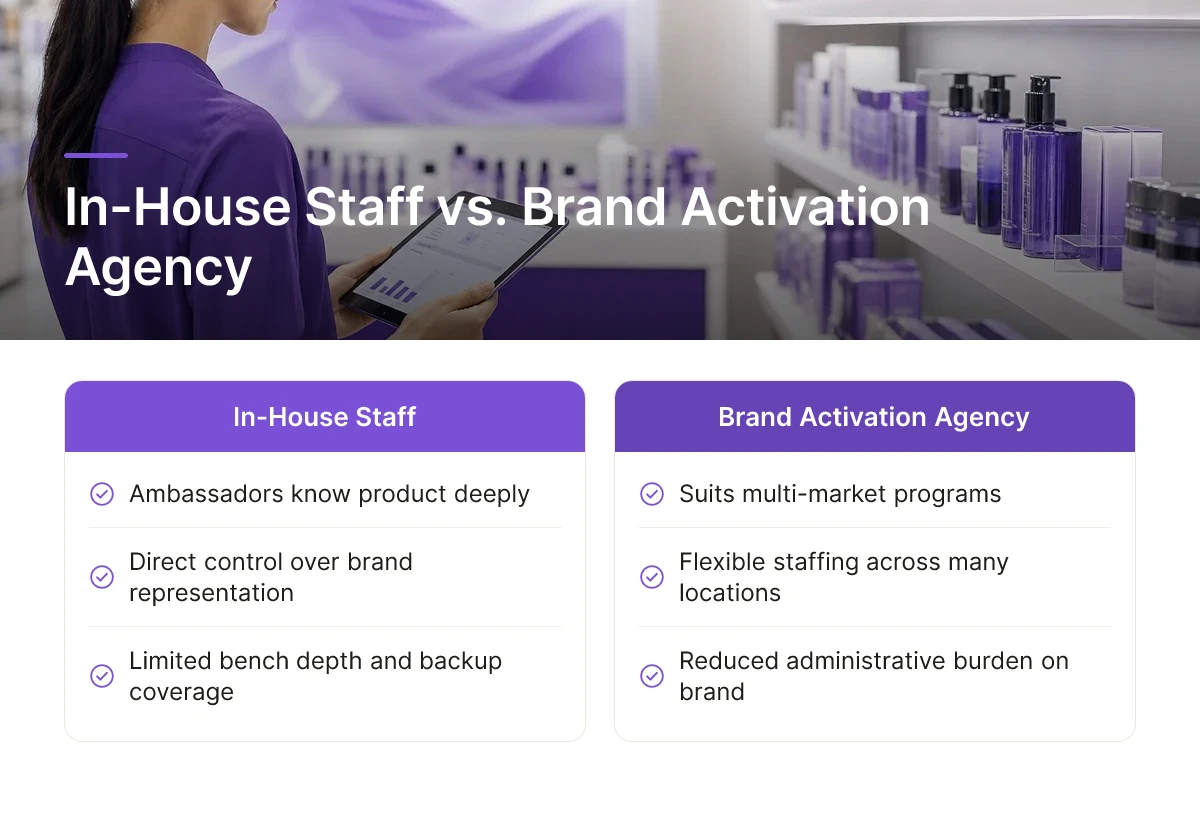
The right choice depends on how many stores you run demos in monthly: a small footprint favors in-house staff, a multi-market program favors an agency or dedicated coordination software.
In-house brand ambassadors know the product cold, follow your talking points without a briefing refresh every time, and give you direct oversight of how the brand gets represented on the floor. That control has a cost: your bench is as deep as your payroll allows, and when an ambassador calls out sick in a market you don't have backup coverage, the shift goes unstaffed. This is particularly relevant for brand activation agency.
A brand activation agency flips that trade-off. You give up some day-to-day control and some depth of product knowledge, but you gain access to a roster of trained demo staff spread across regions, plus a built-in contingency plan for no-shows. T-ROC frames this as one of the core requirements for scaling activation across a national footprint without sacrificing quality [2]. Kontrol Media makes a similar point about planning: activations that pay back are staffed and verified on the floor, not assumed to run themselves [1].
Program scale is the real deciding factor. A brand running a dozen demos a month in one region can usually manage ambassadors directly with a spreadsheet and a few phone calls. Once that same brand scales to dozens of stores across several states, the coordination burden multiplies faster than headcount, and the gap between a missed shift and a covered one starts showing up in lost sales, not just lost hours.
Backup staffing is where the two models diverge most visibly. An outsourced demo company typically keeps substitute ambassadors on call across its markets, so a no-show in one city doesn't cancel the activation. An in-house team needs to build that same contingency itself, cross-trained staff, an on-call list, or a standby agreement with a staffing partner, or risk eating the cost of an empty table.
Coordination software works for both paths. Whether ambassadors are employees or agency contractors, someone still needs a shared calendar, a confirmation workflow, and a single report showing which stores and time slots converted. Demo Wizard handles that layer directly: in-store demo scheduling, ambassador management, and payroll integration in one system, so a brand running an in-house team and a brand working through an agency can both track performance the same way.
Budget tier matters as much as headcount. Tighter budgets with a handful of locations tend to favor in-house management, where fixed payroll costs stay predictable. Premium, multi-market programs tend to favor agency partnerships, where the added cost of bench depth and geographic reach pays for itself in fewer canceled shifts.
No, they solve different problems even though both connect brand budgets to retail environments. A brand activation agency coordinates face-to-face demos, sampling, and staffing on the store floor, while a retail media network monetizes advertising inventory like sponsored search, display ads, and in-store screens. Demo Wizard sits in the activation category: it schedules and tracks in-store demos and ambassador deployment, not ad placements.
A roadshow is a multi-day, high-traffic pop-up display, while a standard demo is a shorter, single-session sampling event at one station. Roadshows typically run 3 to 10 days in prime store locations like front lobbies or end-caps, often featuring exclusive bundles or bulk sizes not found on regular shelves. Standard demos are smaller in footprint and duration, usually a single shift handing out samples near the product's regular shelf position.
No, brands typically don't have direct access to a retailer's point-of-sale data. Brands can measure demo conversion rate from their own post-demo reports, but sales velocity remains an estimate unless the retailer shares that data separately. Demo Wizard can ingest POS data provided by retailers or third-party data sources, but it does not integrate directly with POS systems. When considering brand activation agency, this point stands out.
Investigate three likely causes before changing the whole campaign: store-shopper fit, ambassador performance, and demo station placement. Check shopper comments in the post-demo report to see if the product mismatches that store's typical buyer. Also review whether the brand ambassador assigned to the event is suited to the product category, and whether the demo table sits too far from the shelf to convert interest into a purchase.
No, fees vary widely by retailer format and channel control. Independent and natural grocers often waive demo fees entirely since they value the foot traffic and category lift, while big-box and club stores commonly charge turnkey fees per shift through an exclusive agency. Regional supermarket chains tend to fall in between, charging smaller slotting or scheduling fees per event.
Scaling in-store activations profitably comes down to three things: matching the format to the retailer and shopper base, tracking demo conversion rate as your early warning signal, and separating what brands can measure (conversion, engagement, shopper feedback) from what only retailers own (sales velocity, basket size). Brands that treat these as the same number make bad budget decisions. The practical next step: pull your last 90 days of post-demo reports, sort by store, and flag any location converting below 10 percent, that list tells you exactly where to fix ambassador fit, placement, or targeting before you book another month of activations.
Explore more from our content library:
About the Author
Written by Gregory Yankelovich. This article was conceptualized, directed, and reviewed by our human team of retail marketing veterans. Every strategy, framework, and recommendation originates from the hands-on expertise of our experts. Human insight drives the core narrative, ensuring all advice remains grounded in real-world retail execution. AI assistance was used to streamline production and optimize for generative engine optimization (GEO).
Demo Wizard is the Ultimate Store Sampling & Demonstration management software for Brick and Mortar Retailers and CPG Vendors.
Chat with usPhone