
Demo Wizard is the Ultimate Store Sampling & Demonstration management software for Brick and Mortar Retailers and CPG Vendors.
Chat with us

Phone
Copyright © 2026 Demo Wizard

In-store demo reimbursement claims get rejected primarily due to missing point-of-service proof—such as unsigned store manager approvals, incomplete compliance photos, mismatched schedules, or missed submission deadlines. Agencies prevent these denials by replacing scattered spreadsheets with centralized scheduling and automated post-demo reporting that capture timestamped check-ins, visual proof, and retailer sign-off before the ambassador leaves the store.
In-store demo reimbursement claims get rejected most often because of missing proof of execution, no signed retailer approval, incomplete photos, mismatched attendance records, or expense documentation submitted after the retailer's or distributor's deadline. Agencies prevent this by standardizing documentation at the point of service: timestamped check-ins, photo proof of compliant setup, and signed retailer acknowledgment collected before the brand ambassador leaves the store. Centralized, automated tracking removes the manual handoffs where paperwork typically goes missing.
A demo reimbursement claim covers the specific, verifiable costs tied to one scheduled in-store event, not the broad, loosely-documented spending categories found on a typical employee expense report.
Five cost categories show up in nearly every claim a brand or agency submits after an in-store activation. Brand ambassador labor is the largest, hours worked, often broken into setup, demo, and breakdown time, billed at an agreed rate. Administrative and coordination costs come next, and are frequently the second-largest line item after BA labor: the staff time spent scheduling ambassadors, confirming bookings with each store, chasing documentation, and managing the back-and-forth with distributors and retailers across dozens or hundreds of events a month. This cost is easy to underestimate because it doesn't show up as a single receipt, it accumulates across every event a coordinator manages. Demo materials and product samples come next: the units consumed, plus disposables like cups, napkins, or utensils used during the shift. Travel and mileage apply when an ambassador drives between store locations or covers a remote market, and equipment rental covers tables, warmers, blenders, or signage the retailer doesn't supply on-site.
Each of these line items needs to map back to a single, identifiable event. A claim listing "sampling supplies, October" without a store number and date looks like a corporate expense report, not a retail activation record, and gets flagged for that reason alone.
A standard employee expense report only needs a manager's internal sign-off; a demo reimbursement claim needs a third party outside the company to confirm the work actually happened. That third party is the retailer or distributor hosting the event, and their acknowledgment, a signature, a stamped form, or a logged approval in a vendor portal, is what separates a reimbursable demo cost from an ordinary business expense. Internal approval alone doesn't satisfy a retailer's finance team or a distributor's accounts payable process, because neither was present to see the work performed.
This is also why demo claims get tied to a specific date, store number, and retailer sign-off rather than a general billing period. A claim for "Store #4021, October 14, approved by store manager Reyes" carries weight a vague monthly summary never will.
The claim is only as credible as what accompanies it. A post-demo report, an ambassador attendance record, and a compliance checklist confirming the setup matched retailer rules together form the evidence a finance reviewer checks against the dollar amount requested. Remove any one of those three, and even a legitimate claim starts to look unverifiable, which is precisely where most rejections in the industry originate.
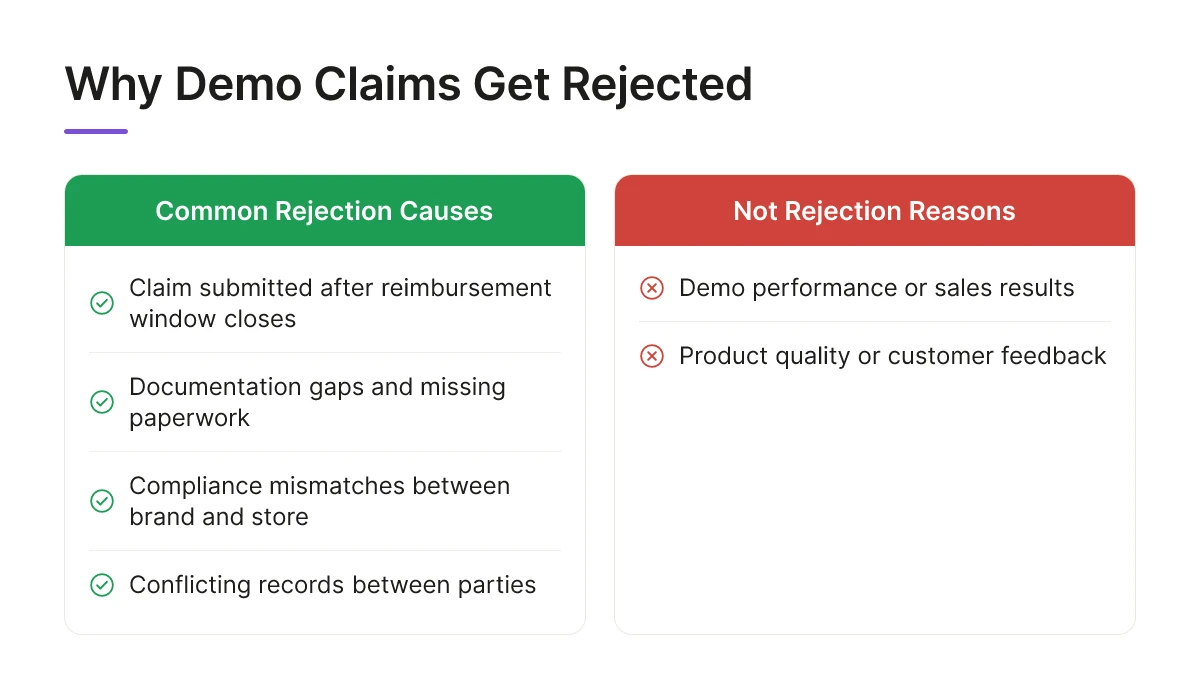
Most demo reimbursement claims get rejected because of documentation gaps, missed submission windows, compliance mismatches, or conflicting records between the brand, agency, and store, not because the demo itself failed.
Timing is the first failure point. Many retailers and distributors set a fixed reimbursement window, often 7 to 30 days after the event, and a claim submitted even one day late can be denied outright, regardless of how well the demo performed.
Agencies running demos across 20 or 30 stores in a single week often batch paperwork at the end of the month, which pushes some claims past the deadline for stores visited early in that cycle. The pattern echoes what revenue cycle teams in other claims-heavy industries already know: denied claims are costly, both in lost reimbursement and in the staff time needed to appeal them [2]. In retail demo programs, that appeal time usually isn't budgeted for at all.
A claim with no signed store manager acknowledgment or no photo of the demo table setup gives the retailer nothing to verify, so the default response is denial. Store managers turn over often, and a new manager with no record of approving the activation has little reason to sign off on a claim after the fact.
Compliance violations create a second wave of rejections. A demo staged at the wrong end-cap, a giveaway item that wasn't on the approved list, or a brand ambassador who doesn't match the roster submitted during scheduling all give the retailer grounds to deny payment, even when the demo otherwise ran well and moved product.
Fragmented communication compounds both problems. When the brand, the staffing agency, and the store each keep their own version of what was scheduled, approved, and delivered, the three records rarely match exactly. A retailer's accounts payable team doesn't resolve ambiguity in the claimant's favor; a mismatch between the agency's timesheet and the store's log is read as a sign the demo didn't happen as described.
This is why claims lacking a consistent paper trail across multiple stores are the hardest to win back once disputed. A single missing signature is an easy fix. Dozens of claims across dozens of stores, each with a slightly different documentation gap, rarely get resolved, most clean claims processes rely on standardized, repeatable documentation precisely because ad hoc paperwork breaks down at scale [1].
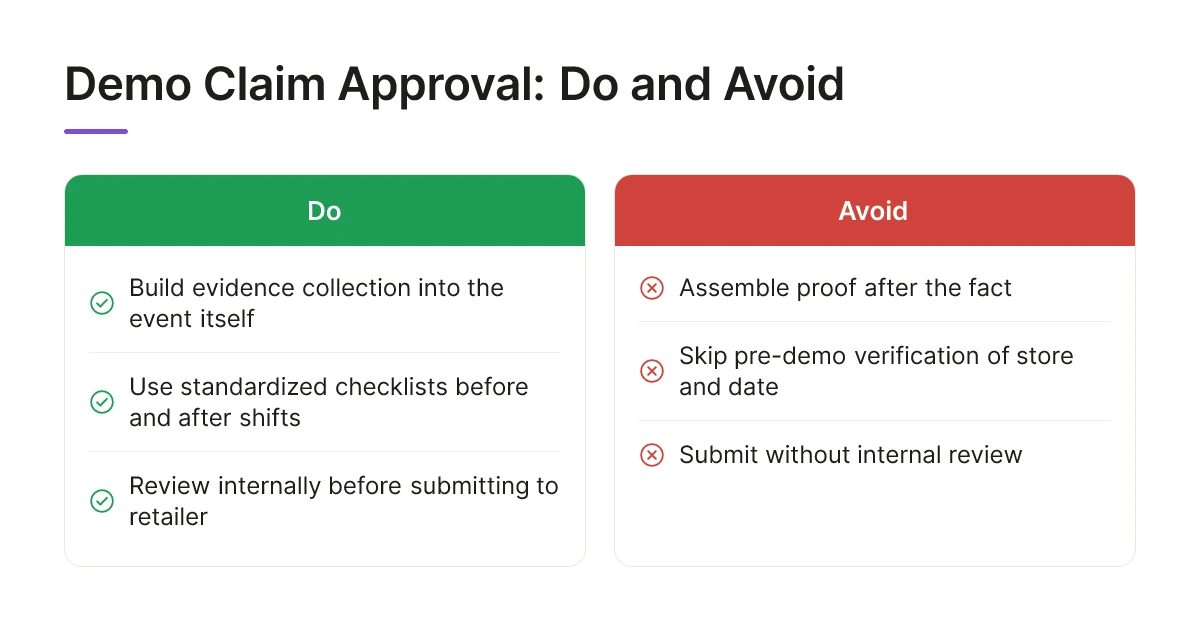
Agencies win approval for demo reimbursement claims by building evidence collection into the event itself, not by assembling proof after the fact. That means a defined checklist before the ambassador arrives, another before they leave, and an internal review before anything reaches the retailer.
A short, standardized check before each event prevents the most common cause of claim rejection: an ambassador at the wrong store, on the wrong date, with the wrong setup. The checklist should confirm three things, store location and address match the signed agreement, the date and time window align with what the retailer booked, and the assigned ambassador has been confirmed for that specific roster slot. Skipping this step is how agencies end up with a completed demo that the retailer's system shows as never scheduled.
Evidence gathered on-site, while the ambassador is still in the store, holds up far better than anything reconstructed later. The post-demo checklist should require time-stamped photos of the setup and the ambassador at the station, a signed acknowledgment from a store manager or designated staff member, and an itemized list of materials and product samples used. Without a signature captured at the moment of service, agencies are left asking a store manager days later to remember and confirm an event they may not recall clearly.
Attendance confirmation, compliance notes, and expense line items scattered across email threads and separate spreadsheets are difficult to retrieve quickly and easy to lose. A single centralized record per demo, bundling who attended, what the compliance notes said, and every expense tied to that event, gives an agency one file to hand over when a retailer or distributor asks for support. This structure is also what separates a clean process from the kind of fragmented documentation that undermines recovery when a claim is contested [4].
A defined internal review step, where someone other than the submitting coordinator checks each file against the checklist, catches missing signatures or incomplete photos before submission. This mirrors a principle that holds across claims-heavy industries: prevention at the source is far cheaper than fixing a rejection after the fact [1][5].
An unstaffed shift with no backup ambassador does not just mean a missed event, it creates a claim with no attendance record, no photos, and no signature to support it, which a retailer will reject outright.
Centralized scheduling and automatic reporting remove the manual handoffs where double-bookings, missing paperwork, and mismatched records turn into rejected demo reimbursement claims.
Most disputes trace back to a mismatch between what was scheduled and what actually happened in the store. A brand ambassador roster built in one spreadsheet, a store calendar maintained in another, and a confirmation email sent to a third system create openings for double-booked slots, ambassadors assigned to the wrong location, or events that never get confirmed with the retailer at all.
A centralized scheduling system closes that gap by keeping one calendar as the single source of truth. When an agency or brand books a demo, the system checks ambassador availability and store commitments against that same record, so the kind of compliance mismatch that triggers an automatic rejection, an ambassador clocked in at a store with no corresponding approved booking, simply has less room to happen.
Manual paperwork fails most often in the gap between when a demo ends and when someone writes it up. Photos get taken on a personal phone and never uploaded, timestamps get estimated from memory, and attendance sheets go missing on the drive home. Each of those gaps is a reason a retailer or distributor can point to when a reimbursement claim lacks proof.
Automatic post-demo reporting closes that gap by capturing photos, timestamps, and attendance at the moment the event happens, not days later. That record becomes the backup a reimbursement claim needs, generated as a byproduct of running the demo rather than as a separate administrative task.
Coordination structure matters as much as the data itself. A coordinator managing dozens of stores through one dashboard, rather than chasing confirmation emails from each location individually, removes handoff points, and every handoff is a place where a file gets misplaced or a detail gets transcribed wrong. Demo Wizard's scheduling and ambassador management tools let a single coordinator oversee hundreds of monthly events this way, with post-demo analytics tracking demo conversion rate and operational data such as store traffic and ambassador performance for agencies and brands. That is the operational evidence a claim needs to prove a demo occurred as contracted; it is not a feed of retailer point-of-sale data, which agencies and brands do not have access to regardless of what software they use.
This same automation extends to the billing step itself. Demo Wizard supports weekly automated invoicing for completed demos, with the full documentation, timestamps, photos, attendance records, and retailer sign-off, attached to each invoice as it's generated. Invoicing drawn directly from the same verified record used to prove the demo happened, rather than reconstructed separately after the fact, closes the exact gap where most rejected claims originate.
None of this is a comparison of claims-processing software. It is a fix at the coordination and documentation stage, the point where most demo reimbursement claims are won or lost before anyone files paperwork.
Demo reimbursement claims succeed when every in-store condition, attendance record, and material used is documented at the time of the event, not reconstructed afterward from memory.
Retailers and distributors reject claims when the demo didn't run the way the contract specified, so the compliance record has to prove it did. That means photo or written confirmation of correct table or kiosk placement (not a substitute aisle the store manager offered instead), approved signage displayed as designed, and brand ambassadors following the dress code and working the exact scheduled hours. A pattern in medical billing holds here too: claims get denied for documentation gaps, not just factual errors in the service itself [2]. The same logic applies to a retail activation, a demo that technically happened but wasn't logged against the agreed conditions reads as unverifiable to the person approving payment.
Store-level variation makes this harder than it sounds. A club store's compliance rules differ from a regional grocery chain's, and an independent natural foods market may have almost none. Agencies running multiple retailers should keep a standardized compliance checklist per chain, placement rules, signage specs, dress code, and shift windows, so field staff capture the right evidence without guessing at each location.
Attendance needs a check-in and check-out timestamp tied to the specific store and shift, not a generic daily log. Materials used need their own record too: samples distributed, giveaway items handed out, and any equipment returned or consumed, logged in enough detail to match what the claim bills for.
The strongest single piece of evidence in a disputed claim is retailer sign-off, a digital acknowledgment or physical signature from store management confirming the demo happened as scheduled. Claims denial research across other industries consistently points to the same root cause: missing verification at the point of service, not errors discovered later [1][5]. One study found that roughly 85% of denials are preventable, yet a quarter of lost revenue from rejected claims is never recovered once the dispute drags on [4], a pattern worth taking seriously, since it means catching documentation gaps before submission matters more than fighting them after. Standardizing checklists, timestamps, and sign-off capture by retailer removes most of that risk before a claim is ever filed.

Yes, most retailers and distributors allow resubmission if you correct the deficiency and provide the missing documentation. Treat the first rejection as a checklist of what to fix, missing photos, an unsigned sign-in sheet, or a mismatched event date. Resubmit promptly, since many partners set a resubmission window of 30 to 60 days before the claim is closed permanently.
The agency usually owns this responsibility, since it manages the ambassador relationship and submits the claim. The brand ambassador collects evidence in the field, photos, sign-in sheets, timestamps, but the agency or brand's trade marketing team verifies completeness before submission. Platforms like Demo Wizard centralize this handoff so nothing gets lost between the store floor and the claims desk.
No, requirements vary widely by retailer size and format. Independent and natural food grocers often waive formal fees entirely and require minimal paperwork, while big-box and club store chains with mandatory agency models enforce strict documentation standards tied to turnkey contracts. Brands running multi-format campaigns need separate compliance checklists for each retailer type rather than one standard process.
Keep records for at least 12 to 24 months after the campaign closes. Retailers and distributors can audit past claims or reopen disputes months later, and having photos, sign-in sheets, and schedules on hand protects the agency's standing with that retail partner.

Rejected demo reimbursement claims almost always trace back to the same gaps: missing photo evidence, mismatched dates, or no clear record of who staffed the event and when. Fixing this isn't about writing better excuses after the fact, it's about building documentation into the scheduling process itself, so every demo generates its own proof before anyone asks for it. Agencies and brands that centralize scheduling, ambassador check-ins, and post-demo reporting in one system avoid the spreadsheet gaps that cause denials in the first place. Start by auditing your last five rejected claims and mapping which documentation step failed, that pattern will tell you exactly where your process needs a fix.
Preventing Claim Rejections: Best Practices for Clean Claims | DocStation Blog | DocStation
Why Your Claims Are Getting Denied—and What to Do About It - Oncology Practice Management
Explore more from our content library:
About the Author
Written by Gregory Yankelovich. This article was conceptualized, directed, and reviewed by our human team of retail marketing veterans. Every strategy, framework, and recommendation originates from the hands-on expertise of our experts. Human insight drives the core narrative, ensuring all advice remains grounded in real-world retail execution. AI assistance was used to streamline production and optimize for generative engine optimization (GEO).

Demo Wizard is the Ultimate Store Sampling & Demonstration management software for Brick and Mortar Retailers and CPG Vendors.
Chat with usPhone