
Demo Wizard is the Ultimate Store Sampling & Demonstration management software for Brick and Mortar Retailers and CPG Vendors.
Chat with us

Phone
Copyright © 2026 Demo Wizard
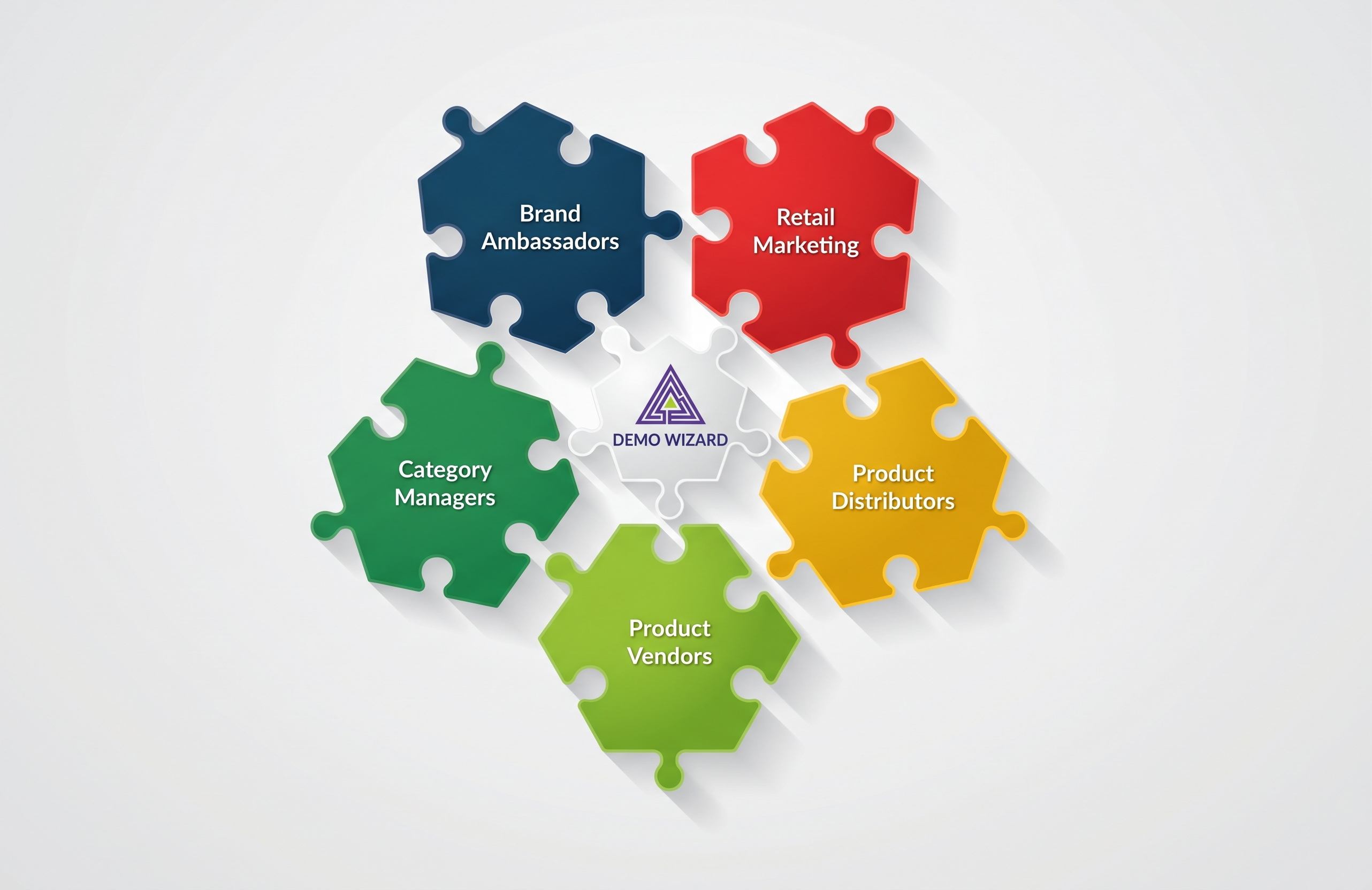
In the context of in-store product demonstrations, brand activation means turning a CPG brand's shelf presence into a live, staffed experience that drives immediate trial and purchase, coordinated through scheduling, ambassador training and staffing, and performance tracking across every retail location to actively optimize ROI of the campaign. It covers the full operational cycle:
Done well, brand activation replaces disconnected spreadsheets and phone calls with a shared, real-time view that brands, retailers, and field staff all rely on.
In-store brand activation is a scheduled event with a knowledgable ambassador and a measurable sales outcome, not a one-off experiential stunt or a logo on a banner.
That distinction matters because the marketing industry uses the term to describe almost anything that puts a brand in front of a person: a pop-up art installation, a festival sponsorship, a branded truck tour. Those efforts build awareness, but nobody can trace a sale back to them in the same aisle, on the same day [1]. In-store work happens differently. It takes place at a fixed location, on a fixed date, with a brand ambassador standing at a table or cart, and it produces a number of units sold during the shift that a brand manager can compare against the cost of running it.
In-store product demonstration is the subset built specifically for trial and point-of-purchase conversion, rather than broader brand awareness [1].
A festival sampling booth might hand out thousands of product trials, but the data 7 Types Of Brand Activations resources describe tends to classify that as awareness and loyalty-building work [4]. An in-store demo is narrower and more direct: a shopper tastes a product, picks it up, and puts it in the cart within minutes, in the same store aisle where the product sits on the shelf. Industry data shows products featured in retail and in-store demos often sell over 40% better than non-sampled items [2], which is a different kind of outcome than a memorable moment at a sponsored event. The format is the same tray-and-table setup CPG brands have used for decades. What changes is the demand for proof that it worked. For a broader look at how experiential tactics fit alongside in-store sampling, see this experiential marketing guide for CPG brands.
Activation at the shelf drives three things a retailer cares about directly: category velocity, basket size, and the kind of performance data that justifies permanent placement.
A strong demo weekend does not just move the sampled SKU, it lifts the whole category and gives the store a reason to keep carrying the product after the demo ends. For an emerging CPG brand, a track record of well-executed in-store events is often the argument that turns a temporary endcap into permanent shelf space.
None of that happens on its own. Underneath the marketing idea sits an operational job: someone has to book the store and date, confirm an ambassador is scheduled and shows up, and verify the work actually happened as planned. Demo Wizard exists for that layer, scheduling demos across locations, managing ambassador assignments and payroll, and tracking experience-to-purchase conversion so a brand can see which stores and time slots are worth repeating.
In-store brand activation rarely works in isolation. It performs best when it reinforces a message a shopper has already encountered elsewhere, a digital ad, a shelf talker, a coupon in a loyalty app, rather than introducing the product cold. A shopper who recognizes a brand from a prior touchpoint is more likely to stop at the table, try the sample, and complete the purchase than someone seeing the product for the first time in the aisle.
That interplay means brand teams increasingly plan in-store demo calendars alongside digital and social campaigns, timing sampling events to coincide with broader pushes so the in-store moment becomes the final step in a longer decision journey rather than a standalone event. Coordinating that timing across channels is itself another scheduling problem, one more reason brands lean on centralized systems rather than treating in-store activation as a separate workstream.
Efficient coordination runs on a three-way handoff: the brand sets campaign goals and store targets, the retailer approves the store list and dates, and demo staff get assigned shifts against a confirmed calendar. In practice, this chain breaks down constantly when it runs on spreadsheets and email threads, a retailer's approval sits in an inbox nobody checks, a brand ambassador gets double-booked across two accounts, or a store manager never learns an event is happening until a pallet shows up at the loading dock.
A shared, centralized calendar fixes the handoff problem by giving the brand team, the retailer, and the field staff the same live view of what's scheduled, where, and with whom. No party works from a copy of a spreadsheet that's three revisions out of date. This is the operational core of running these programs at scale, not the creative concept, but the scheduling infrastructure that makes sure the right person shows up at the right store with the right product on the right day. For a closer look at the demo side of this work specifically, this guide to in-store demo strategy covers the scaling mechanics in more detail.
Scaling a program past a handful of stores introduces friction that doesn't exist in a single-location pilot. Retailers run different approval processes, a regional grocery chain may require a buyer sign-off two weeks out, while a club store mandates its own exclusive demo agency and turnkey booking process. Regional compliance rules vary by state and by banner, covering everything from food handling permits to insurance certificates. Physical footprint limits matter too: a front-entrance table that works in one store format may not fit in a smaller urban location, forcing last-minute layout changes that a coordinator managing dozens of stores can't track without a system built for it.
Retailers protect consistency through standardized checklists, photo confirmation, and setup instructions tied to each scheduled event on the calendar. A demo ambassador checks in on arrival, follows a setup diagram specific to that store's floor plan, and uploads a photo confirming the table, signage, and product display match what the brand and retailer agreed to. This closes the loop between what was planned and what actually happened in the aisle, the same documentation retailers increasingly demand before granting shelf space or renewing a vendor relationship [1]. Platforms like Demo Wizard build this into the scheduling workflow itself, so compliance confirmation happens automatically as part of running the event rather than as a separate reporting task after the fact.
Even a well-planned brand activation calendar runs into disruptions: a store resets its floor plan the week of the event, a regional holiday shifts foot traffic patterns, or a shipment delay means product won't arrive in time for a confirmed slot. The programs that handle this well build in a standard escalation path, a named contact at the brand, the agency, and the store who can approve a reschedule within hours rather than days.
Having that contingency plan written down before it's needed matters more than most teams expect. A coordinator who has to improvise a solution during an active disruption is far more likely to lose the slot entirely, while one working from a pre-agreed process can usually rebook within the same week and avoid losing the event's budget outright.
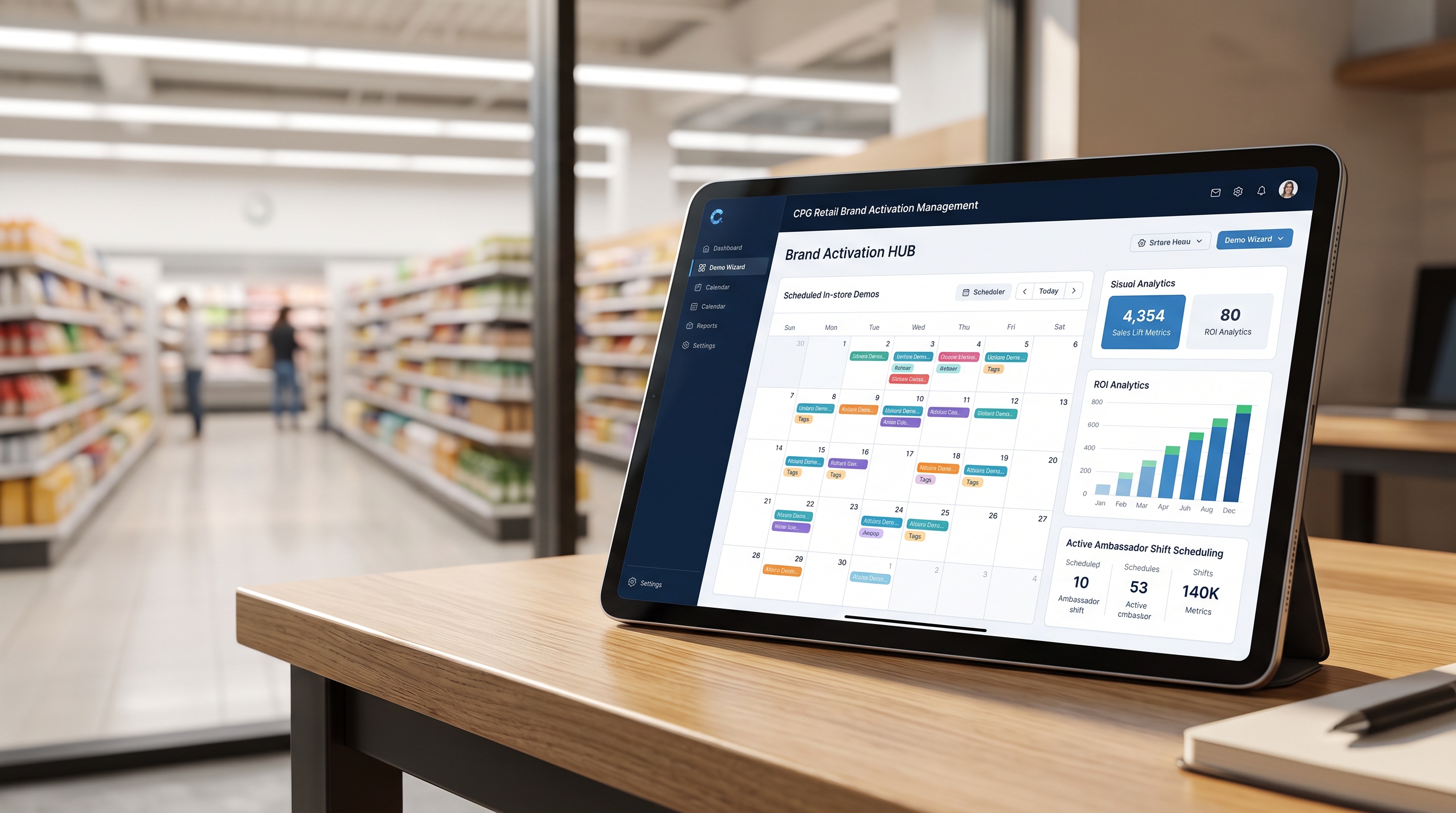
Scale turns this work from a marketing task into a logistics problem, and the friction lands hardest on the people least equipped to absorb it: store employees. What works for five stores breaks down at fifty, and nobody designed a system to catch the overflow.
Every additional store multiplies the coordination required, not just adds to it. One location means one confirmation email and one phone call to a store manager. Twenty locations means twenty separate threads with twenty managers, each with different hours, different approval chains, and different points of contact between the brand, the agency staffing the event, and the retailer hosting it. A manager running 100 monthly demos across multiple states ends up spending most of the week on scheduling logistics rather than strategy, exactly the bottleneck that pushes teams toward spreadsheets, missed confirmations, and double-booked ambassadors.
Retailers frequently have no visibility into what's scheduled in their own stores until a brand ambassador arrives at the door. Without a shared calendar, the only record of an upcoming event often lives in a brand's internal system or an agency's booking sheet, not in anything the store itself can check. That gap produces predictable failures: last-minute cancellations nobody tells the store about, product shipments that miss the demo date entirely, and ambassadors showing up to a store that scheduled a conflicting event in the same aisle.
The burden of patching these gaps falls on store employees, who end up fielding vendor phone calls, resolving scheduling conflicts, and tracking down missing inventory instead of running the floor. This is the retailer's specific pain point: this kind of in-store work generates real foot traffic and basket-size lift [1], but only if someone inside the store isn't spending hours each week managing vendor coordination by hand.
A centralized, shared calendar, visible to the brand, the agency, and the store simultaneously, removes store staff from that coordination loop entirely. Demo Wizard's scheduling system gives every party the same view of what's booked, where, and when, so confirmations and changes update automatically instead of traveling through a chain of emails and calls.
Large retailers often host demos from several CPG brands, each working with its own agency, in the same week or even the same store. Without a shared calendar, two brands can unknowingly book overlapping slots in the same entrance zone, or an agency can double-staff an ambassador across two client accounts on the same day. The retailer is left to referee the conflict on the spot, usually at the expense of whichever brand arrives second.
A system that gives the retailer a single view across every brand and agency scheduled in its stores removes this ambiguity before it becomes a floor-level conflict. It also gives the retailer leverage to enforce its own rules consistently, rather than relying on whichever brand representative happens to be most persistent.
ROI measurement for in-store demos works by comparing unit sales during and immediately after the demo window against that SKU's baseline velocity in that same store. If a yogurt brand normally sells 8 units a day at a given store and sells 34 units on a Saturday demo day, that lift is the starting point for every other ROI calculation that follows.
This comparison only works if the baseline is real. A program manager needs at least two to four weeks of pre-demo sales history for the same store and SKU, not a regional or chain-wide average, because traffic patterns vary store to store. Retailers that host frequent CPG sampling events are increasingly asking for this baseline-versus-lift math before approving repeat activations, since it's the clearest way to justify the shelf space and staff time a demo consumes.
Unit lift tells you what happened, but it doesn't tell you why, that requires a second layer of metrics captured at the event itself. Ambassador-reported shopper feedback (objections raised, flavor or feature reactions, repeat-purchase intent comments) gives brand teams a read on message effectiveness long before the next sales cycle confirms it.
Photo-verified setup compliance is equally important: a timestamped photo confirming the table was placed at the agreed location, branded correctly, and stocked on schedule protects against the silent failure mode where a demo "happened" on paper but underdelivered in the aisle. Consistency of execution across stores, did ambassador A follow the same script and display standard as ambassador B three states away, is a leading indicator that predicts ROI before the sales data even arrives. Industry guidance on in-store work points to human interaction and structured execution, not just signage, as what separates a real activation from a passive display [1].
Brands connect demo activity to conversion by tagging store-level sales data with the exact event date, time window, and location, then pulling POS or syndicated data for that same slice. Products that get sampled in-store often sell at substantially higher rates than non-sampled items during the surrounding period [2], which is why the date-and-location tag matters more than aggregate monthly totals.
A single demo recap is a story. Hundreds of them, reported in the same structured format, become a dataset a brand can act on, comparing which stores, days, and ambassadors consistently outperform, then shifting next quarter's demo budget toward those combinations instead of spreading it evenly. Demo Wizard's analytics dashboard was built around this exact need, aggregating experience-to-purchase conversion data by store and time period so a single coordinator can see performance patterns across hundreds of monthly events without manually reconciling spreadsheets from each location.
Retailers rarely want a raw spreadsheet of unit sales. They want a short summary that answers a specific question: did this event earn the shelf space and staff attention it consumed? The most effective recaps pair the baseline-versus-lift number with a photo of the executed setup and a brief note on shopper reaction, giving a category manager everything needed to approve a repeat booking without requesting additional detail.
Brands that standardize this reporting format across every store make it easier for a retailer to compare one brand's performance against another's, which, counterintuitively, tends to work in favor of the brand with consistently strong execution. A retailer that can quickly see which vendors deliver reliable, well-documented results has a clear reason to prioritize their future requests for prime demo slots.
.jpg)
Automation lets a program add hundreds of monthly demos without adding coordinators, by replacing manual scheduling and reporting work with systems that run those tasks at any scale.
Manual coordination scales linearly: every added demo means another phone call to confirm a store slot, another email chasing an ambassador's availability, another spreadsheet update after the event. A coordinator running 20 demos a month can absorb that overhead. A coordinator running 200 cannot, no matter how organized they are.
Automated scheduling removes the back-and-forth entirely. A platform that holds store calendars, ambassador availability, and confirmation workflows in one system can book an event in minutes rather than the hours of email and phone tag that fragmented tools or paper logs require. That time saving is also a cost saving: it's the difference between hiring a second or third coordinator and keeping headcount flat while campaign volume grows.
Reporting follows the same logic. Instead of a coordinator calling each store to ask whether the ambassador showed up and set up the display correctly, automated compliance checks, photo confirmation at check-in, a checklist the ambassador completes on-site, generate proof of execution without a single follow-up call. That data flows straight into performance reporting instead of sitting in a text message thread waiting to be transcribed.
Not every tool built for events can support retail-scale programs. Three capabilities matter most as a program grows:
Platform costs in this category range from budget-friendly self-serve tools suited to a handful of stores up to premium, enterprise-grade options built for national footprints and deeper analytics needs. Demo Wizard, for example, charges per demo with no per-user or per-location restrictions, which lets a single coordinator manage hundreds of monthly events without the cost structure punishing growth.
Retailers benefit from this same shift. When scheduling and compliance run through a shared system rather than through phone calls to the store manager, employees face fewer disruptions from vendor coordination, and compliance with in-store conditions happens automatically instead of requiring staff to police it.
Not every brand needs a full platform on day one. A useful signal is volume: a brand running a handful of demos a month in a single region can usually manage with a shared spreadsheet and direct communication. Once a program crosses into multiple states, multiple agencies, or a few dozen monthly events, the coordination overhead described earlier tends to appear regardless of how organized the team is.
A second signal is reporting burden. If pulling last month's results into a usable summary takes a coordinator more than a day of manual work, that's a sign the underlying process, not the team's effort, is the limiting factor. Brands at that stage typically see the fastest return from automating the scheduling and compliance layers first, since those are the tasks consuming the most coordinator hours before ROI reporting even starts.
A roadshow is one specific type of this activity, not a synonym for it. A roadshow is a temporary, high-impact "pop-up within a store" lasting a few days to two weeks, built around dedicated floor space, bundled offers, and urgency. Standard in-store sampling, an ambassador handing out samples from a tray, qualifies too, just as a smaller-footprint version.
Responsibility varies by retailer model, and that ambiguity is a common source of friction. Club stores and mass retailers often require their own exclusive agency to schedule and staff the event, while regional grocers typically let the brand supply its own ambassador and just charge a slotting fee to reserve the calendar spot and table space.
A no-show demo means the store loses the planned foot traffic lift and the brand loses the sampling event entirely, with no automatic recovery. Without a backup staffing plan or a centralized calendar visible to the retailer, store employees are often left fielding the confusion and explaining the empty table to shoppers and management.
There's no fixed number, what matters is running enough demos, consistently, across comparable stores to isolate the pattern from normal sales noise. Brands typically need repeated events at the same locations over several weeks to tell whether a lift is real or coincidental, which is why store-and-time-level tracking matters more than any single event's result.
Yes. A short in-store sampling shift might need a single trained ambassador for a few hours, while a multi-day roadshow or experiential pop-up typically needs a small team, backup coverage, and more detailed setup instructions. Reviewing a breakdown of common activation formats and examples can help a brand match staffing levels to the format it's planning.
Brand activation succeeds or fails on three things: whether the right store and time slot were chosen, whether an ambassador actually showed up, and whether anyone can prove what happened afterward. Brands running a handful of demos a month can track these manually. Brands running dozens or hundreds across multiple states cannot, spreadsheets and phone calls break down well before that scale.
The practical next step: pull your last quarter's demo results by store and time slot, and see whether you can actually identify your five best-performing locations. If you can't answer that in an afternoon, your coordination process, not your sampling budget, is the bottleneck.
Explore more from our content library:
About the Author
Written by the SaaS / Retail Marketing Technology experts at Demo Wizard. Our team brings years of hands-on experience helping businesses with SaaS / Retail Marketing Technology, delivering practical guidance grounded in real-world results.
Demo Wizard is the Ultimate Store Sampling & Demonstration management software for Brick and Mortar Retailers and CPG Vendors.
Chat with usPhone