
Demo Wizard is the Ultimate Store Sampling & Demonstration management software for Brick and Mortar Retailers and CPG Vendors.
Chat with us

Phone
Copyright © 2026 Demo Wizard
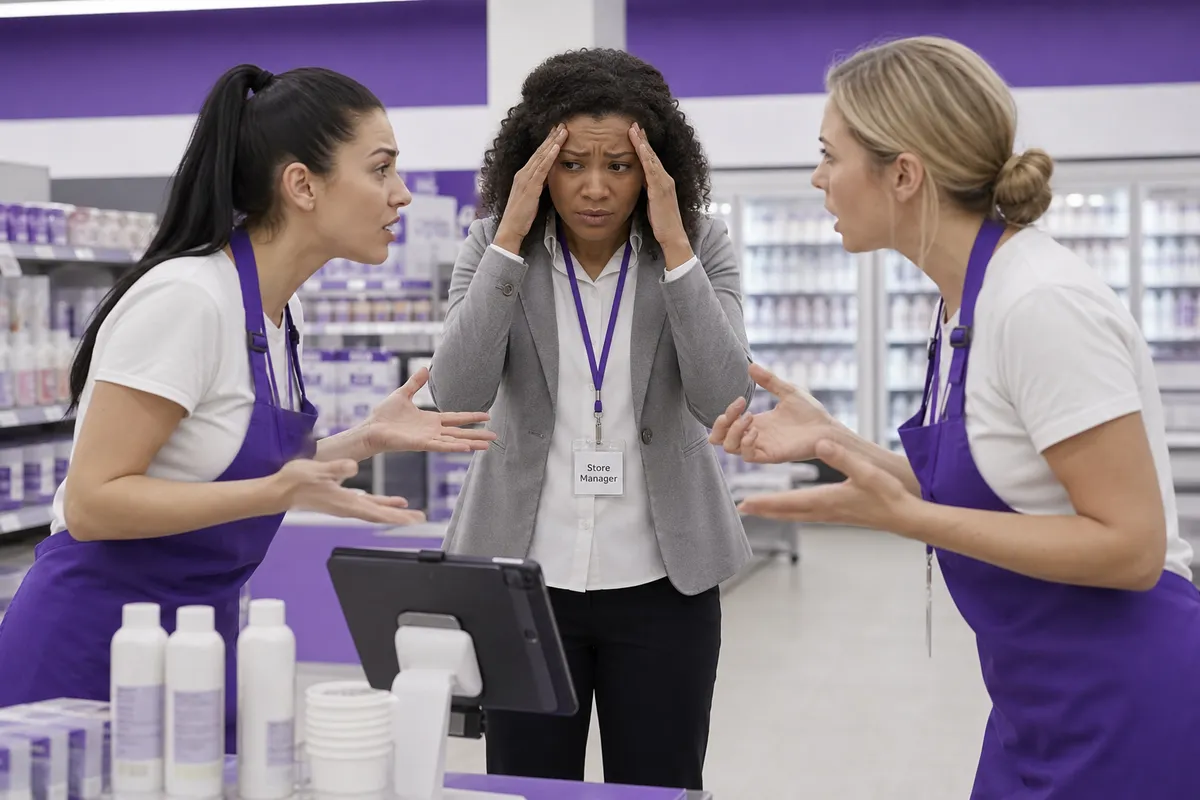
Grocery executives don't dismiss sampling for lack of belief in trial-driven sales, they dismiss it when the operational cost falls on their own staff. The fix isn't less sampling, it's better coordination: a shared calendar, documented compliance rules, and ROI data tied to store and time slot rather than vague impressions.
Understanding in-store sampling grocery retail is essential. Grocery retail executives undervalue in-store sampling mainly because the operational cost falls on store staff while the sales credit goes to the CPG brand. Without a centralized calendar or automated coordination, managers see sampling as a source of vendor disruption, scheduling conflicts, and compliance risk rather than a measurable driver of sales velocity. When coordination is automated and tied to clear before/after sales data, the same programs shift from a staff burden to a visible, trackable contributor to basket size and category performance.
Sampling events land on store managers as unpaid coordination work, while the sales benefit gets attributed somewhere else entirely, that mismatch is the real source of executive skepticism.
When a CPG brand or agency schedules a demo, someone at the store still has to approve the table placement, confirm the ambassador shows up, and resolve whatever scheduling conflict comes up that morning. Store staff absorb these check-ins and approvals as an add-on to their regular shift, with no line item recognizing the time spent. A produce manager fielding three vendor calls in one morning isn't doing anything that appears in a labor report, but it's real time pulled from stocking, customer service, or opening tasks.
Grocery stores routinely run demos for several CPG brands in the same week, and each one often reaches the store manager through a separate channel, a broker's email, an agency's phone call, a direct rep visit. Without one shared system, the same manager answers nearly identical questions five different times instead of once. That repetition is a structural result of fragmented, brand-by-brand outreach rather than any one vendor acting unreasonably.
A store's calendar already has planogram resets, delivery windows, and promotional endcaps competing for the same floor space and staff attention. When sampling events get booked without visibility into that existing schedule, they collide with it, a demo table shows up on reset day, or blocks a delivery lane. These conflicts are what sampling firms and retailers have been working to reduce as programs return to stores post-pandemic, with modified formats aimed at easing exactly this kind of friction [3].
Executives manage by what their reporting surfaces, and disruption reports itself automatically, a blocked aisle, a staff complaint, a vendor no-show. Incremental sales lift from a sampling event rarely reaches the same dashboard unless someone deliberately builds the before/after comparison. That asymmetry is why in-store sampling grocery retail programs get flagged as a cost center internally even when they're moving product.
Retailers already track sales velocity and basket size closely when they evaluate endcap placement, seasonal displays, or category resets, sampling is one of the only merchandising investments still judged mainly by the disruption it causes rather than the same velocity and basket metrics applied everywhere else.
Coordination works when one shared system replaces the separate spreadsheets, text threads, and phone calls that brands, agencies, and store managers each keep on their own. In-store sampling grocery retail campaigns involve several parties who rarely see the same version of the schedule, which is where most breakdowns start.
A single regional campaign might require placing 15 to 20 brand ambassadors across dozens of stores, each with its own hours, floor plan, and manager preferences. The brand team has to match ambassador availability to store time slots, confirm product and equipment are in stock at each location, and account for no-shows or last-minute swaps without losing the date.
When this runs on phone calls, spreadsheets, and email, a trade marketing manager often spends entire days reconciling who is scheduled where, then calling stores to confirm the slot is still open. Multiply that across 20 or more locations in a single week, and the administrative load alone can rival the cost of running the demos themselves.
A shared calendar that store managers, brand teams, and ambassadors can all view at once closes the gap that causes double-bookings and missed setups. If a store's front-entrance table is already reserved for a competing brand's Saturday demo, the system blocks that slot before a second vendor can request it, something a disconnected set of emails and phone calls cannot reliably catch.
Automatic confirmations and reminders then take over the follow-up work that used to run through manual phone and email chains between vendors, distributors, and store staff. An ambassador gets a reminder the day before with store address and setup instructions; the store manager gets a confirmation showing who is arriving, at what time, and for how long. Platforms like Demo Wizard handle this scheduling and confirmation workflow automatically across every location on the calendar, which is part of how a single coordinator can manage hundreds of monthly events without adding headcount.
This visibility is what builds trust on the store side. A manager who has been burned by no-show ambassadors or vendors arriving at the wrong time learns to expect it; a centralized calendar with confirmed, trackable bookings gives that same manager confidence that a scheduled demo will show up prepared, on time, and ready to execute.
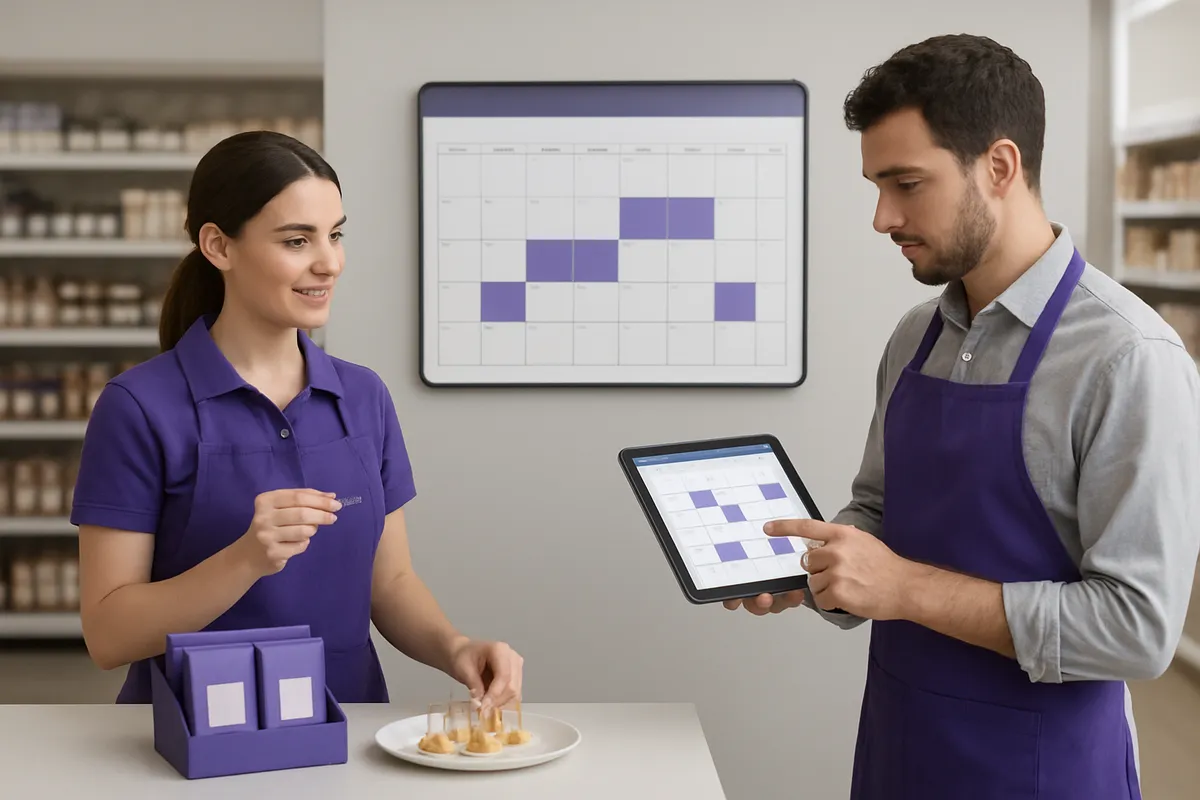
Manual coordination turns store employees into unpaid project managers for every brand that walks through the door, pulling them off register and shelf duties to answer questions no one trained them to handle.
When a CPG brand books a demo without a shared system, the store becomes the fallback contact for everything that goes wrong between booking and setup. A distributor runs late with product, a brand ambassador calls out sick, or a vendor shows up expecting a table that was never reserved, and the store manager or department lead is the one fielding the phone calls.
None of this is in a grocery employee's job description. Yet without a shared calendar visible to the brand, the agency, and the store, someone on-site has to track who is coming, when, and with what. That tracking happens over email threads, texts, and sticky notes, and it falls apart the moment two brands want the same end-cap on the same Saturday.
Retailers set real expectations for demo staff: approved table placement away from fire exits, food safety handling for any product involving sampling of perishable goods, and dress and conduct standards that reflect on the store's brand as much as the vendor's. Enforcing these standards manually means a department manager has to notice a violation in real time, a tray left uncovered, a table blocking an aisle, while also running the floor.
Busy staff miss things. That is not a training failure; it is a bandwidth problem. A platform built for in-store sampling grocery retail operations shifts this enforcement earlier in the process. Ambassadors check in digitally on arrival, confirm they have reviewed store-specific placement rules, and submit photo confirmation that setup matches what was approved, before a manager ever has to intervene.
That shift matters more than it sounds. Demo Wizard's scheduling and check-in workflow builds these compliance confirmations into the booking itself, so the standard is enforced by the system rather than by a manager's attention span.
Once coordination and compliance stop pulling hours out of a manager's week, the math around sampling changes. Executives who saw the channel as a drain on staff time start seeing it as a programmable, low-friction source of foot traffic and basket lift, because the labor cost that made them skeptical no longer sits on their own payroll.
Grocery retailers should judge a sampling event by sales velocity and average transaction value, not by "conversion rate," a metric built for websites and shopping carts.
Conversion rate works online because every visitor is tracked from landing page to checkout. A physical store has no equivalent funnel: shoppers walk past a sampling table, pick up other items, leave, and return days later to buy the sampled product. Trying to force ecommerce language onto in-store sampling grocery retail programs produces numbers that look precise but measure the wrong thing. The brick-and-mortar equivalents that actually hold up are sales velocity, units sold per store per week for the sampled SKU and its category, and average transaction value, which shows whether the sampling event pulled shoppers into a bigger basket, not just a cheaper trial purchase.
Cost-per-trial divides total event cost, ambassador labor, product used, any retailer slotting fee, by the number of shoppers who sampled the product, and it's most useful for comparing one sampling event against another, not against a digital acquisition cost. A brand running the same product at ten stores can rank those ten events by cost-per-trial and immediately see which store, time slot, or ambassador produced the cheapest trials. That ranking is what informs where to repeat the investment.
Connecting a sampling window to a sales change means pulling category velocity for a defined period before the event, the event days themselves, and a follow-up window afterward, then comparing the three. A sustained bump that holds after the sampling table comes down is a different signal than a one-day spike that fades once the ambassador leaves. Demo Wizard doesn't integrate directly with point-of-sale systems, but it can ingest velocity and sales data that retailers or third-party data providers already collect, which lets a coordinator line up event dates against that external sales data without building a custom reporting pipeline.
Three signals matter more than any single-day sales number: whether the same store requests the sampling program again, whether velocity lift outlasts the event window by a week or more, and what ambassadors report hearing from shoppers at the table. A store manager who asks for a repeat booking is voting with scarce floor space and staff time. Sustained lift separates genuine trial-driven adoption from a one-time novelty. Ambassador feedback, objections, questions, comparisons to competing brands, gives retailers qualitative context that no velocity chart can capture on its own.
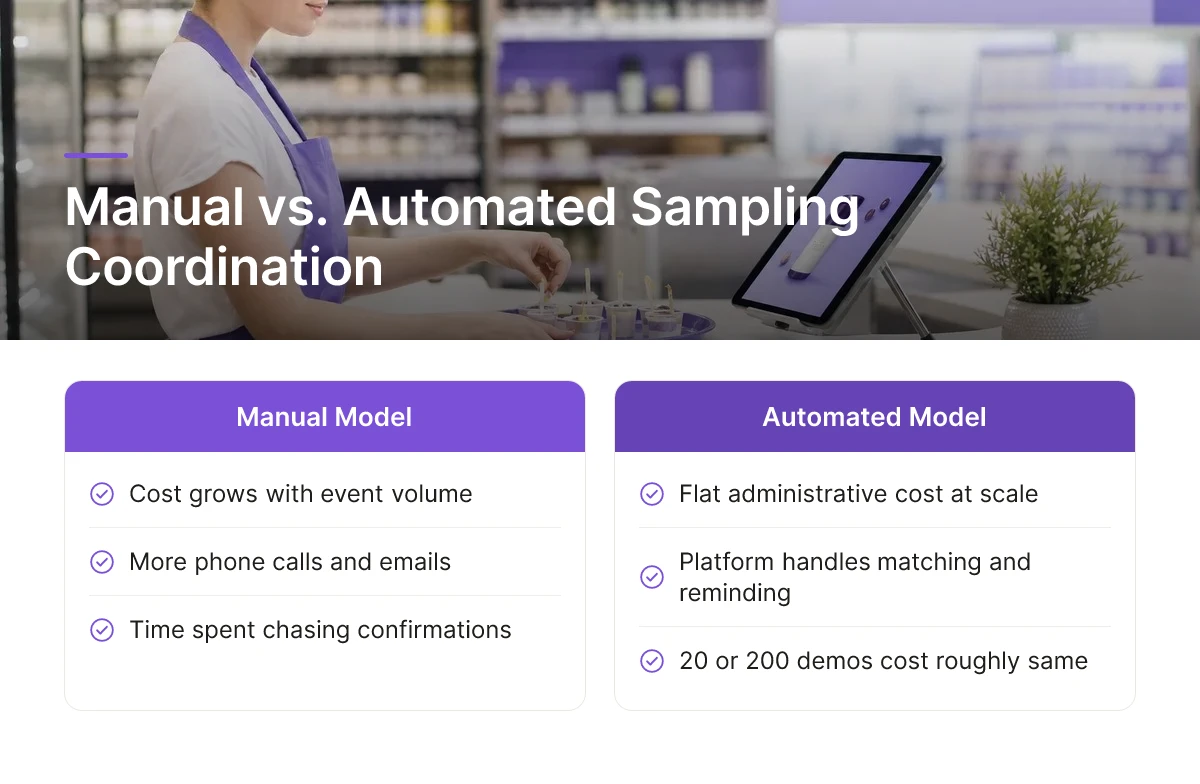
Automation changes sampling's math by removing the link between event volume and headcount, turning a program that used to cost more as it grew into one that scales at flat administrative cost.
Under a manual model, every added demo means more phone calls, more emails, and more time spent chasing confirmations. Automated coordination breaks that link. The retailer's cost to run 20 demos a month and 200 demos a month stops being 10x apart, it becomes roughly the same, because a platform, not a person, is doing the matching, confirming, and reminding.
A single administrator managing a handful of weekly demos by spreadsheet and email hits a ceiling fast, there are only so many confirmation calls and reschedule emails one person can handle before something falls through. Automated scheduling platforms remove that ceiling by letting one coordinator oversee hundreds of monthly events across dozens of store locations without the workload scaling in step. Demo Wizard, for example, is built around this specific shift: multi-location campaign coordination that lets a single person manage hundreds of events a month, with no added headcount per store or per demo.
That matters because the retailer's real cost of sampling has never just been the gatekeeper fee or the shelf space. It's the hours store managers and category staff spend fielding vendor calls, resolving calendar conflicts, and chasing down who's showing up when. Automating that layer is where the labor savings actually show up.
A centralized, externally visible calendar lets store staff, brand teams, and distributors all check the same schedule instead of routing every update through the retailer. Nobody needs to call the store to confirm a Saturday slot is still open, and nobody double-books a demo table because the information wasn't shared in real time. That visibility is what makes in-store sampling grocery retail programs survivable at scale, it replaces a web of one-off conversations with a single source of truth everyone can see.
The alternative is familiar to anyone who has run a poorly coordinated program: stockouts mid-Saturday because nobody forecast demand, two vendors claiming the same end-cap, an ambassador showing up without a table reservation confirmed. Each of those failures costs the retailer sales velocity and goodwill with the brand, on top of the staff time spent untangling the mess after the fact [3].
Removing the need for proportional staff increases is what ultimately reclassifies sampling in an executive's mind, from a line item that drains store labor to a measurable driver of foot traffic and basket size that costs the same to run at 20 events or 200.
Uncoordinated sampling pulls store associates away from their assigned tasks to field vendor questions, find table space, or settle scheduling conflicts between brands. Two brand ambassadors showing up for the same end-cap on a Saturday morning is a common failure mode without a shared calendar. The result is blocked aisles, frustrated shoppers, and staff time lost to problems a coordination system would have caught in advance.
Retailers need a single calendar showing every scheduled demo across every store, visible to store managers, brand teams, and ambassadors alike. Without it, double-bookings and last-minute no-shows go unnoticed until a shopper or associate flags the problem on the floor. A centralized view also lets store leadership confirm staffing and inventory are ready before the activation starts, not after it fails.
Sampling earns its footprint because trial, not advertising, is usually the strongest driver of a first purchase in CPG categories [4]. Unlike a price discount or shelf tag, a demo gives the retailer real-time foot traffic, a reason to visit the aisle, and a bigger basket during the event window. The catch is that value depends on execution quality and measurement; a poorly staffed or unmonitored demo can look like wasted square footage rather than a sales driver.
The brand or its agency hires and trains the ambassador, but the retailer sets and enforces the in-store rules they must follow. That includes food safety handling, table placement, and traffic-flow limits. When sampling programs reduced in scope and later returned with stricter modifications, retailers and sampling firms both took on a more active role in defining what compliant execution looks like [3].

Grocery executives don't dismiss sampling for lack of belief in trial-driven sales, they dismiss it when the operational cost falls on their own staff. The fix isn't less sampling, it's better coordination: a shared calendar, documented compliance rules, and ROI data tied to store and time slot rather than vague impressions. Retailers who adopt this structure stop treating demos as a disruption to manage and start treating them as a scheduled, measurable part of the floor plan. The next step is straightforward: ask any brand requesting a demo slot to show you their store-level conversion data and their ambassador compliance process before you approve the booking.
Explore more from our content library:
About the Author
Written by the SaaS / Retail Marketing Technology experts at Demo Wizard. Our team brings years of hands-on experience helping businesses with SaaS / Retail Marketing Technology, delivering practical guidance grounded in real-world results.
Demo Wizard is the Ultimate Store Sampling & Demonstration management software for Brick and Mortar Retailers and CPG Vendors.
Chat with usPhone